The guilt and shame felt by Germans over the crimes of the Nazis have become pillars of their national identity. Two simple, potent words have acted as a guiding principle in politics and society: nie wieder – never again. But demonstrators in eastern Germany are now warning that this principle, and even democracy itself, is under threat.
That is because the far-right Alternative for Germany (AfD) are on track to win the most votes in regional elections this year. It is the first time a far-right party has had a realistic shot at power in Germany’s post-war history.
Who are the AfD?
“They are the most successful far-right party in Germany’s post-war history. They are strongly against immigration; they have some Islamophobic policies; and they are against Germany’s membership in the European Union,” says Dr Julian Hoerner, a specialist on the German far-right and lecturer in Politics at the University of Birmingham.
“Part of the party, especially in the eastern German states, is even watched by the internal security services as they are considered to be extreme right.”
The AfD “are the most successful far-right party in Germany’s post-war history.”
– Dr Julian Hoerner
Nationwide anti-AfD protests earlier this year failed to make a significant dent in the party’s popularity. They were sparked by a report from investigative group Correctiv of a secret meeting between AfD members and neo-Nazis. It is alleged that a “remigration” plan was discussed, which would see mass deportations of immigrants were the AfD to gain power.
Now, protest groups are taking the fight to the AfD. They are organising demonstrations at rural towns deep inside the three states where support for the party is strongest: Saxony, Thuringia, and Brandenburg. These are also the states which will hold elections in the autumn.
Colditz: The Anti-AfD Demonstration
In a car park in Dresden I meet Michal, the founder of the brass band and protest group Banda Comunale. He has agreed to let me join their anti-AfD demonstration in Colditz, a small town in the state of Saxony.
“In these towns,” he tells me, “young people don’t stay there. You have a very old population. And you have less wealth in the East. What is really important, is you have very few migrants.” Michal is himself a Polish immigrant who came to Germany in the heady days of 1989.
“And then you have the past: the reunion of the East and West.” He believes people in this part of Germany still feel left behind by the reunification of the capitalist West and the formerly communist East (the GDR) in 1990.
Gathered in the old cobble-stoned town square are around 150 people, mostly residents from Colditz and neighbouring towns. Stalls are selling traditional German cakes.
This might sound like a village fête, but there is a heavy police presence and a tension in the air. Everybody knows a counter-demonstration might appear at any moment.
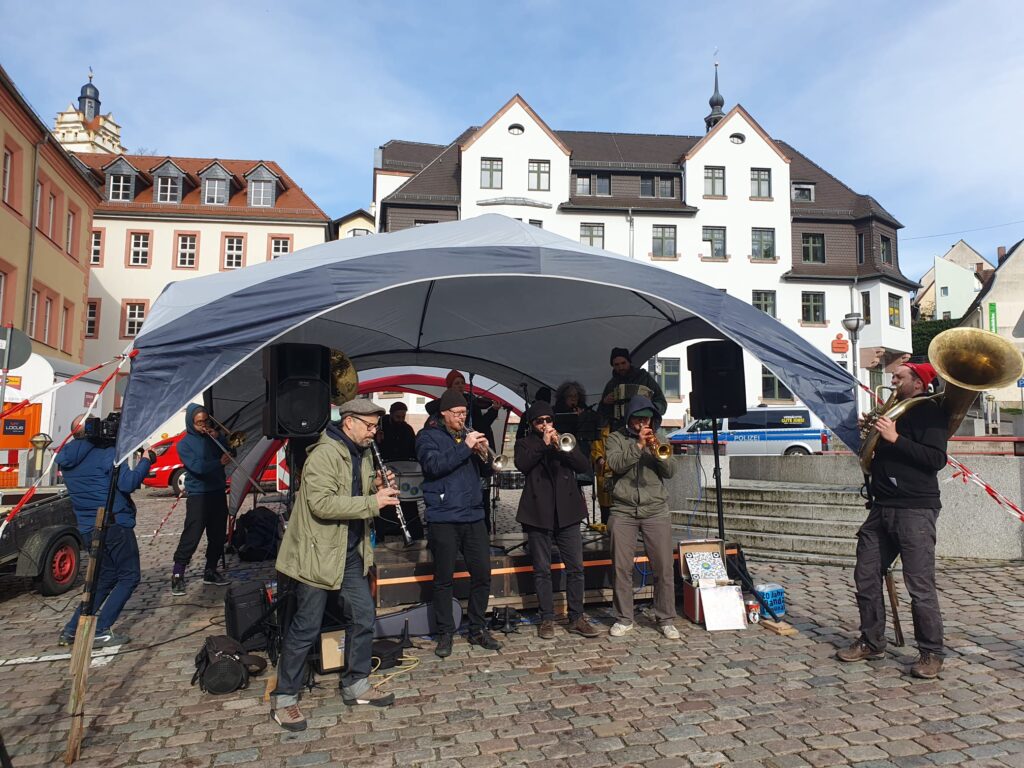
The Banda Comunale.
As the band plays, I meet the protest group Omas Gegen Rechts – the Grannies Against the Right. One member tells me that they have been confronting the far-right in the eastern towns.
“We’ve often been to Waldheim, where the radical right has been marching for three years – without resistance! I was a victim of the GDR. I wanted to have more freedom back then. So, we went onto the streets to gain our democracy. Now I see a similar threat to democracy.”
Another tells me it is not only the AfD that concerns her, but the wider public. “What frustrates me is the great passivity of the people. Whatever happens in the coming years, if it gets better, I was there. If it gets worse, I was part of those who tried.”
Anti-AfD protestors with signs reading ‘stand up against racism’ and ‘no person is illegal’.
Towering above the square is Schloss Colditz, the infamous Nazi prisoner of war camp. Speeches are made by Michal, the town mayor, and the local vicar. The demonstration ends with group photos and a final song titled “AfD it is time for you to go.”
Leipzig: Meeting the Politicians
I take the train to Leipzig, Saxony’s biggest city. I am going to meet two politicians to find out how opposite sides of the political divide are approaching the state elections here.
In Saxony, the AfD are polling at around 30%. That puts them just ahead of Germany’s main conservative opposition party: the CDU, Angela Merkel’s former party. But they are far ahead of the rest of the mainstream parties, who are struggling to even get the 5% needed to appear on the ballot.
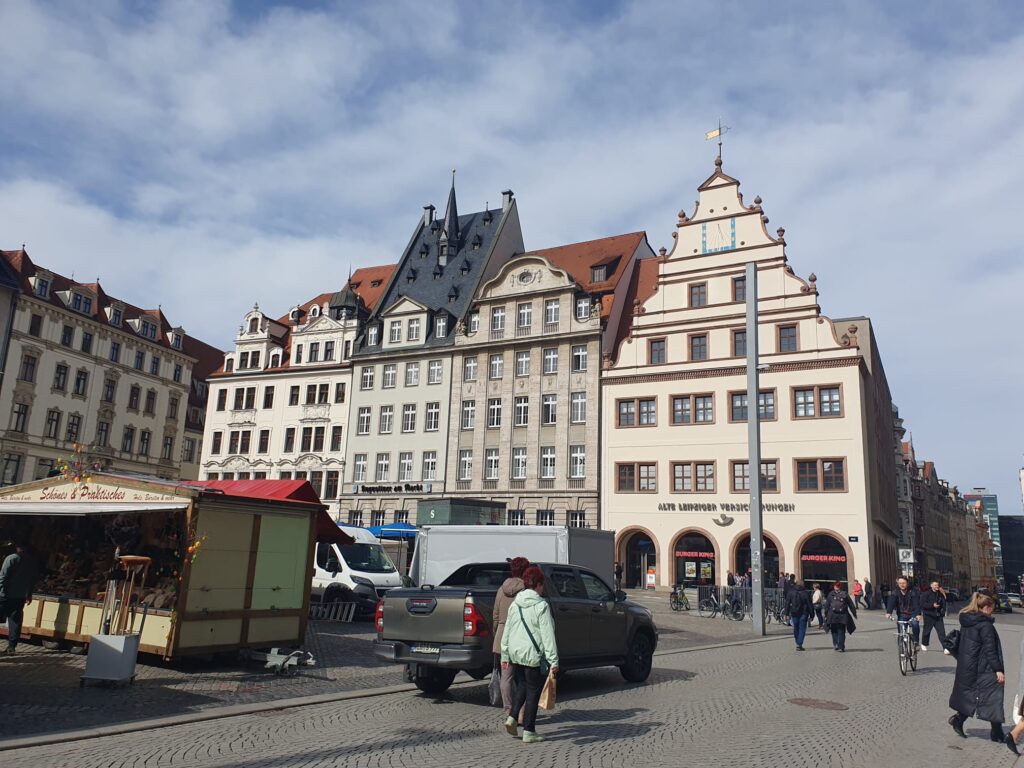
Leipzig’s historic market square.
“It will be a very exciting election,” says Irena Rudolph Kokot. She is the centre-left SDP’s candidate for the state election. They are the main party in the national government, but are fighting for survival here.
“So there are three parties that must fight to keep their influence in Saxony: the SPD, the Greens, and the Left. The polls aren’t looking good. So we need to convince people not to vote CDU to prevent the AfD. Instead, people should vote for the party which closest aligns with their values. This is because if the progressive parties are wiped out, who will the CDU form a coalition with?”
This is question keeping politicians up at night.
German parties usually form governments by building coalitions to achieve a vote share of over 50%. Currently, all other parties have an agreement not to work with the AfD. They call it the “firewall”. But given the vote share of the AfD is so high, and that of most mainstream parties is so low, it is not clear how a government could be formed without the AfD.
Across town, I meet Siegbert Droese at his party’s local headquarters. He is the leader of the AfD in Leipzig and a candidate for the EU elections in June, which they are also expected to do well in. Mr Droese is a member of the radical wing of the party, die Flugel.
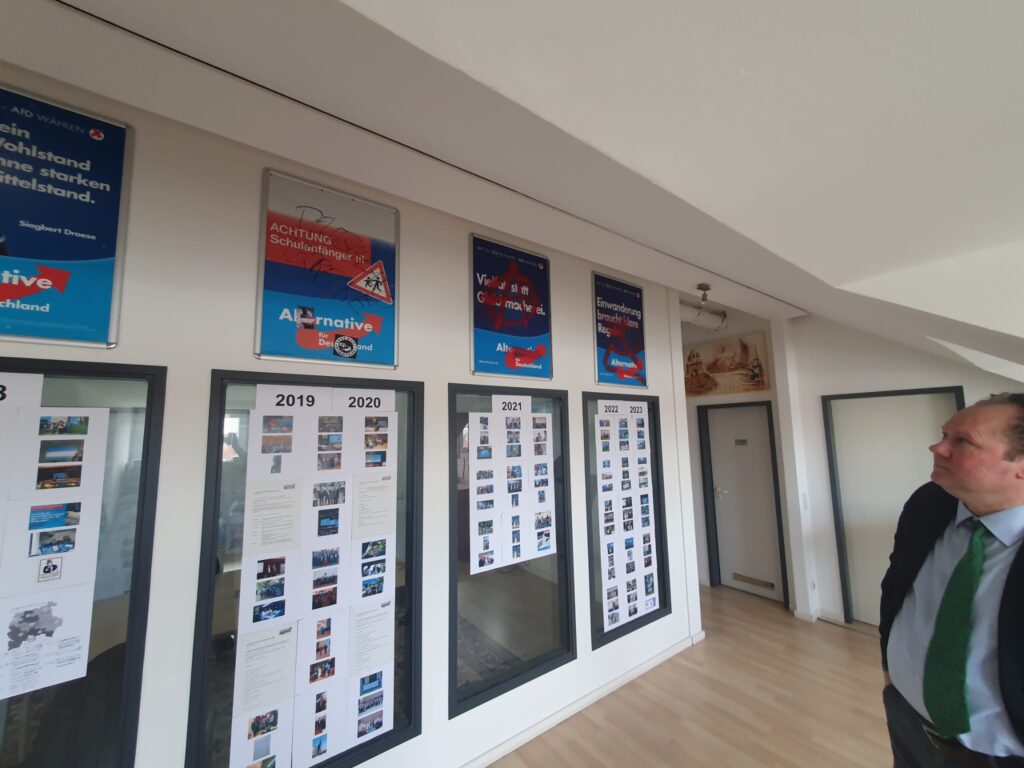
Siegbert Droese gives me a tour of the party office.
“We’re certainly a right-wing party, but not extreme right. That’s a fairy tale,” he insists. “This Correctiv report was based on lies. The meeting was about normal remigration, if anything. We have a lot of illegal people here. We’re just the messengers of the news. We’re pleased we have elections coming up, and we want to win those elections.”
I put it to him that even if they win the most votes, the firewall pact may exclude them from power. “I don’t know what motivates other parties not to work with us. We’re widely supported, but are being excluded undemocratically.
“I also don’t know if they actually know what a firewall is,” Mr Droese chuckles. “It’s not like the Great Wall of China, built to last for centuries. It’s only a temporary structure designed to withhold a fire for ninety minutes. We are not the fire. So it’s only a matter of time before we start working together. We’ll see.”
Moeckner: The Anti-Government Demonstration
To better understand what is attracting people to the AfD, I attend an anti-government demonstration in Moeckner in north Leipzig.
It is an uncertain time in national politics. The ruling coalition of the SPD, the Greens, and the FDP – a pro-business party – are strange bedfellows, often appearing divided on key issues. Meanwhile, Germany’s Chancellor Olaf Scholz has seen the lowest approval ratings in decades.
Demonstrations like this one gather every Monday – the day the GDR was toppled – across Germany. They protest the government’s position on the green transition, the supply of weapons to Ukraine, LGBTQ+ rights, and its handling of the Covid pandemic.
The crowd of around fifty mostly wear black and wave German and Saxon flags. We march along the main road which the police have cleared especially. Over the beats of drums, the group chant:
Die Ampel muss weg! – The traffic light must go! (A reference to the colours of the government coalition parties: red, yellow and green.)
Teures Gas, teures Bier, Olaf Scholz wir danken dir! – Expensive petrol, expensive beer, Olaf Scholz we thank you!
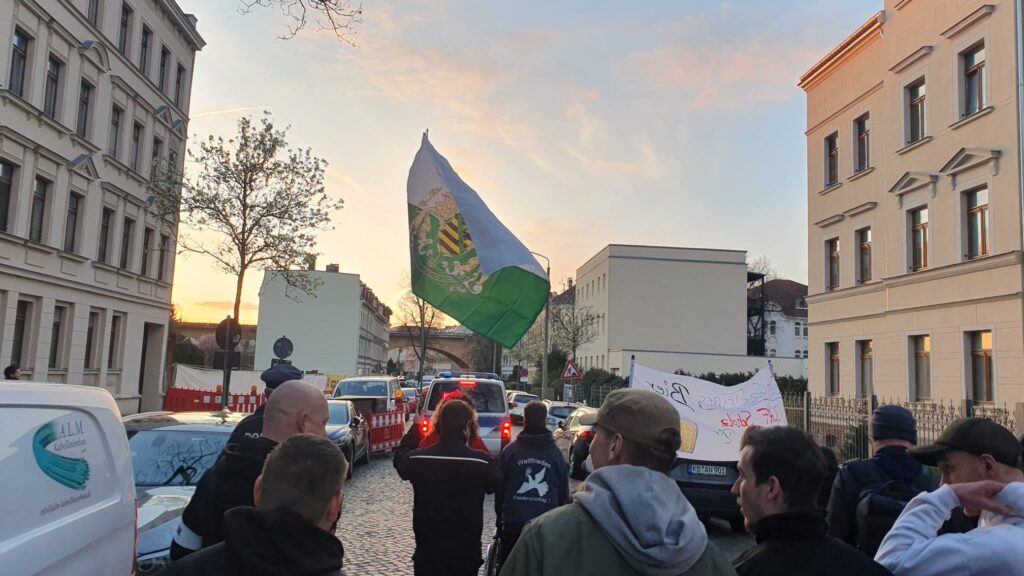
The demonstrators wave a Saxon flag.
Uwe, the organiser, tells me he feels disillusioned with the mainstream parties. “For seven, eight years I voted for the CDU. Now I vote for the AfD, really, I vote for the Alternative for Germany. Because for me, they are the only alternative. Of course I find some of them too right-wing, but I see myself more on their left side.”
Germany’s supply of weapons to Ukraine is deeply controversial here. East Germany has an historic cultural connection to Russia from its forty-one years as a Communist Republic.
“The biggest threat to Germany is this government – this war government. More and more weapons won’t solve anything. We should hold back, especially us Germans. We know what war is. So, why not solve it with diplomacy?”
Just like in Colditz, I am told democracy is in danger as it was under the GDR. But Uwe tells me it is the government that is the threat. “I’m 60. I was out on the streets against the GDR in 1989. Now I believe we are in times similar to the GDR. You can no longer say what you like.”
Lessons from History
These repeated, contested references to the past show how much it still shapes attitudes here. For many Germans, voting for a far-right party would be unthinkable. It would go against what they see as Germany’s historic commitment to nie wieder – never again.
“The decisive difference is that Germany waged a systematic war of annihilation,” urges Ms Rudolph Kokot. “This history will remain. And with this history, Germany must confront itself, always anew.”
But for others, it is time to look forward and the AfD offers hope and change. “The time of National Socialism was over one hundred years ago,” Mr Droese tells me. “I don’t feel responsible. I also don’t think it’s fair to keep reminding a strong country like Germany of this past.”
In East Germany, the former GDR, the trauma of the Nazi period was dealt with differently to the West. Could this help to explain why the far-right is more successful here?
“By the 1990s, the time of the reunification, in West Germany a ‘culture of memory’ with particular emphasis on the Holocaust was being crystalised. It really became unquestioned. Whereas in the eastern states, there hasn’t been a similar engagement with Germany’s past. There was much more emphasis on Communist victims,” explains Dr Julian Hoerner.
“So, there are some lines of inquiry which suggest that in the East, in addition to the economic factors, the absence of as strong a culture of memory may have made it easier for far-right parties to be successful there.”
The divisions in German society are not as simple as left and right. They run across East and West, past and present. What is clear, is that people on all sides feel that this is a moment of reckoning for Germany.
The state elections will set the tone for its future. But even the experts like Dr Hoerner can’t predict how this will play out. “My outlook is that there’s certainly more volatility than there has been at any point in the last fifty, sixty years or so.
“That might mean there will have to be some more flexible arrangements: some minority coalitions, or coalitions involving a large number of parties. That poses its own challenges. So, I think there is a lot of volatility ahead.”
Submitted Article
Headline
Short Headline
Standfirst
Published Article
HeadlineNever again: inside Germany’s ‘fight for democracy’
Short HeadlineInside Germany's 'fight for democracy'
StandfirstRegional elections this year could see a far-right party gain power for the first time in its post-war era.
The guilt and shame felt by Germans over the crimes of the Nazis have become pillars of their national identity. Two simple, potent words have acted as a guiding principle in politics and society: nie wieder – never again. But demonstrators in eastern Germany are now warning that this principle, and even democracy itself, is under threat.
That is because the far-right Alternative for Germany (AfD) are on track to win the most votes in regional elections this year. It is the first time a far-right party has had a realistic shot at power in Germany’s post-war history.
Who are the AfD?
“They are the most successful far-right party in Germany’s post-war history. They are strongly against immigration; they have some Islamophobic policies; and they are against Germany’s membership in the European Union,” says Dr Julian Hoerner, a specialist on the German far-right and lecturer in Politics at the University of Birmingham.
“Part of the party, especially in the eastern German states, is even watched by the internal security services as they are considered to be extreme right.”
The AfD “are the most successful far-right party in Germany’s post-war history.”
– Dr Julian Hoerner
Nationwide anti-AfD protests earlier this year failed to make a significant dent in the party’s popularity. They were sparked by a report from investigative group Correctiv of a secret meeting between AfD members and neo-Nazis. It is alleged that a “remigration” plan was discussed, which would see mass deportations of immigrants were the AfD to gain power.
Now, protest groups are taking the fight to the AfD. They are organising demonstrations at rural towns deep inside the three states where support for the party is strongest: Saxony, Thuringia, and Brandenburg. These are also the states which will hold elections in the autumn.
Colditz: The Anti-AfD Demonstration
In a car park in Dresden I meet Michal, the founder of the brass band and protest group Banda Comunale. He has agreed to let me join their anti-AfD demonstration in Colditz, a small town in the state of Saxony.
“In these towns,” he tells me, “young people don’t stay there. You have a very old population. And you have less wealth in the East. What is really important, is you have very few migrants.” Michal is himself a Polish immigrant who came to Germany in the heady days of 1989.
“And then you have the past: the reunion of the East and West.” He believes people in this part of Germany still feel left behind by the reunification of the capitalist West and the formerly communist East (the GDR) in 1990.
Gathered in the old cobble-stoned town square are around 150 people, mostly residents from Colditz and neighbouring towns. Stalls are selling traditional German cakes.
This might sound like a village fête, but there is a heavy police presence and a tension in the air. Everybody knows a counter-demonstration might appear at any moment.
The Banda Comunale.
As the band plays, I meet the protest group Omas Gegen Rechts – the Grannies Against the Right. One member tells me that they have been confronting the far-right in the eastern towns.
“We’ve often been to Waldheim, where the radical right has been marching for three years – without resistance! I was a victim of the GDR. I wanted to have more freedom back then. So, we went onto the streets to gain our democracy. Now I see a similar threat to democracy.”
Another tells me it is not only the AfD that concerns her, but the wider public. “What frustrates me is the great passivity of the people. Whatever happens in the coming years, if it gets better, I was there. If it gets worse, I was part of those who tried.”
Anti-AfD protestors with signs reading ‘stand up against racism’ and ‘no person is illegal’.
Towering above the square is Schloss Colditz, the infamous Nazi prisoner of war camp. Speeches are made by Michal, the town mayor, and the local vicar. The demonstration ends with group photos and a final song titled “AfD it is time for you to go.”
Leipzig: Meeting the Politicians
I take the train to Leipzig, Saxony’s biggest city. I am going to meet two politicians to find out how opposite sides of the political divide are approaching the state elections here.
In Saxony, the AfD are polling at around 30%. That puts them just ahead of Germany’s main conservative opposition party: the CDU, Angela Merkel’s former party. But they are far ahead of the rest of the mainstream parties, who are struggling to even get the 5% needed to appear on the ballot.
Leipzig’s historic market square.
“It will be a very exciting election,” says Irena Rudolph Kokot. She is the centre-left SDP’s candidate for the state election. They are the main party in the national government, but are fighting for survival here.
“So there are three parties that must fight to keep their influence in Saxony: the SPD, the Greens, and the Left. The polls aren’t looking good. So we need to convince people not to vote CDU to prevent the AfD. Instead, people should vote for the party which closest aligns with their values. This is because if the progressive parties are wiped out, who will the CDU form a coalition with?”
This is question keeping politicians up at night.
German parties usually form governments by building coalitions to achieve a vote share of over 50%. Currently, all other parties have an agreement not to work with the AfD. They call it the “firewall”. But given the vote share of the AfD is so high, and that of most mainstream parties is so low, it is not clear how a government could be formed without the AfD.
Across town, I meet Siegbert Droese at his party’s local headquarters. He is the leader of the AfD in Leipzig and a candidate for the EU elections in June, which they are also expected to do well in. Mr Droese is a member of the radical wing of the party, die Flugel.
Siegbert Droese gives me a tour of the party office.
“We’re certainly a right-wing party, but not extreme right. That’s a fairy tale,” he insists. “This Correctiv report was based on lies. The meeting was about normal remigration, if anything. We have a lot of illegal people here. We’re just the messengers of the news. We’re pleased we have elections coming up, and we want to win those elections.”
I put it to him that even if they win the most votes, the firewall pact may exclude them from power. “I don’t know what motivates other parties not to work with us. We’re widely supported, but are being excluded undemocratically.
“I also don’t know if they actually know what a firewall is,” Mr Droese chuckles. “It’s not like the Great Wall of China, built to last for centuries. It’s only a temporary structure designed to withhold a fire for ninety minutes. We are not the fire. So it’s only a matter of time before we start working together. We’ll see.”
Moeckner: The Anti-Government Demonstration
To better understand what is attracting people to the AfD, I attend an anti-government demonstration in Moeckner in north Leipzig.
It is an uncertain time in national politics. The ruling coalition of the SPD, the Greens, and the FDP – a pro-business party – are strange bedfellows, often appearing divided on key issues. Meanwhile, Germany’s Chancellor Olaf Scholz has seen the lowest approval ratings in decades.
Demonstrations like this one gather every Monday – the day the GDR was toppled – across Germany. They protest the government’s position on the green transition, the supply of weapons to Ukraine, LGBTQ+ rights, and its handling of the Covid pandemic.
The crowd of around fifty mostly wear black and wave German and Saxon flags. We march along the main road which the police have cleared especially. Over the beats of drums, the group chant:
Die Ampel muss weg! – The traffic light must go! (A reference to the colours of the government coalition parties: red, yellow and green.)
Teures Gas, teures Bier, Olaf Scholz wir danken dir! – Expensive petrol, expensive beer, Olaf Scholz we thank you!
The demonstrators wave a Saxon flag.
Uwe, the organiser, tells me he feels disillusioned with the mainstream parties. “For seven, eight years I voted for the CDU. Now I vote for the AfD, really, I vote for the Alternative for Germany. Because for me, they are the only alternative. Of course I find some of them too right-wing, but I see myself more on their left side.”
Germany’s supply of weapons to Ukraine is deeply controversial here. East Germany has an historic cultural connection to Russia from its forty-one years as a Communist Republic.
“The biggest threat to Germany is this government – this war government. More and more weapons won’t solve anything. We should hold back, especially us Germans. We know what war is. So, why not solve it with diplomacy?”
Just like in Colditz, I am told democracy is in danger as it was under the GDR. But Uwe tells me it is the government that is the threat. “I’m 60. I was out on the streets against the GDR in 1989. Now I believe we are in times similar to the GDR. You can no longer say what you like.”
Lessons from History
These repeated, contested references to the past show how much it still shapes attitudes here. For many Germans, voting for a far-right party would be unthinkable. It would go against what they see as Germany’s historic commitment to nie wieder – never again.
“The decisive difference is that Germany waged a systematic war of annihilation,” urges Ms Rudolph Kokot. “This history will remain. And with this history, Germany must confront itself, always anew.”
But for others, it is time to look forward and the AfD offers hope and change. “The time of National Socialism was over one hundred years ago,” Mr Droese tells me. “I don’t feel responsible. I also don’t think it’s fair to keep reminding a strong country like Germany of this past.”
In East Germany, the former GDR, the trauma of the Nazi period was dealt with differently to the West. Could this help to explain why the far-right is more successful here?
“By the 1990s, the time of the reunification, in West Germany a ‘culture of memory’ with particular emphasis on the Holocaust was being crystalised. It really became unquestioned. Whereas in the eastern states, there hasn’t been a similar engagement with Germany’s past. There was much more emphasis on Communist victims,” explains Dr Julian Hoerner.
“So, there are some lines of inquiry which suggest that in the East, in addition to the economic factors, the absence of as strong a culture of memory may have made it easier for far-right parties to be successful there.”
The divisions in German society are not as simple as left and right. They run across East and West, past and present. What is clear, is that people on all sides feel that this is a moment of reckoning for Germany.
The state elections will set the tone for its future. But even the experts like Dr Hoerner can’t predict how this will play out. “My outlook is that there’s certainly more volatility than there has been at any point in the last fifty, sixty years or so.
“That might mean there will have to be some more flexible arrangements: some minority coalitions, or coalitions involving a large number of parties. That poses its own challenges. So, I think there is a lot of volatility ahead.”
As e-bike riders weave through London’s busiest junctions, red lights are increasingly treated as optional. One software engineer says the problem may be baked into how hire firms charge users
Deliveroo has announced its sale to U.S. rival DoorDash, but concerns linger over the controversial ‘substitute’ feature at the heart of its operations.
Inside Success Union CIC claim to empower vulnerable young people, but allegations of underpayment and concerns over their fundraising practices are undermining their message.