Hackney’s Moth Club planning dispute becomes national test case for grassroots venue protections
The future of one of London's most iconic grassroots music venues has become a critical examination of the UK's cultural protection policies, according to the Music Venue Trust.
The Music Venue Trust (MVT) is warning that a planning dispute over Hackney’s Moth Club represents an “existential threat” to the wider live-music ecosystem and risks setting a “catastrophic” national precedent.
The organisation accuses Hackney Council of disregarding established planning safeguards, with the outcome poised to test whether the UK’s cultural protections genuinely function.
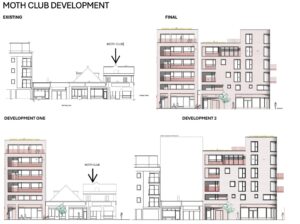
The dispute centres on two planning applications submitted in late 2024 for new housing on Morning Lane. The venue’s owners argue the proposed flats, some with balconies facing the stage wall, would inevitably lead to noise complaints and jeopardise its operation.
Proposed developments showing how new flats would sit directly beside MOTH Club. (Image: Peter Davy Smith Architects)
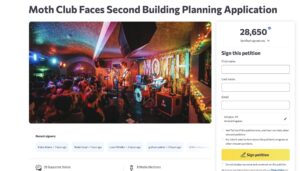
A public petition against the development has gathered more than 25,000 signatures. However, the MVT claims the local authority may approve the plans using delegated powers, sidestepping a full, public planning committee hearing.
“The Council has disregarded the Agent of Change principle, dismissed specialist advice, and withheld a key acoustic study from an FOI request while relying on assessments described by independent experts as ‘useless’,” the Trust alleges.
The petition to protect MOTH Club has gathered tens of thousands of signatures. (Image: change.org)
The Agent of Change planning principle
Central to the confrontation is the Agent of Change planning principle, designed to protect established venues when new residential developments are built nearby. The policy stipulates that it is the developer’s responsibility to fund and install necessary soundproofing measures.
The government reinforced this measure in July 2025 within its national licensing framework, explicitly placing the onus for noise mitigation on developers.
The MVT argues that Hackney Council is failing to uphold these rules, setting a dangerous template for the country.
“This is not solely about Moth Club,” its statement says. “It is a test of whether cultural protections genuinely function.”
The case echoes other high-profile disputes, such as the lengthy legal battle involving Manchester’s Night & Day Café, and unfolds against a severe strain on the grassroots sector. The MVT reports small venues are closing at a rate of one every two weeks.
Contrasting fortunes in the capitals music scene
The struggle of Moth Club unfolds against a mixed backdrop for London’s live music landscape.
Earlier this year, London was named the world’s best city for music lovers, yet 2025 has also seen the closure of legendary venues like Corsica Studios and G-A-Y. The sector’s strains exist alongside significant new investments.
Render of the new British Airways ARC venue, opening at Olympia in 2026. (Image: British Airways)
This struggle contrasts sharply with significant new investments at the top tier, like the recently confirmed 3,800-capacity British Airways ARC venue, highlighting a bifurcated industry where the grassroots network that nurtures future talent is under existential pressure.
A sector under severe and accelerating strain
Kelly Wood of the Musicians’ Union told City News that the issue extends beyond individual venues, describing a broader “cost-of-touring” crisis preventing emerging artists from taking shows on the road. “Grassroots venues are hugely important, but artists are also facing enormous challenges.”
Members of the Musicians’ Union marching in support of artists’ rights. (Image: Musicians’ Union)
Community campaign reaches decisive phase
The Moth Club, originally an ex-servicemen’s social club and now renowned for hosting acts from IDLES and Jarvis Cocker to Lady Gaga, began mobilising its supporters in September 2024.
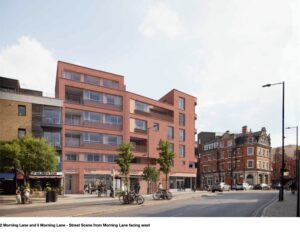
A visual of the planned Morning Lane flats that could impact the venue’s future. (Image: Peter Davy Smith Architects)
Campaigners believe the coming weeks may prove decisive, and the outcome will signal whether the ecosystems that foster musical talent can survive amidst urban development, setting a precedent that will resonate far beyond Hackney’s borders.
Submitted Article
Headline
Short Headline
Standfirst
Published Article
HeadlineHackney’s Moth Club planning dispute becomes national test case for grassroots venue protections
Short HeadlineHackney's Moth Club fight sparks national venue-protections row
StandfirstThe future of one of London's most iconic grassroots music venues has become a critical examination of the UK's cultural protection policies, according to the Music Venue Trust.
The Music Venue Trust (MVT) is warning that a planning dispute over Hackney’s Moth Club represents an “existential threat” to the wider live-music ecosystem and risks setting a “catastrophic” national precedent.
The organisation accuses Hackney Council of disregarding established planning safeguards, with the outcome poised to test whether the UK’s cultural protections genuinely function.
The dispute centres on two planning applications submitted in late 2024 for new housing on Morning Lane. The venue’s owners argue the proposed flats, some with balconies facing the stage wall, would inevitably lead to noise complaints and jeopardise its operation.
Proposed developments showing how new flats would sit directly beside MOTH Club. (Image: Peter Davy Smith Architects)
A public petition against the development has gathered more than 25,000 signatures. However, the MVT claims the local authority may approve the plans using delegated powers, sidestepping a full, public planning committee hearing.
“The Council has disregarded the Agent of Change principle, dismissed specialist advice, and withheld a key acoustic study from an FOI request while relying on assessments described by independent experts as ‘useless’,” the Trust alleges.
The petition to protect MOTH Club has gathered tens of thousands of signatures. (Image: change.org)
The Agent of Change planning principle
Central to the confrontation is the Agent of Change planning principle, designed to protect established venues when new residential developments are built nearby. The policy stipulates that it is the developer’s responsibility to fund and install necessary soundproofing measures.
The government reinforced this measure in July 2025 within its national licensing framework, explicitly placing the onus for noise mitigation on developers.
The MVT argues that Hackney Council is failing to uphold these rules, setting a dangerous template for the country.
“This is not solely about Moth Club,” its statement says. “It is a test of whether cultural protections genuinely function.”
The case echoes other high-profile disputes, such as the lengthy legal battle involving Manchester’s Night & Day Café, and unfolds against a severe strain on the grassroots sector. The MVT reports small venues are closing at a rate of one every two weeks.
Contrasting fortunes in the capitals music scene
The struggle of Moth Club unfolds against a mixed backdrop for London’s live music landscape.
Earlier this year, London was named the world’s best city for music lovers, yet 2025 has also seen the closure of legendary venues like Corsica Studios and G-A-Y. The sector’s strains exist alongside significant new investments.
Render of the new British Airways ARC venue, opening at Olympia in 2026. (Image: British Airways)
This struggle contrasts sharply with significant new investments at the top tier, like the recently confirmed 3,800-capacity British Airways ARC venue, highlighting a bifurcated industry where the grassroots network that nurtures future talent is under existential pressure.
A sector under severe and accelerating strain
Kelly Wood of the Musicians’ Union told City News that the issue extends beyond individual venues, describing a broader “cost-of-touring” crisis preventing emerging artists from taking shows on the road. “Grassroots venues are hugely important, but artists are also facing enormous challenges.”
Members of the Musicians’ Union marching in support of artists’ rights. (Image: Musicians’ Union)
Community campaign reaches decisive phase
The Moth Club, originally an ex-servicemen’s social club and now renowned for hosting acts from IDLES and Jarvis Cocker to Lady Gaga, began mobilising its supporters in September 2024.
A visual of the planned Morning Lane flats that could impact the venue’s future. (Image: Peter Davy Smith Architects)
Campaigners believe the coming weeks may prove decisive, and the outcome will signal whether the ecosystems that foster musical talent can survive amidst urban development, setting a precedent that will resonate far beyond Hackney’s borders.
A 2024 Freedom of Information request showed Bromley Council had £4.5 million invested in arms companies that year with £1.5 million reportedly linked to Israel.
Undercover officers raided three linked shops in Barking town centre, revealing how illicit tobacco is being hidden in walls, ceilings and nearby locations to evade detection.
More than 330,000 people across the UK sought support from the Stop It Now helpline in 2025 over concerns about their own or someone else’s online sexual behaviour towards children, according to new charity data. The anonymous service says contacts by phone, email and webchat rose significantly over the year.