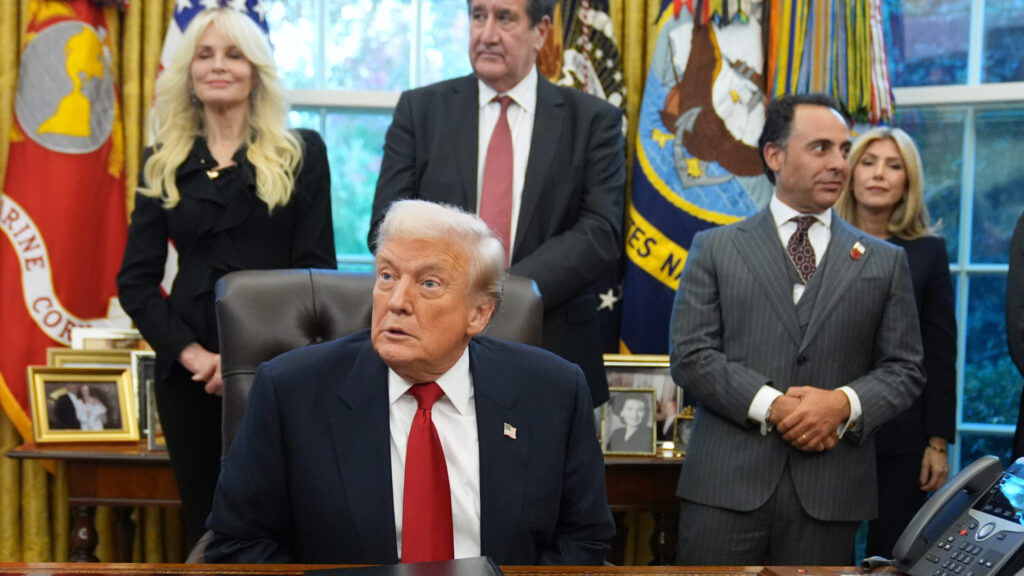
US President Donald Trump in the Oval Office with his personal lawyer Robert Garson (right). Source: AP
SHARE:
Jewish Londoners have given a mixed response to claims that the United States should offer British Jews asylum.
Robert Garson, a British Jew from Manchester who is now serving as President Trump’s personal lawyer, claimed in The Telegraph that “the UK is no longer a safe place for Jews”. He says he’s in discussions with the State Department about offering British Jews asylum in the US.
The Trump administration has repeatedly criticised the UK over its handling of antisemitism in the past year. In a report last summer, they accused the UK of backsliding on human rights, citing increased antisemitic violence as a key reason for this.
Meanwhile, Warren Stephens, the US ambassador to the UK, said “there should be no place for… hateful incitement or tolerance of antisemitism in the UK” after a live broadcast of the “antisemitic” chant against the Israel Defence Forces at Glastonbury.
South London Jew David thinks Garson’s comments are “unhelpful”. Source: Adobe Stock.
Over half of all British Jews are based in London. Their reactions reveal a community divided between unease and scepticism.
Progressive Rabbi Zach, who’s based in the capital, said he didn’t know anyone who is thinking of leaving.
The Institute for Jewish Policy Research (JPR) findings support this, stating “there’s no ‘Jewish exodus’ from the UK”.
Others, however, say the picture is more complex. 53-year-old Gayle Klein from east London is a prominent member of her community as Vice Chair of Jewish Care. She says she knows people who have left the UK, often moving to places like America, Dubai and Israel.
Klein says people have moved “because of a combination of antisemitism and a general dislike of [UK government] policies”.
Dr Jonathan Boyd, the Executive Director of JPR, says “I wouldn’t expect to see a dramatic shift in the numbers of Jews leaving the UK, unless the security situation around Jews in the UK deteriorated substantially.”
Gayle Klein says she’s “extremely careful about openly showing my Jewishness” in London. Source: Abigail Cohen for City News.
David, president of a south London synagogue, also struck a cautious note.
“Now isn’t a bad time to be prepared.”
“I don’t think there’s a need for asylum right now”, he says, “but the history of the Jews suggests that one needs to be prepared, and the current climate suggests that now isn’t a bad time to be prepared.”
Klein echoed this sense of uncertainty, reflecting that “it is very common amongst my friends who are Jewish to chat about where they might go, as there is a general feeling that the UK is not going to provide a long-term safe haven for the Jewish community.”
JPR research from 2025 found that 82% of British Jews say antisemitism is ‘very big’ or ‘fairly big’ in the UK. Yet in the US, an even higher proportion of Jews perceive antisemitism as an issue, with 92% of American Jewish adults saying it is a problem there today.
“The suggestion that British Jews can avoid the dangers of antisemitism by fleeing to the US doesn’t hold water.”
The Community Security Trust (CST), a charity that protects British Jews from antisemitism, agrees with this broader framing and argues “antisemitism is a global problem”.
“Last year, tragically, Jews were murdered by hateful terrorists in the US as well as in the UK, so the suggestion that British Jews can avoid the dangers of antisemitism by fleeing to the US doesn’t hold water.”
Most of those interviewed said they wouldn’t feel any safer in America than in Britain, with Rabbi Zach noting that in his community “there are more people who are worried about what’s going on in America than thinking about what’s going on here in London.”
Britain’s Prime Minister Keir Starmer meets members of the Jewish community. Source: AP.
Garson claims that Prime Minister Keir Starmer has “allowed rampant anti-semitism to become commonplace in [British] society”.
Klein agrees with this sentiment, describing a “noticeable change since Starmer took office” and arguing his government “have played a part in legitimising antisemitism dressed up as a criticism of Israel.”
“I think our government has been pretty woeful”
Noah, a 34-year-old Jewish teacher in north London, agrees, claiming “I think our government has been pretty woeful… they say things but don’t take any meaningful action.”
24-year-old student Eliah from west London is concerned about Jewish safety across the capital: “let’s just say I have more nightmares about antisemitism now than I have since I was 8 and first learnt about the Holocaust in detail.”
However, she also says that “while I feel the least safe I have ever felt as a Jew in London, it isn’t related to Starmer”.
Instead, she agrees with David that the rise in antisemitism is linked to the attacks by Hamas on Israel on 7th October 2023 and Israel’s response afterwards.
Rabbi Zach reflected, “what’s coming out of the Trump administration is so extraordinary at the moment – this is just one more thing”.
Some names have been changed to protect the identity of interviewees.
Submitted Article
Headline
Short Headline
Standfirst
Published Article
HeadlineJews in London sceptical of possible American asylum offer
Short HeadlineLondon Jews sceptical of potential US asylum offer
StandfirstThis comes after top Trump lawyer says he sees "no future" for Jews in the UK.
Jewish Londoners have given a mixed response to claims that the United States should offer British Jews asylum.
Robert Garson, a British Jew from Manchester who is now serving as President Trump’s personal lawyer, claimed in The Telegraph that “the UK is no longer a safe place for Jews”. He says he’s in discussions with the State Department about offering British Jews asylum in the US.
The Trump administration has repeatedly criticised the UK over its handling of antisemitism in the past year. In a report last summer, they accused the UK of backsliding on human rights, citing increased antisemitic violence as a key reason for this.
Meanwhile, Warren Stephens, the US ambassador to the UK, said “there should be no place for… hateful incitement or tolerance of antisemitism in the UK” after a live broadcast of the “antisemitic” chant against the Israel Defence Forces at Glastonbury.
South London Jew David thinks Garson’s comments are “unhelpful”. Source: Adobe Stock.
Over half of all British Jews are based in London. Their reactions reveal a community divided between unease and scepticism.
Progressive Rabbi Zach, who’s based in the capital, said he didn’t know anyone who is thinking of leaving.
The Institute for Jewish Policy Research (JPR) findings support this, stating “there’s no ‘Jewish exodus’ from the UK”.
Others, however, say the picture is more complex. 53-year-old Gayle Klein from east London is a prominent member of her community as Vice Chair of Jewish Care. She says she knows people who have left the UK, often moving to places like America, Dubai and Israel.
Klein says people have moved “because of a combination of antisemitism and a general dislike of [UK government] policies”.
Dr Jonathan Boyd, the Executive Director of JPR, says “I wouldn’t expect to see a dramatic shift in the numbers of Jews leaving the UK, unless the security situation around Jews in the UK deteriorated substantially.”
Gayle Klein says she’s “extremely careful about openly showing my Jewishness” in London. Source: Abigail Cohen for City News.
David, president of a south London synagogue, also struck a cautious note.
“Now isn’t a bad time to be prepared.”
“I don’t think there’s a need for asylum right now”, he says, “but the history of the Jews suggests that one needs to be prepared, and the current climate suggests that now isn’t a bad time to be prepared.”
Klein echoed this sense of uncertainty, reflecting that “it is very common amongst my friends who are Jewish to chat about where they might go, as there is a general feeling that the UK is not going to provide a long-term safe haven for the Jewish community.”
JPR research from 2025 found that 82% of British Jews say antisemitism is ‘very big’ or ‘fairly big’ in the UK. Yet in the US, an even higher proportion of Jews perceive antisemitism as an issue, with 92% of American Jewish adults saying it is a problem there today.
“The suggestion that British Jews can avoid the dangers of antisemitism by fleeing to the US doesn’t hold water.”
The Community Security Trust (CST), a charity that protects British Jews from antisemitism, agrees with this broader framing and argues “antisemitism is a global problem”.
“Last year, tragically, Jews were murdered by hateful terrorists in the US as well as in the UK, so the suggestion that British Jews can avoid the dangers of antisemitism by fleeing to the US doesn’t hold water.”
Most of those interviewed said they wouldn’t feel any safer in America than in Britain, with Rabbi Zach noting that in his community “there are more people who are worried about what’s going on in America than thinking about what’s going on here in London.”
Britain’s Prime Minister Keir Starmer meets members of the Jewish community. Source: AP.
Garson claims that Prime Minister Keir Starmer has “allowed rampant anti-semitism to become commonplace in [British] society”.
Klein agrees with this sentiment, describing a “noticeable change since Starmer took office” and arguing his government “have played a part in legitimising antisemitism dressed up as a criticism of Israel.”
“I think our government has been pretty woeful”
Noah, a 34-year-old Jewish teacher in north London, agrees, claiming “I think our government has been pretty woeful… they say things but don’t take any meaningful action.”
24-year-old student Eliah from west London is concerned about Jewish safety across the capital: “let’s just say I have more nightmares about antisemitism now than I have since I was 8 and first learnt about the Holocaust in detail.”
However, she also says that “while I feel the least safe I have ever felt as a Jew in London, it isn’t related to Starmer”.
Instead, she agrees with David that the rise in antisemitism is linked to the attacks by Hamas on Israel on 7th October 2023 and Israel’s response afterwards.
Rabbi Zach reflected, “what’s coming out of the Trump administration is so extraordinary at the moment – this is just one more thing”.
Some names have been changed to protect the identity of interviewees.
A 2024 Freedom of Information request showed Bromley Council had £4.5 million invested in arms companies that year with £1.5 million reportedly linked to Israel.
Undercover officers raided three linked shops in Barking town centre, revealing how illicit tobacco is being hidden in walls, ceilings and nearby locations to evade detection.
More than 330,000 people across the UK sought support from the Stop It Now helpline in 2025 over concerns about their own or someone else’s online sexual behaviour towards children, according to new charity data. The anonymous service says contacts by phone, email and webchat rose significantly over the year.