Cycling is key part of London's 2030 Net Zero ambition.
SHARE:
The London Cycling Campaign has urged for further investment in road safety after releasing a list of the cities’ most dangerous junctions for cyclists.
In data gathered on their website, the LCC says there have been ‘six fatal collisions’ for people cycling across London this year, which the campaign suggests will falter progress for London Mayor Sadiq Khan’s ambition to end road deaths in London by 2041.
Transport for London declined City News’ offer of an interview, but released a statement on the issue.
As cycling numbers grow in London, it’s clear that safety remains at the top of everyone’s minds.
-Transport For London
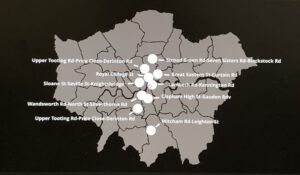
Junctions like Upper Tooting Road, Great Eastern Street and Clapham High Street rank high in the list of London’s 11 most dangerous junctions published by the LCC.
LCC’s map of the 11 most dangerous junctions for cyclists in London.
The campaign group are urging various councils for further investment in road safety through measures like more pedestrian crossings, green man crossings and cycle lanes.
There definitely needs to be more cycle lanes in London. Quite a few cars don’t care about cyclists.
-Benji Rohl, Local resident and cyclist (Great Eastern Street)
With over 1.2 million journeys cycled in the city every day, the streets of London are seeing more two-wheelers than ever before. However, as the boom in bike traffic increases, so does the concern for rider safety.
This all comes against the backdrop of London trying to transition towards greener transport links and eventually achieve net zero carbon emissions by 2030.
Anika Heckwolf, Policy fellow at the Grantham Research Institute explained that “A quarter of London’s emissions come from transport, that’s from both goods and people. So to achieve that net zero target we really do need a substantial increase in cycling.”
Submitted Article
Headline
Short Headline
Standfirst
Published Article
HeadlineLondon Cycling Campaign reveals the cities’ most dangerous junctions
Short HeadlineCampaign calls for further investment in road safety
StandfirstLondon Cycling Campaign has urged for more road safety after releasing a list of the cities' most dangerous junctions.
The London Cycling Campaign has urged for further investment in road safety after releasing a list of the cities’ most dangerous junctions for cyclists.
In data gathered on their website, the LCC says there have been ‘six fatal collisions’ for people cycling across London this year, which the campaign suggests will falter progress for London Mayor Sadiq Khan’s ambition to end road deaths in London by 2041.
Transport for London declined City News’ offer of an interview, but released a statement on the issue.
As cycling numbers grow in London, it’s clear that safety remains at the top of everyone’s minds.
-Transport For London
Junctions like Upper Tooting Road, Great Eastern Street and Clapham High Street rank high in the list of London’s 11 most dangerous junctions published by the LCC.
LCC’s map of the 11 most dangerous junctions for cyclists in London.
The campaign group are urging various councils for further investment in road safety through measures like more pedestrian crossings, green man crossings and cycle lanes.
There definitely needs to be more cycle lanes in London. Quite a few cars don’t care about cyclists.
-Benji Rohl, Local resident and cyclist (Great Eastern Street)
With over 1.2 million journeys cycled in the city every day, the streets of London are seeing more two-wheelers than ever before. However, as the boom in bike traffic increases, so does the concern for rider safety.
This all comes against the backdrop of London trying to transition towards greener transport links and eventually achieve net zero carbon emissions by 2030.
Anika Heckwolf, Policy fellow at the Grantham Research Institute explained that “A quarter of London’s emissions come from transport, that’s from both goods and people. So to achieve that net zero target we really do need a substantial increase in cycling.”
A 2024 Freedom of Information request showed Bromley Council had £4.5 million invested in arms companies that year with £1.5 million reportedly linked to Israel.
Undercover officers raided three linked shops in Barking town centre, revealing how illicit tobacco is being hidden in walls, ceilings and nearby locations to evade detection.
More than 330,000 people across the UK sought support from the Stop It Now helpline in 2025 over concerns about their own or someone else’s online sexual behaviour towards children, according to new charity data. The anonymous service says contacts by phone, email and webchat rose significantly over the year.