As new infrastructure leads to bill increases hit England and Wales, how long is it before artificial intelligence (A.I.) is the new antagonist?
Average household water bills in England and Wales are set to increase in April this year by 5.4%. Luckily for Londoners though, the increase is not as big as last year and Thames Water the increase will only be 0.4% which is an average of £3 a year.
However, with a rising number of people and businesses relying on A.I. every day, it is hard to escape the ease of using this handy technology in the capital.
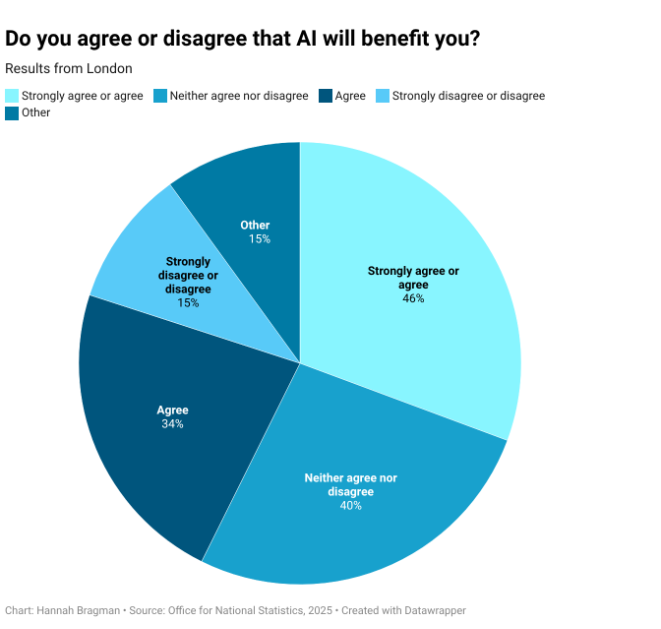
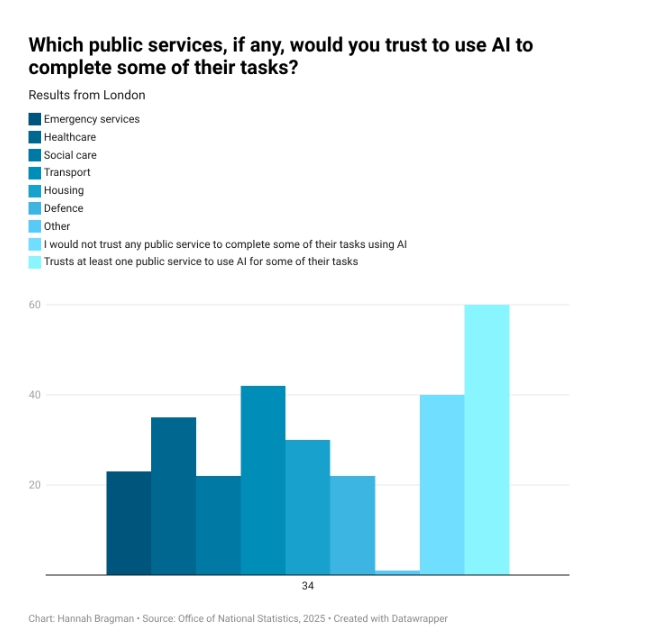
Nearly half of Londoners believe that A.I. will benefit them, with many saying they’d trust it in public services such as the transport sector. The technology is fast, usually reliable and a real gamechanger in this digital era. However, there is one problem… Water.
The AI data-centres are under ever-growing pressure to perform efficiently, and so when they overheat, cold water is used to cool them down.
According to Dr Venkatesh Uddameri (Professor of Civil & Environmental Engineering, Lamar University), a typical data-centre uses between 11 million and 19 million litres of water per day, which is similar usage to a town of 30,000 to 50,000 people.
Last year, Prime Minister Keir Starmer planned to make the UK a “world leader” in A.I., but there would be a significant impact on the UK’s water.
Just over a week ago, the United Nations (UN) announced that our world is entering an era of “global water bankruptcy” .
And whilst we don’t see daily effects now, they are just around the corner for London.
The first government-designated “A.I. Growth Zone” was located close to London and since its development, Thames Water classified itself as “seriously water stressed”. Further developments have now spanned across the UK showing a direct correlation with various regional water companies facing water-stress problems.
Rich Kenny, the Co-Chair of the GDSA Planetary Impact Working Group, says that the data-centres have made Greater London an example of the “impact of localised climate risks like heatwaves and water stress”.
With household water bills from Thames Water increasing to an average of £658 this year, it could be forecast that in the near future our bills could increase more drastically but this time due to the thirst of these AI data-centres.
Along with bill increases, there’s a chance of “biodiversity loss and ecosystem collapse” within the next 10 years according to The World Economic Forum Report on Global Risks.
So, is the answer to just stop using A.I.?
Well, partially. The Government still recommends the classic tips of shorter showers, taps off when brushing teeth and fully loading the washing machines to help our dwindling water supply, but a reduction of AI usage is encouraged too.
A recent Government blog mentioned that just during ChatGPT’s development three years ago, 700,000 litres of water were used. The same report mentioned that it’s crucial to prioritise using rainwater for the data-centres, or testing if air-cooling systems would be effective.
Submitted Article
Headline
Short Headline
Standfirst
Published Article
Headline“Hey A.I., create an image of London without water”
Short Headline“Hey A.I., create an image of London without water”
StandfirstHow artificial intelligence (A.I.) is impacting our water supply and could increase our water bills.
As new infrastructure leads to bill increases hit England and Wales, how long is it before artificial intelligence (A.I.) is the new antagonist?
Average household water bills in England and Wales are set to increase in April this year by 5.4%. Luckily for Londoners though, the increase is not as big as last year and Thames Water the increase will only be 0.4% which is an average of £3 a year.
However, with a rising number of people and businesses relying on A.I. every day, it is hard to escape the ease of using this handy technology in the capital.
Nearly half of Londoners believe that A.I. will benefit them, with many saying they’d trust it in public services such as the transport sector. The technology is fast, usually reliable and a real gamechanger in this digital era. However, there is one problem… Water.
The AI data-centres are under ever-growing pressure to perform efficiently, and so when they overheat, cold water is used to cool them down.
According to Dr Venkatesh Uddameri (Professor of Civil & Environmental Engineering, Lamar University), a typical data-centre uses between 11 million and 19 million litres of water per day, which is similar usage to a town of 30,000 to 50,000 people.
Last year, Prime Minister Keir Starmer planned to make the UK a “world leader” in A.I., but there would be a significant impact on the UK’s water.
Just over a week ago, the United Nations (UN) announced that our world is entering an era of “global water bankruptcy” .
And whilst we don’t see daily effects now, they are just around the corner for London.
The first government-designated “A.I. Growth Zone” was located close to London and since its development, Thames Water classified itself as “seriously water stressed”. Further developments have now spanned across the UK showing a direct correlation with various regional water companies facing water-stress problems.
Rich Kenny, the Co-Chair of the GDSA Planetary Impact Working Group, says that the data-centres have made Greater London an example of the “impact of localised climate risks like heatwaves and water stress”.
With household water bills from Thames Water increasing to an average of £658 this year, it could be forecast that in the near future our bills could increase more drastically but this time due to the thirst of these AI data-centres.
Along with bill increases, there’s a chance of “biodiversity loss and ecosystem collapse” within the next 10 years according to The World Economic Forum Report on Global Risks.
So, is the answer to just stop using A.I.?
Well, partially. The Government still recommends the classic tips of shorter showers, taps off when brushing teeth and fully loading the washing machines to help our dwindling water supply, but a reduction of AI usage is encouraged too.
A recent Government blog mentioned that just during ChatGPT’s development three years ago, 700,000 litres of water were used. The same report mentioned that it’s crucial to prioritise using rainwater for the data-centres, or testing if air-cooling systems would be effective.
City news has spoken to a long-term rough sleeper to see how those on the street feel about the Andy Burham’s plan to end homelessness and the upcoming winter.