When the idea of hosting a tabloid week was announced in our newsroom, it was met with a quiet kind of nervousness.
“Do we have to include a pun?” someone said, not quite under their breath.
And really, that summed things up nicely. The question hanging over that pitching session was obvious: would we be expected to avoid complex news to dress up gossip as reporting?
The budding foreign correspondent and aspiring newsreader looked on nervily.
The reaction wasn’t especially surprising. It doesn’t take much digging to find the opinion that tabloid journalism is at best, unserious; and at worst, corrosive.
Even for those of us, and it’s the majority, who don’t remember the Leveson Inquiry firsthand, its shadow lingers. The scandals of the past have done their job: they’ve fixed negative assumptions about tabloids firmly in place.
And yet, the tabloids endure.
They remain widely read, heavily clicked, and, crucially — always understood. The latest figures still put The Sun at the top for combined print and digital reach, with millions of readers engaging every day.
In a fractured media landscape, where attention is short and audiences hard to pin down, the tabloid form has proven resilient.
But of course, the form hasn’t stood still. News has shifted; rapidly and unevenly into digital spaces. Storytelling looks different. Audiences behave differently. And tabloids, like everything else, are having to adapt to escape the same landscape that defined its worst excesses.
Which is exactly why this newsweek matters most.
Because in a moment where journalism is being constantly rethought, there’s an opportunity. Not to imitate the tabloids of the past, but to revisit the form and ask what it could look like now?
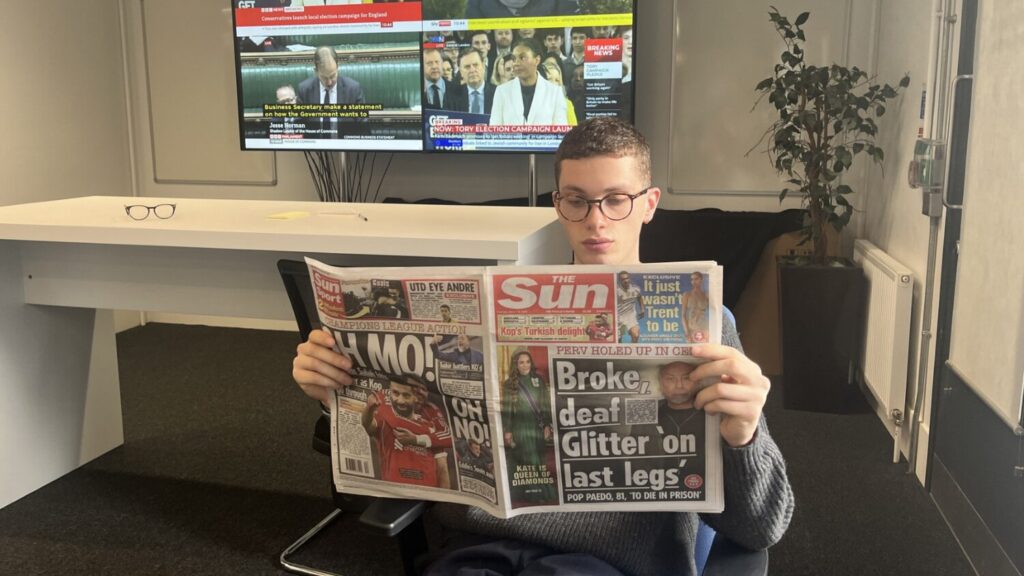
Tabloids are known for their bold headlines and bright colours / Credit: Bobbie Johnson
Not so much to rebuild it entirely, but to reclaim some of what made it tick. Its colour, clarity, and immediacy. If not to restore trust outright, then at least to engage eyeballs in new, exciting ways.
And that’s where the challenge lies. We shouldn’t be afraid to commit to so-called ‘hard news’, without denying the right to make news entertaining.
And say it quietly, but giving a story colour doesn’t mean it is being denied a serious tone — as you’ll see in this week’s explainer on protest rights and the Met’s powers.
Elsewhere, our social video team has been digging into the piles of complaints about dog owners who don’t pick up after their pets. Rest assured, there won’t be a colon in sight.
And in Wood Green, we’ve been racing to a church basement where, for decades, a group of men have kept competitive Scalextric alive through leagues and cups of their own making.
If this newsday is to be successful, it won’t be through an exercise in imitation. It has to show you, the reader, that this form still has life in it for a digital generation. That tabloid journalism can be bold without being trashy, popular without being empty, and entertaining without letting you click away.
Submitted Article
Headline
Short Headline
Standfirst
Published Article
HeadlineCity News: Make Tabloids Great Again!
Short HeadlineMake Tabloids Great Again!
StandfirstDigital editor Adam Robinson comments on how the tabloid can be reimagined.
When the idea of hosting a tabloid week was announced in our newsroom, it was met with a quiet kind of nervousness.
“Do we have to include a pun?” someone said, not quite under their breath.
And really, that summed things up nicely. The question hanging over that pitching session was obvious: would we be expected to avoid complex news to dress up gossip as reporting?
The budding foreign correspondent and aspiring newsreader looked on nervily.
The reaction wasn’t especially surprising. It doesn’t take much digging to find the opinion that tabloid journalism is at best, unserious; and at worst, corrosive.
Even for those of us, and it’s the majority, who don’t remember the Leveson Inquiry firsthand, its shadow lingers. The scandals of the past have done their job: they’ve fixed negative assumptions about tabloids firmly in place.
And yet, the tabloids endure.
They remain widely read, heavily clicked, and, crucially — always understood. The latest figures still put The Sun at the top for combined print and digital reach, with millions of readers engaging every day.
In a fractured media landscape, where attention is short and audiences hard to pin down, the tabloid form has proven resilient.
But of course, the form hasn’t stood still. News has shifted; rapidly and unevenly into digital spaces. Storytelling looks different. Audiences behave differently. And tabloids, like everything else, are having to adapt to escape the same landscape that defined its worst excesses.
Which is exactly why this newsweek matters most.
Because in a moment where journalism is being constantly rethought, there’s an opportunity. Not to imitate the tabloids of the past, but to revisit the form and ask what it could look like now?
Tabloids are known for their bold headlines and bright colours / Credit: Bobbie Johnson
Not so much to rebuild it entirely, but to reclaim some of what made it tick. Its colour, clarity, and immediacy. If not to restore trust outright, then at least to engage eyeballs in new, exciting ways.
And that’s where the challenge lies. We shouldn’t be afraid to commit to so-called ‘hard news’, without denying the right to make news entertaining.
And say it quietly, but giving a story colour doesn’t mean it is being denied a serious tone — as you’ll see in this week’s explainer on protest rights and the Met’s powers.
Elsewhere, our social video team has been digging into the piles of complaints about dog owners who don’t pick up after their pets. Rest assured, there won’t be a colon in sight.
And in Wood Green, we’ve been racing to a church basement where, for decades, a group of men have kept competitive Scalextric alive through leagues and cups of their own making.
If this newsday is to be successful, it won’t be through an exercise in imitation. It has to show you, the reader, that this form still has life in it for a digital generation. That tabloid journalism can be bold without being trashy, popular without being empty, and entertaining without letting you click away.
As the weather turns, City News has spoken to a long-term rough sleeper to see how those on the street feel about Andy Burnham’s plan to end homelessness and the upcoming winter.