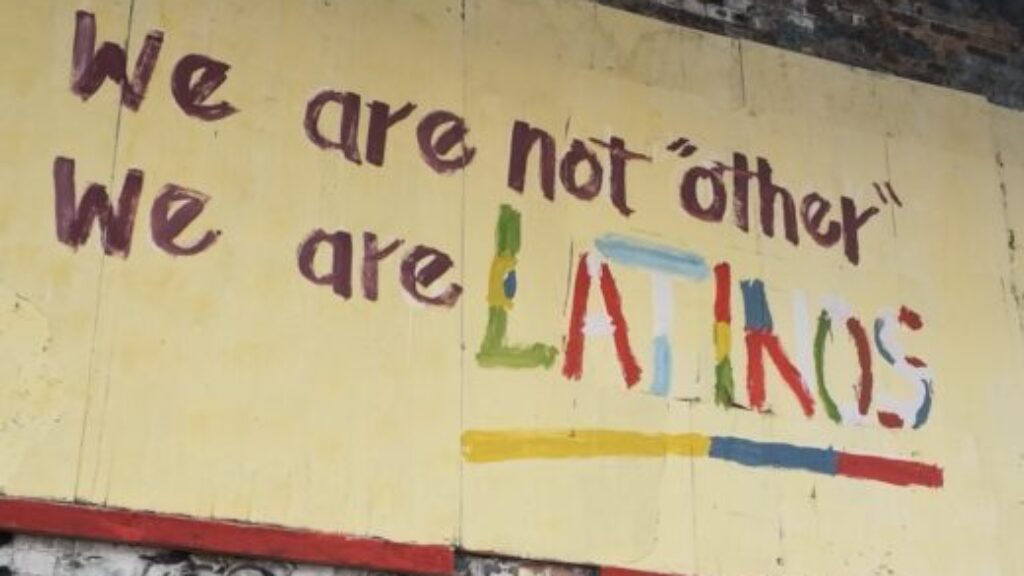
Billboard in Elephant and Castle, home to a large population of London's Latin American community.
SHARE:
In what campaigners for London’s Latin American community describe as ‘a major step closer to official recognition’, the Government Statistical Service (GSS) has announced that Latin American is one of seven ethnic classifications being considered for formal recognition.
The UK is home to an estimated 500,000 Latin Americans, according to campaigners’ estimates, with a large majority living in London. However, limited data on Latin American communities mean official statistics are sparse. In London, there have been breadcrumbs of official recognition already, with Southwark and Lambeth already including Latin American classification in their data collection. However, this has not yet become nationwide.
Why is this significant?
Campaigners say the lack of classification has caused them to become ‘statistically invisible’, translating into a lack of awareness for specific needs and barriers within the community.
The organisation UK Latin Community believes official recognition would result in some important changes. They say that visibility in national statistics would come from having their own specific category outside of ‘Other’, helping to measure population size and distribution more accurately. The organisation says this would allow for the development of better public services, particularly in ‘language support, health access, youth programmes and employment support’ and a deeper understanding of inequalities. The push for inclusion comes from the belief that if government bodies have reliable data they can build services and strengthen advocacy for targeted interventions, bringing a better quality of life for many people.
Monica Marin, the operations manager at Latin American House, a London-based charity that has been supporting Spanish and Portuguese speakers since 1983, described it as ‘awkward’ to not have a box for her ethnicity. She says she feels excluded and that the categorisation would help people understand that the community are also part of the whole, and not just ‘Other’.
This perspective was echoed by Natalie, a staff member at DistriAndina, a Latin American supermarket in Elephant and Castle. She described a mixed experience of living in London, saying she met people who made her feel at home whilst also facing judgement. If this decision is made official, she says it would mark a ‘great advance’, as Latin Americans have ‘always been here, we haven’t just started existing’.
Does this mean automatic inclusion in the UK Census?
Natalie hopes the recognition would mean future inclusion in the UK Census. A GSS spokesperson said: ‘Progression is not a commitment to include any of the ethnic groups as a response option in the new ethnicity harmonised standard or in Census 2031.’ However they ‘do expect the Census 2031 ethnic group question to be aligned to the harmonised standard for ethnicity currently being developed’. The change could bring hope to many Latin Americans living in the UK, as many campaigners have been advocating for this for over a decade.
The support for this change is not unanimous
However, some community members remain divided on whether a single label truly captures their identity. There has been ongoing debate around the use of ‘Latin American’ as the classification as opposed to individual nationalities, with some perceiving the umbrella term as reductive to varying cultures and histories. In addition, there is concern as to the representation of indigenous people of South America under this term. These conversations are ongoing and it is unclear if they will be taken into account during this consideration process.
What happens now?
The final decision will be made in February 2027 and deliberation will continue over the seven ethnic classifications being considered. These groups are: Jewish, Kurdish, Latin American, Sikh, Somali, Ukrainian, and separate response options for “Gypsy”, “Irish Traveller” and “Traveller”. The GSS says the next stage of the process includes focus group discussions, community roundtables, and engagement with government data collectors. Latin Americans will thus have to wait a bit longer for an answer to a long-standing but complicated plea for official categorisation.
Submitted Article
Headline
Short Headline
Standfirst
Published Article
Headline‘Statistically invisible’: Latin American through to next stage of possible Census consideration
Short HeadlineIs the Latin American community getting closer to inclusion in the UK Census?
StandfirstSeven ethnic classifications are through to the next stage of consideration for formal recognition.
In what campaigners for London’s Latin American community describe as ‘a major step closer to official recognition’, the Government Statistical Service (GSS) has announced that Latin American is one of seven ethnic classifications being considered for formal recognition.
The UK is home to an estimated 500,000 Latin Americans, according to campaigners’ estimates, with a large majority living in London. However, limited data on Latin American communities mean official statistics are sparse. In London, there have been breadcrumbs of official recognition already, with Southwark and Lambeth already including Latin American classification in their data collection. However, this has not yet become nationwide.
Why is this significant?
Campaigners say the lack of classification has caused them to become ‘statistically invisible’, translating into a lack of awareness for specific needs and barriers within the community.
The organisation UK Latin Community believes official recognition would result in some important changes. They say that visibility in national statistics would come from having their own specific category outside of ‘Other’, helping to measure population size and distribution more accurately. The organisation says this would allow for the development of better public services, particularly in ‘language support, health access, youth programmes and employment support’ and a deeper understanding of inequalities. The push for inclusion comes from the belief that if government bodies have reliable data they can build services and strengthen advocacy for targeted interventions, bringing a better quality of life for many people.
Monica Marin, the operations manager at Latin American House, a London-based charity that has been supporting Spanish and Portuguese speakers since 1983, described it as ‘awkward’ to not have a box for her ethnicity. She says she feels excluded and that the categorisation would help people understand that the community are also part of the whole, and not just ‘Other’.
This perspective was echoed by Natalie, a staff member at DistriAndina, a Latin American supermarket in Elephant and Castle. She described a mixed experience of living in London, saying she met people who made her feel at home whilst also facing judgement. If this decision is made official, she says it would mark a ‘great advance’, as Latin Americans have ‘always been here, we haven’t just started existing’.
Does this mean automatic inclusion in the UK Census?
Natalie hopes the recognition would mean future inclusion in the UK Census. A GSS spokesperson said: ‘Progression is not a commitment to include any of the ethnic groups as a response option in the new ethnicity harmonised standard or in Census 2031.’ However they ‘do expect the Census 2031 ethnic group question to be aligned to the harmonised standard for ethnicity currently being developed’. The change could bring hope to many Latin Americans living in the UK, as many campaigners have been advocating for this for over a decade.
The support for this change is not unanimous
However, some community members remain divided on whether a single label truly captures their identity. There has been ongoing debate around the use of ‘Latin American’ as the classification as opposed to individual nationalities, with some perceiving the umbrella term as reductive to varying cultures and histories. In addition, there is concern as to the representation of indigenous people of South America under this term. These conversations are ongoing and it is unclear if they will be taken into account during this consideration process.
What happens now?
The final decision will be made in February 2027 and deliberation will continue over the seven ethnic classifications being considered. These groups are: Jewish, Kurdish, Latin American, Sikh, Somali, Ukrainian, and separate response options for “Gypsy”, “Irish Traveller” and “Traveller”. The GSS says the next stage of the process includes focus group discussions, community roundtables, and engagement with government data collectors. Latin Americans will thus have to wait a bit longer for an answer to a long-standing but complicated plea for official categorisation.
A 2024 Freedom of Information request showed Bromley Council had £4.5 million invested in arms companies that year with £1.5 million reportedly linked to Israel.
Undercover officers raided three linked shops in Barking town centre, revealing how illicit tobacco is being hidden in walls, ceilings and nearby locations to evade detection.
More than 330,000 people across the UK sought support from the Stop It Now helpline in 2025 over concerns about their own or someone else’s online sexual behaviour towards children, according to new charity data. The anonymous service says contacts by phone, email and webchat rose significantly over the year.