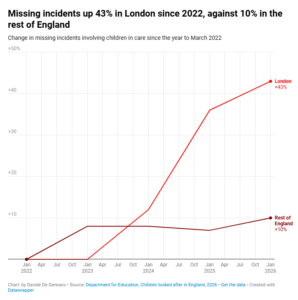
Children in care in London were reported missing 22,380 times in the year to March 2026, up from 15,620 in 2022, according to Department for Education data published on Thursday.
Over the same four years, missing incidents in the rest of England rose only by 10%.
The rise came even as the number of children in the capital’s care system fell by 8% over the same period, suggesting the rise is driven by some children repeatedly going missing. In fact, each child who went missing in London did so 10.6 times on average, compared with 6.2 in the rest of England.
A child is recorded as missing when they are not where they are expected to be and their whereabouts are unknown. Although most incidents are short, going missing can be a warning sign of a range of serious harms. This includes sexual and criminal exploitation, bullying, mental health issues and unhappiness at home, according to Missing People’s report, ‘Children’s views on being reported missing from care’ (2021).
The care system includes foster families, children’s homes and secure children’s homes. It also includes supported accommodation, where 16 and 17 year olds live in flats or shared houses with some support but no live-in carer. Other children in care live with their parents under a court order, or with prospective adopters.
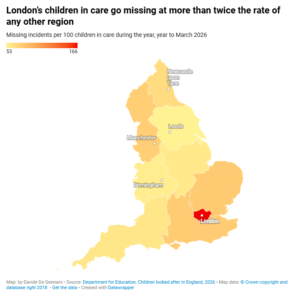
The gap between London and the rest of the country is even wider when the size of the capital’s care population is taken into account. Children in care in London are going missing at two and a half times the rate of those elsewhere in England: there were 166 missing incidents for every 100 children in care in the capital in the year to March 2026, compared to 67 incidents in the rest of England.
Why are London’s children going missing so much more often?
One factor may be where they live. Become, the national charity for children in care, says children in care may go missing because they have been moved far away from their family or home. A report it published in July 2026 found that being moved far away can leave children isolated and “exposed to exploitation and harm”.
That is a particular issue in London, where nearly two-thirds of children in care live outside their home borough, compared with 44% across England. Become has warned that more children than ever are “living more than 100 miles from everything they know” because of a shortage of suitable homes locally.
Children’s own accounts point the same way. In a report on the views of children in its care, Southwark Council found that some go missing to spend time with family and friends in their home area after being moved away.
The data released by the Department for Education is based on records kept by councils, and some of the increase may reflect changes in how incidents are recorded. But the gap with the rest of the country is far too large to be explained by recording practices alone.
Submitted Article
Headline
Short Headline
Standfirst
Published Article
HeadlineMissing incidents involving London’s children in care up 43%, official figures show
Short HeadlineMissing incidents involving London’s children in care up 43%
StandfirstCharities say children may go missing because of exploitation, unhappiness in their placement, or being moved far from home.
Children in care in London were reported missing 22,380 times in the year to March 2026, up from 15,620 in 2022, according to Department for Education data published on Thursday.
Over the same four years, missing incidents in the rest of England rose only by 10%.
The rise came even as the number of children in the capital’s care system fell by 8% over the same period, suggesting the rise is driven by some children repeatedly going missing. In fact, each child who went missing in London did so 10.6 times on average, compared with 6.2 in the rest of England.
A child is recorded as missing when they are not where they are expected to be and their whereabouts are unknown. Although most incidents are short, going missing can be a warning sign of a range of serious harms. This includes sexual and criminal exploitation, bullying, mental health issues and unhappiness at home, according to Missing People’s report, ‘Children’s views on being reported missing from care’ (2021).
The care system includes foster families, children’s homes and secure children’s homes. It also includes supported accommodation, where 16 and 17 year olds live in flats or shared houses with some support but no live-in carer. Other children in care live with their parents under a court order, or with prospective adopters.
The gap between London and the rest of the country is even wider when the size of the capital’s care population is taken into account. Children in care in London are going missing at two and a half times the rate of those elsewhere in England: there were 166 missing incidents for every 100 children in care in the capital in the year to March 2026, compared to 67 incidents in the rest of England.
Why are London’s children going missing so much more often?
One factor may be where they live. Become, the national charity for children in care, says children in care may go missing because they have been moved far away from their family or home. A report it published in July 2026 found that being moved far away can leave children isolated and “exposed to exploitation and harm”.
That is a particular issue in London, where nearly two-thirds of children in care live outside their home borough, compared with 44% across England. Become has warned that more children than ever are “living more than 100 miles from everything they know” because of a shortage of suitable homes locally.
Children’s own accounts point the same way. In a report on the views of children in its care, Southwark Council found that some go missing to spend time with family and friends in their home area after being moved away.
The data released by the Department for Education is based on records kept by councils, and some of the increase may reflect changes in how incidents are recorded. But the gap with the rest of the country is far too large to be explained by recording practices alone.
Daily pitching fees are rising due to Council budget cuts. City News has spoken to the chair of Berwick Street Trader's society to understand the impact the new year changes will bring.