New research shows that many neighbourhoods once considered lower-income are now seeing rising costs, shifting populations, and fewer affordable homes.
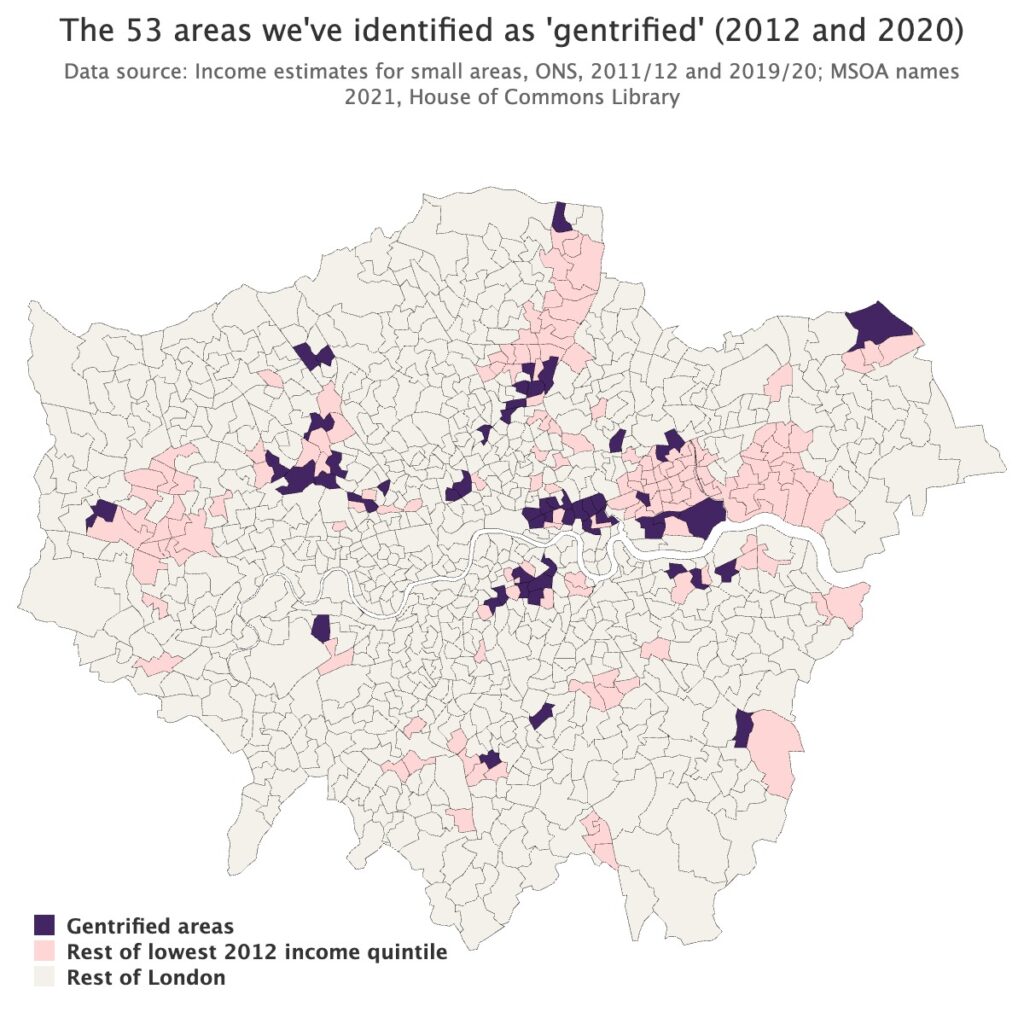
The latest analysis tracks 25 years of migration data to understand how people move into, out of and across London. Researchers focused on 53 neighbourhoods that have experienced gentrification since 2012.
These areas have seen incomes rise sharply, while populations of children and black residents have declined. People moving into these areas now come from further away and from less deprived parts of the city, highlighting the growing financial and social pressure in gentrified neighbourhoods.
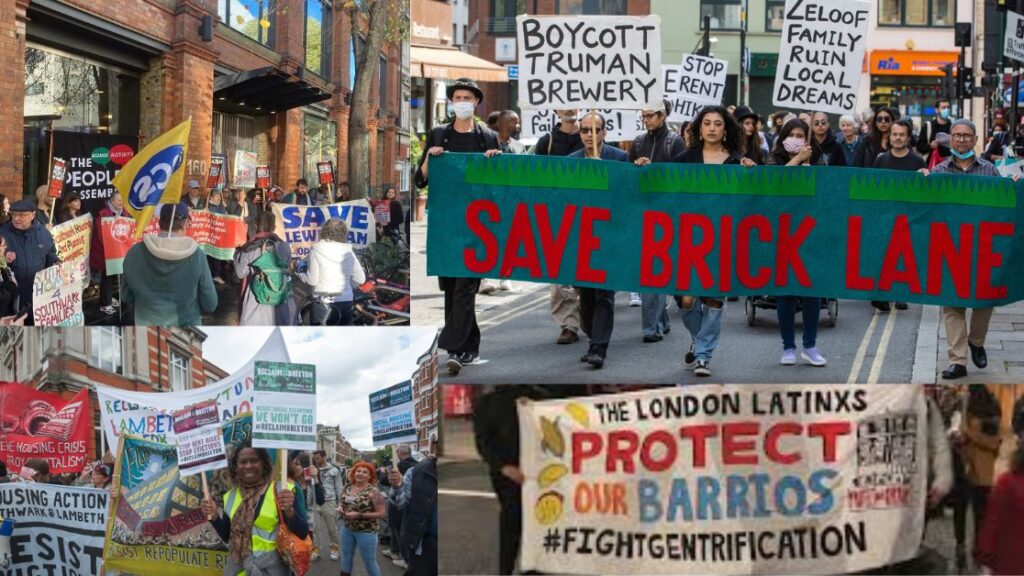
Gentrification refers to the movement of more affluent residents into lower-income areas, leading to rising costs and the displacement of existing residents. This can make housing, services, shops and restaurants unaffordable.
Source: Trust for London
Some members of the community are more affected than others, and even long-standing residents can be forced to leave areas they have lived in for their entire lives.
Where gentrification is most visible
In Tower Hamlets, Spitalfields has seen average incomes rise by 45 percent between 2012 and 2020. Aldgate has recorded a 29 percent increase.
Tower Hamlets contains 12 of the 53 gentrified neighbourhoods. Large clusters are also in Brent, Southwark, Newham and Haringey.
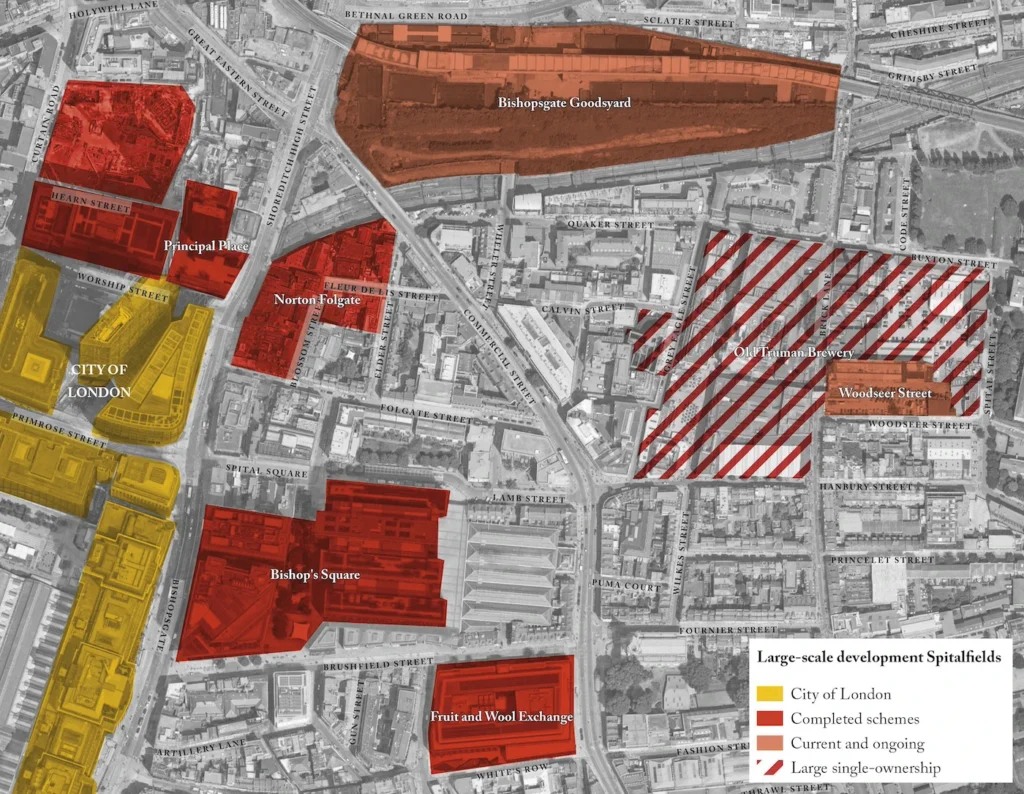
In Spitalfields, commercial redevelopment has transformed narrow streets and historic buildings. Spitalfields Market, the Fruit & Wool Exchange and Norton Folgate have all been redeveloped into offices and retail spaces.
The Fruit & Wool Exchange, once home to small local businesses, is now occupied by an international law firm, with street-level shops mostly empty. In Norton Folgate, the City of London acquired around 40 property leases over 10 years.
Developers replaced over 80 percent of the original buildings with large office blocks.
Source: Battle for Brick Lane
Cafés and the social fabric
Gentrification is not limited to housing and offices. Cafés and other community spaces also reflect changes in London neighbourhoods.
The City of London Corporation (CLC) recently awarded contracts for four cafés in Hampstead Heath and Queen’s Park to the London-based café chain Daisy Green. The cafés affected are at Queen’s Park, Golders Hill Park, Parliament Hill Lido and Parliament Hill Fields.
The decision followed a competitive tender process, but long-standing operators were told they must vacate their sites by 31 January 2026.
Emma Fernandez, who co-runs three of the sites, said the City of London Corporation was “destroying this fabric which is holding together the community.”
Emma Fernandez and Patrick Matthews, who run the Parliament Hill Lido cafe, which is due to be taken over by a chain. Source: Aaron Chown/AP
The change has prompted concern from local communities. A petition to retain the current operators gathered more than 15,000 signatures and received support from celebrities including Benedict Cumberbatch and James McAvoy.
Cumberbatch said, “This is about people and not profit. We must stand up for people who run businesses that serve the community, to preserve the livelihoods of individuals who have been crafting relationships with their customers.”
The D’Auria family is leaving Parliament Hill Fields café after being unsuccessful in their bid to keep the café they have operated since the 1970s.
Alberto D’Auria and his son Alfonso at the Parliament Hill Fields Cafe.
Doug Crawford from the Real Cafés Campaign said, “Residents worry that the new operator may not preserve the community atmosphere and affordability that existing cafés provide.”
The City of London Corporation stated the cafés will remain open and affordable. They stressed that the operators had previously been on short-term leases, which had limited investment in buildings and facilities.
Daisy Green plans to pay all staff at least the London Living Wage and invest in the cafés while maintaining menus that are accessible to the local community.
Source: AP
Housing pressures and new developments
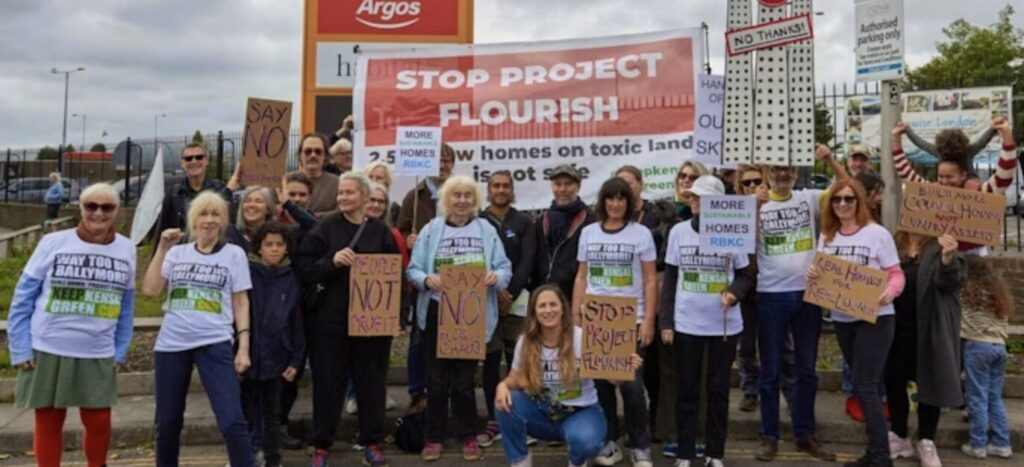
Housing redevelopment in areas like Kensal Green shows how gentrification can reshape who can live in a neighbourhood.
The site of a former estate is being replaced with 2,704 new homes, but only 82 are designated for social housing.
Alex Mees, who works for the National Education Union and lives in the area, said families are being forced out.
“They have removed family homes and replaced them with one- and two-bedroom apartments. All the families are moving out. They should have seen this coming,” Mees said.
The shortage of family-sized housing has broader effects. Research from the Affordable Housing Commission found that 13 percent of adults under 45 delayed or decided not to start a family because of housing costs.
London’s population overall is growing, but the number of residents aged 25 to 39 has dropped by four percent, the age range most associated with starting families. London Councils attribute the decline to the shortage of homes suitable for families.
Moreover, Kensal Gasworks is one of the most historically toxic gasworks sites in London. Its previous use as a 19th-century gas plant has left widespread contamination from legacy chemicals such as hydrocarbons, heavy metals, asbestos, cyanide, and volatile organic compounds (VOCs).
Many of these chemicals give off a foul odor that can linger in people’s homes for months. When contaminated soil is disturbed, toxic gas and dust are released into the atmosphere with devastating environmental and health impacts.
Source: Luana Basso for City News
UCL: “A city changing faster than the rest of itself.”
The research shows that gentrified areas are changing faster than other parts of London.
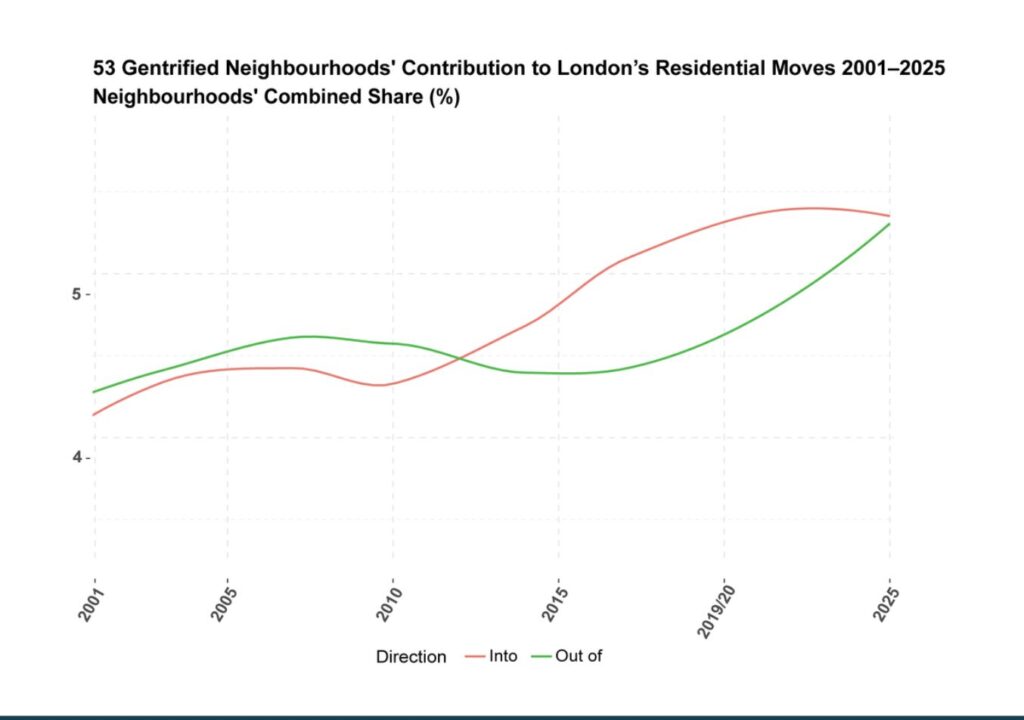
Relocations into these neighbourhoods now make up a growing share of all residential moves across the capital, a trend that has strengthened over time.
As these areas account for more people arriving and leaving, they are becoming increasingly central to London’s overall housing churn.
Residents moving into gentrified neighbourhoods tend to come from further away and from less deprived areas than those moving into other parts of London.
The research also shows a weakening of London’s traditional “escalator effect”, where young families moved out of the city in search of more affordable housing.
In gentrified neighbourhoods, the proportion of people living in social housing has fallen, professional occupations have increased, and fewer families with children remain. In several areas, the black population has also declined.
Professor Paul Longley from UCL said: “Gentrification is used as an umbrella term to describe different neighbourhood trajectories. High-resolution data can show the pace and detail of local change across London.”
Source: Trust for London
How London’s housing market compares with Europe
London’s housing market has been among the most expensive in Western Europe over the past two decades, and its price growth has outpaced some comparable global cities.
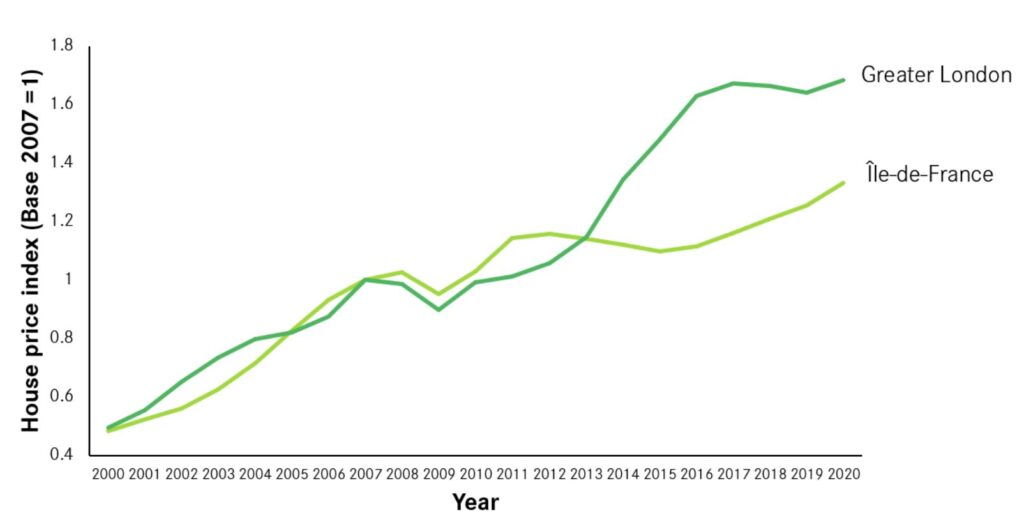
One analysis found that between 2000 and 2007, house prices in both London and Paris rose quickly, then diverged after the financial crisis, with prices in Greater London increasing substantially more than in the Paris region.
Source: OECD
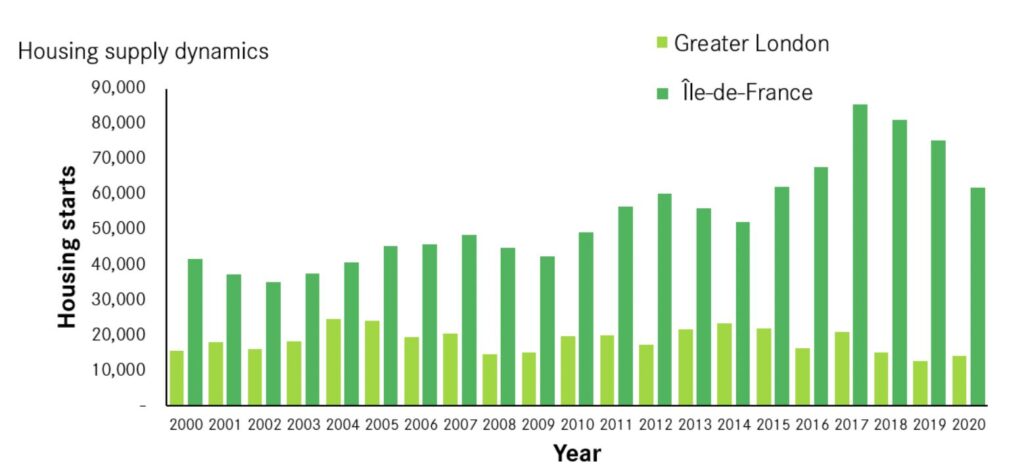
A major factor behind this divergence is housing supply. Data on new housing starts shows that Paris consistently built more new homes than London since 2000, even though London’s population and job growth were stronger.
Over the decade before the pandemic, Paris had roughly 474,000 more housing starts than London despite higher demand pressures in the British capital.
Source: French Ministry of Ecological Transition; Department for Levelling Up, Housing and Communities and Ministry of Housing, Communities & Local Government.
More recent European housing data suggests that London’s experience is not unique, but both price levels and trends vary across major cities.
In a 2025 snapshot of residential markets across Europe, average prices per square metre in capitals showed wide differences, with Paris higher than many cities and London among the most expensive, while other capitals such as Berlin and Amsterdam recorded lower price levels and moderate annual growth.
For example, one price‑per‑square‑metre comparison listed Berlin at around €5,800/£5,026 and Amsterdam at around €7,200/£6,240 per square metre, compared with significantly higher levels in London.
According to Eurostat data, EU house prices rose an average of about 5.4 percent year‑on‑year in the second quarter of 2025, with several countries, including Portugal, Bulgaria and Spain, seeing double‑digit increases, while some central European markets experienced more modest growth.
Taken together, these figures paint a picture in which London has experienced historically high prices and strong long‑term growth relative to some peers, but underlying pressures such as constrained housing supply, strong demand, and wider European price rises contribute to affordability challenges not unique to the British capital.
This context helps explain why gentrification pressures in London have been particularly acute.
The consequences for communities
Not only cafés, small shops, and cultural spaces are at risk, but also schools.
While gentrification is often framed as economic growth or urban improvement, the data show that it has tangible consequences for families. There’s been a sharp drop in the number of children in these areas, a larger drop than in the rest of London.
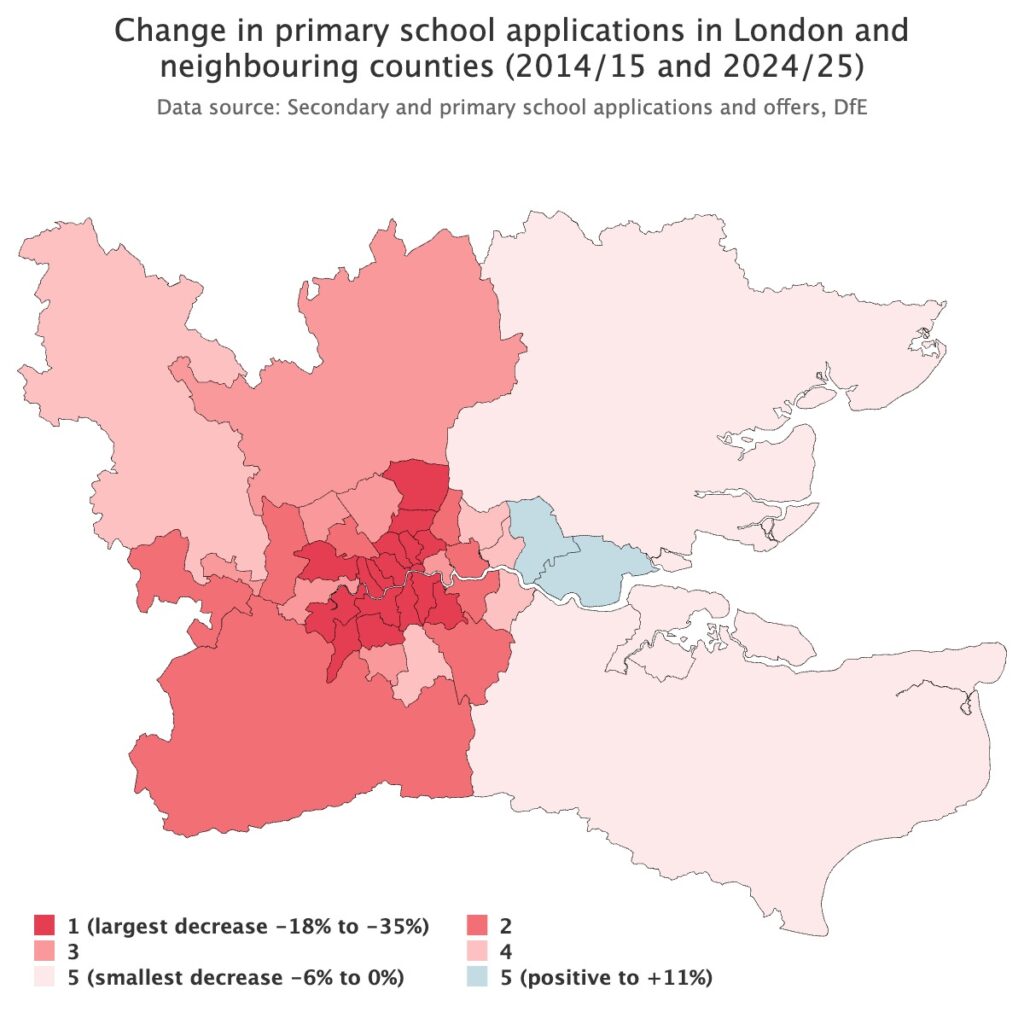
This reflects a trend across the Capital. As a consequence, primary school applications are falling dramatically.
Source: Trust for London
The combined effects of redevelopment, rising housing costs, and changes to social infrastructure are redefining who London is for.
Mayor outlines long-term housing plans
London’s citywide budget for 2026‑27, set out by the Mayor and Greater London Authority (GLA), shows how local government is planning to prioritise housing and related services in the context of the city’s ongoing affordability pressures.
Source: James Manning/PA Wire
According to the draft consolidated budget, total planned expenditure for 2026‑27 is £22.7 billion, an increase from previous estimates, with ongoing investment across transport, skills, environment and housing.
The budget is currently under scrutiny by the London Assembly as part of the consultation process.
Within this overall framework, the Mayor has secured billions in funding for social and affordable housing through the London Social and Affordable Homes Programme (LSAHP) 2026‑36.
According to the draft budget documents, up to £11.7 billion of government funding has been committed to support new social and affordable housing starts in London over the next decade.
This funding is part of the Mayor’s broader commitment to increase the delivery of genuinely affordable homes in the capital.
City Hall’s Affordable Housing Monitor 2024 also highlights delivery challenges under current housing programmes.
It shows that targets for new home starts under the 2021‑26 Affordable Homes Programme remain behind schedule, with fewer than 2,000 homes started by March 2024 and a requirement for tens of thousands more to be delivered by 2030.
Submitted Article
Headline
Short Headline
Standfirst
Published Article
HeadlineLondon’s Changing Neighbourhoods: How Gentrification Is Reshaping The City
Short HeadlineLondon’s Gentrification Crisis
StandfirstRising incomes, falling social housing, and the displacement of long-standing residents are changing the city’s social fabric.
London is changing fast.
New research shows that many neighbourhoods once considered lower-income are now seeing rising costs, shifting populations, and fewer affordable homes.
The latest analysis tracks 25 years of migration data to understand how people move into, out of and across London. Researchers focused on 53 neighbourhoods that have experienced gentrification since 2012.
These areas have seen incomes rise sharply, while populations of children and black residents have declined. People moving into these areas now come from further away and from less deprived parts of the city, highlighting the growing financial and social pressure in gentrified neighbourhoods.
Gentrification refers to the movement of more affluent residents into lower-income areas, leading to rising costs and the displacement of existing residents. This can make housing, services, shops and restaurants unaffordable.
Source: Trust for London
Some members of the community are more affected than others, and even long-standing residents can be forced to leave areas they have lived in for their entire lives.
Where gentrification is most visible
In Tower Hamlets, Spitalfields has seen average incomes rise by 45 percent between 2012 and 2020. Aldgate has recorded a 29 percent increase.
Tower Hamlets contains 12 of the 53 gentrified neighbourhoods. Large clusters are also in Brent, Southwark, Newham and Haringey.
In Spitalfields, commercial redevelopment has transformed narrow streets and historic buildings. Spitalfields Market, the Fruit & Wool Exchange and Norton Folgate have all been redeveloped into offices and retail spaces.
The Fruit & Wool Exchange, once home to small local businesses, is now occupied by an international law firm, with street-level shops mostly empty. In Norton Folgate, the City of London acquired around 40 property leases over 10 years.
Developers replaced over 80 percent of the original buildings with large office blocks.
Source: Battle for Brick Lane
Cafés and the social fabric
Gentrification is not limited to housing and offices. Cafés and other community spaces also reflect changes in London neighbourhoods.
The City of London Corporation (CLC) recently awarded contracts for four cafés in Hampstead Heath and Queen’s Park to the London-based café chain Daisy Green. The cafés affected are at Queen’s Park, Golders Hill Park, Parliament Hill Lido and Parliament Hill Fields.
The decision followed a competitive tender process, but long-standing operators were told they must vacate their sites by 31 January 2026.
Emma Fernandez, who co-runs three of the sites, said the City of London Corporation was “destroying this fabric which is holding together the community.”
Emma Fernandez and Patrick Matthews, who run the Parliament Hill Lido cafe, which is due to be taken over by a chain. Source: Aaron Chown/AP
The change has prompted concern from local communities. A petition to retain the current operators gathered more than 15,000 signatures and received support from celebrities including Benedict Cumberbatch and James McAvoy.
Cumberbatch said, “This is about people and not profit. We must stand up for people who run businesses that serve the community, to preserve the livelihoods of individuals who have been crafting relationships with their customers.”
The D’Auria family is leaving Parliament Hill Fields café after being unsuccessful in their bid to keep the café they have operated since the 1970s.
Alberto D’Auria and his son Alfonso at the Parliament Hill Fields Cafe.
Doug Crawford from the Real Cafés Campaign said, “Residents worry that the new operator may not preserve the community atmosphere and affordability that existing cafés provide.”
The City of London Corporation stated the cafés will remain open and affordable. They stressed that the operators had previously been on short-term leases, which had limited investment in buildings and facilities.
Daisy Green plans to pay all staff at least the London Living Wage and invest in the cafés while maintaining menus that are accessible to the local community.
Source: AP
Housing pressures and new developments
Housing redevelopment in areas like Kensal Green shows how gentrification can reshape who can live in a neighbourhood.
The site of a former estate is being replaced with 2,704 new homes, but only 82 are designated for social housing.
Alex Mees, who works for the National Education Union and lives in the area, said families are being forced out.
“They have removed family homes and replaced them with one- and two-bedroom apartments. All the families are moving out. They should have seen this coming,” Mees said.
The shortage of family-sized housing has broader effects. Research from the Affordable Housing Commission found that 13 percent of adults under 45 delayed or decided not to start a family because of housing costs.
London’s population overall is growing, but the number of residents aged 25 to 39 has dropped by four percent, the age range most associated with starting families. London Councils attribute the decline to the shortage of homes suitable for families.
Moreover, Kensal Gasworks is one of the most historically toxic gasworks sites in London. Its previous use as a 19th-century gas plant has left widespread contamination from legacy chemicals such as hydrocarbons, heavy metals, asbestos, cyanide, and volatile organic compounds (VOCs).
Many of these chemicals give off a foul odor that can linger in people’s homes for months. When contaminated soil is disturbed, toxic gas and dust are released into the atmosphere with devastating environmental and health impacts.
Source: Luana Basso for City News
UCL: “A city changing faster than the rest of itself.”
The research shows that gentrified areas are changing faster than other parts of London.
Relocations into these neighbourhoods now make up a growing share of all residential moves across the capital, a trend that has strengthened over time.
As these areas account for more people arriving and leaving, they are becoming increasingly central to London’s overall housing churn.
Residents moving into gentrified neighbourhoods tend to come from further away and from less deprived areas than those moving into other parts of London.
The research also shows a weakening of London’s traditional “escalator effect”, where young families moved out of the city in search of more affordable housing.
In gentrified neighbourhoods, the proportion of people living in social housing has fallen, professional occupations have increased, and fewer families with children remain. In several areas, the black population has also declined.
Professor Paul Longley from UCL said: “Gentrification is used as an umbrella term to describe different neighbourhood trajectories. High-resolution data can show the pace and detail of local change across London.”
Source: Trust for London
How London’s housing market compares with Europe
London’s housing market has been among the most expensive in Western Europe over the past two decades, and its price growth has outpaced some comparable global cities.
One analysis found that between 2000 and 2007, house prices in both London and Paris rose quickly, then diverged after the financial crisis, with prices in Greater London increasing substantially more than in the Paris region.
Source: OECD
A major factor behind this divergence is housing supply. Data on new housing starts shows that Paris consistently built more new homes than London since 2000, even though London’s population and job growth were stronger.
Over the decade before the pandemic, Paris had roughly 474,000 more housing starts than London despite higher demand pressures in the British capital.
Source: French Ministry of Ecological Transition; Department for Levelling Up, Housing and Communities and Ministry of Housing, Communities & Local Government.
More recent European housing data suggests that London’s experience is not unique, but both price levels and trends vary across major cities.
In a 2025 snapshot of residential markets across Europe, average prices per square metre in capitals showed wide differences, with Paris higher than many cities and London among the most expensive, while other capitals such as Berlin and Amsterdam recorded lower price levels and moderate annual growth.
For example, one price‑per‑square‑metre comparison listed Berlin at around €5,800/£5,026 and Amsterdam at around €7,200/£6,240 per square metre, compared with significantly higher levels in London.
According to Eurostat data, EU house prices rose an average of about 5.4 percent year‑on‑year in the second quarter of 2025, with several countries, including Portugal, Bulgaria and Spain, seeing double‑digit increases, while some central European markets experienced more modest growth.
Taken together, these figures paint a picture in which London has experienced historically high prices and strong long‑term growth relative to some peers, but underlying pressures such as constrained housing supply, strong demand, and wider European price rises contribute to affordability challenges not unique to the British capital.
This context helps explain why gentrification pressures in London have been particularly acute.
The consequences for communities
Not only cafés, small shops, and cultural spaces are at risk, but also schools.
While gentrification is often framed as economic growth or urban improvement, the data show that it has tangible consequences for families. There’s been a sharp drop in the number of children in these areas, a larger drop than in the rest of London.
This reflects a trend across the Capital. As a consequence, primary school applications are falling dramatically.
Source: Trust for London
The combined effects of redevelopment, rising housing costs, and changes to social infrastructure are redefining who London is for.
Mayor outlines long-term housing plans
London’s citywide budget for 2026‑27, set out by the Mayor and Greater London Authority (GLA), shows how local government is planning to prioritise housing and related services in the context of the city’s ongoing affordability pressures.
Source: James Manning/PA Wire
According to the draft consolidated budget, total planned expenditure for 2026‑27 is £22.7 billion, an increase from previous estimates, with ongoing investment across transport, skills, environment and housing.
The budget is currently under scrutiny by the London Assembly as part of the consultation process.
Within this overall framework, the Mayor has secured billions in funding for social and affordable housing through the London Social and Affordable Homes Programme (LSAHP) 2026‑36.
According to the draft budget documents, up to £11.7 billion of government funding has been committed to support new social and affordable housing starts in London over the next decade.
This funding is part of the Mayor’s broader commitment to increase the delivery of genuinely affordable homes in the capital.
City Hall’s Affordable Housing Monitor 2024 also highlights delivery challenges under current housing programmes.
It shows that targets for new home starts under the 2021‑26 Affordable Homes Programme remain behind schedule, with fewer than 2,000 homes started by March 2024 and a requirement for tens of thousands more to be delivered by 2030.
Pope Francis was an advocate for the poor, opened the church's relationship with the LGBT+ community, and worked to combat climate change, but where does Pope Leo XIV stand on these issues?