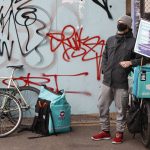
Luqman Onikosi and Owen Haisley live in different parts of the UK. They were born on opposite sides of the globe. But they are living very similar lives. Both men have active immigration cases and risk removal from the UK. Neither can work, study or legally rent in the meantime.
Luqman’s immigration case has been ongoing for nearly eight years. He is at risk of enforced removal from the UK and is fighting his case on human rights grounds.
Originally from Nigeria, he came to the UK to study at the University of Sussex in 2007. He arrived in Brighton with a student visa.

Two brothers died from the same illness
Halfway through university, Luqman was diagnosed with hepatitis B, a life-threatening liver condition requiring intensive medical support.
This essential healthcare needed to treat his condition is not available in Nigeria. In 2011 and 2012, both of his brothers died of the same condition back home.
When his three year student visa ran out, Luqman applied to remain in the UK on medical grounds. However, his appeal was rejected by the Home Office and he is still fighting his case today.
A life with no structure
Luqman lives in emergency council accommodation and by law, has to report to the Home Office every four weeks.
Previously an active member of his student community in Brighton, Luqman now struggles with the lack of structure in his life.
“I’m very self-critical. I’m always asking myself, ‘what have I done today?’”, he says.
“I measure my day on my level of productivity. If I can’t do anything or haven’t been able to do anything, I worry that I’m just being lazy. And I don’t want to be lazy.
“Physical health plays into it, as I have a physical health restraint. I’m mostly fatigued but sometimes I have energy. If I have nothing to do, it plays upon my anxiety. And there are times when I have something to do and I can’t do it because I’m fatigued.”
“It’s one day a week when you don’t have to worry”
One certainty in Luqman’s life is volunteering at a local cafe every Tuesday, which is run by migrants, for migrants. For Luqman, the social interaction he gets from the session is a vital part of the week.
“It’s a neutral space for us, a joyous and happy environment, where you don’t have to think about your immigration case. It’s one day when you don’t have to worry and can talk about something normal about your life.”
“People are socially isolated, particularly precarious migrants and refugees. Socialising in Britain is not very cheap. You have to have money to go to social spaces, to have a drink or even to get the bus. So having places like the Jollof Cafe allows everyone to come out and socialise.”
Enforced removal vs. deportation
Fighting to remain in the UK on human rights grounds puts Luqman at risk of enforced removal, whereas foreign nationals with criminal convictions can face a deportation order.
In 2018, almost 9,500 people were forcibly removed from the UK. On average, 27,000 people are detained by the Home Office every year.
Like Luqman, Owen Haisley is also fighting an immigration case. But there’s one crucial difference. Owen is at risk of deportation from the UK because he committed a crime. He spent sixteen months in prison following a conviction for domestic assault in 2015.

Originally from Jamaica, Owen moved to the UK when he was four years old. He is a father to three children who were all born here, but despite living in the UK for forty one years, Owen doesn’t have British citizenship. He is legally classed as a foreign national.
When Owen arrived in the UK, he received indefinite leave to remain and therefore did not see the need to apply for citizenship. He attended primary school in North London and moved to Manchester at the age of 18. He has not returned to Jamaica and no longer knows anyone who lives there.
Foreign nationals who serve a prison sentence of twelve months or longer receive an automatic deportation order.
Pulled off the plane with hours to go
The Home Office tried to deport Owen on a private charter flight to Jamaica on 6th February 2019. A huge public campaign for him to stay in the UK quickly gathered momentum and received over 100,000 signatures.
There was also intervention in his support from Labour MP for Manchester Central, Lucy Powell, and Mayor of Greater Manchester, Andy Burnham. Shortly before the flight to Jamaica was due to depart, Owen was pulled off the plane.
He is currently on immigration bail but still risks deportation to Jamaica. Many prominent figures are still campaigning for him to be able remain in the UK permanently.
I was pleased to hear on @BBCNews just now that another person due to be deported tomorrow will now not be. However, I’m still very concerned to hear about Owen Haisley’s fate. I urged ministers to review and a decision is imminent https://t.co/O25I13B0Mx
— Lucy Powell MP (@LucyMPowell) February 5, 2019
Owen Haisley – who came to Britain when he was aged 4, over forty years ago – has had his deportation to Jamaica temporarily halted, but that's not good enough. His deportation has to be stopped, full stop. https://t.co/Ems7tgohfU
— Owen Jones???? (@OwenJones84) February 6, 2019
“Where do I belong?”
Unable to rent with an active immigration case, Owen is relying on friends and family members. He is currently living with his cousin in Manchester.
“It makes me feel a bit worthless,” says Owen.
“When I sit and think about it it makes me feel like I’ve got no value, nothing going on in my life. I’ve always worked since I was seventeen years old, and been self-sufficient and now just to have it all just taken away from you… I feel a bit stateless. Where do I belong?”
“I feel ashamed I can’t work for my children”
Owen’s deportation case is putting a huge strain on his closest family.
Back in February, the Home Office told him he could bring his children up over Skype from Jamaica.
With the threat of deportation lingering over Owen each week he reports to the Home Office, his two youngest sons have become very anxious. Owen is concerned about the effect his case is having on them.
“I feel ashamed that I can’t go out and work for my children. I’m ashamed that I’ve got to go and ask family and friends to help me with money, to be able to go and see my children and do things with my children.
“Like any father out there I should be able to go and work, provide for my children and do what I want without the pressure of not being able to work.”
Owen expresses his deep regret for the crime that put him behind bars. However, he fears being sent back to Jamaica would be a “life sentence” and would be devastating for his children.
“What I’ve done was wrong and shouldn’t have happened. But it did happen and I’m not a re-offender. I went to prison, I served my time. I’ve done my rehabilitation.
“Like anybody, I made a mistake. But I’ve done my time for my mistake. I shouldn’t be punished twice. No one should.”
“It’s a perfect storm”
There is currently very little research into the long-term mental effects that ongoing immigration cases can have on a person’s mental health.
“People who come from traumatised backgrounds find that the detention process impacts every aspect of their lives. In essence, their lives are on hold. It’s a perfect storm really, removing all the aspects of life that make for a meaningful life,” says Dr Christina Curry, a psychotherapist with the Helen Bamber Foundation.
Luqman and Owen have two very different stories. But they do have one thing in common: they’re living in immigration limbo.
The Home Office declined to speak to City News when approached for comment.