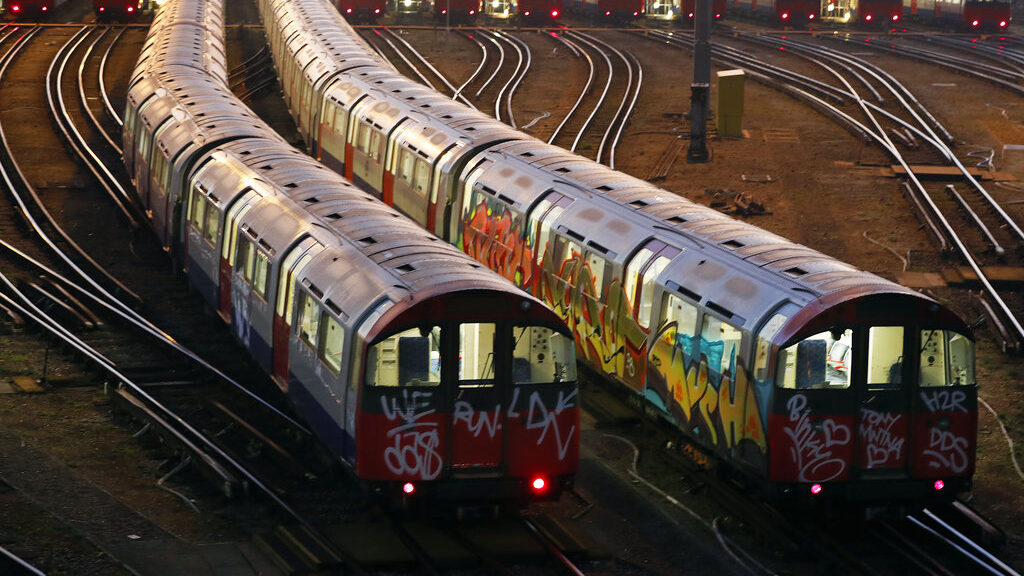
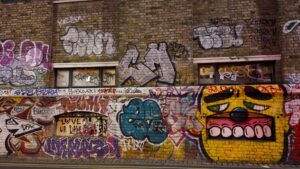
TfL have revealed they spend up to £11 million annually removing graffiti, but what do the artists behind it think?
I met up with a London based graffiti artist, ‘Liam’ to discuss his thoughts on the revelation. Walking around Shoreditch, known for its abundance of graffiti and street art, he showed me some of his favourite pieces and spoke about trains, culture, crime and community.
“If you get groped on the train BTP [British Transport Police] will send you a f*****g reference number and never follow it up, but do a little tag on the side of a window they’ll follow you home on cameras and come kick your door in.”
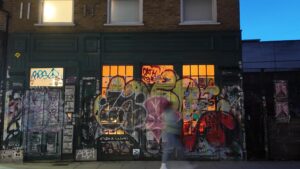
Shoreditch Graffiti, Artist Unknown. Credit: Eva Clark, City News
He was passionate about the way graffiti is treated as a crime, discussing the way artists will avoid persecution.
“A lot of people who paint trains won’t paint the same name they paint on streets on the train, they’ll do like a slightly different version of it so then their case files harder to prove its all one person”.
When I mentioned the street artist Banksy, he said, “it’s one rule for one person and another rule for the next.”
“When he painted the inside of that tube and got invited back, it was a bit of a slap in the face for the same people that you’re sending to prison for doing the exact same thing”.
He implied the question of whether crime is okay as long as your famous.
“It’s all in the game, you can’t have one without the other”
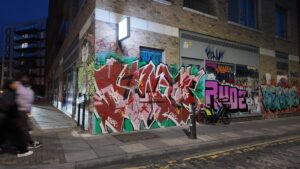
Shoreditch Graffiti, Artist Unknown, Credit: Eva Clark, CityNews
Following a freedom of information request, TFL have said they are removing “one tag on average every three minutes”. The tagging of the inside of trains is the more expensive part of the problem.
Liam speaks about larger pieces on the outside of trains which he says “takes them ten minutes to put solvent on it and wash it off with sprayers”.
He explains that tags are a key element of the art form, just as important as the large colour pieces you will see on the outside of trains, “its all in the game, you can’t have one without the other”.
Pointing out a piece of graffiti tagged ‘TenFoot’ he tells me about an artist he admires: “the sheer amount of repetition he does, you can’t fault him for the fact that his work rate is ridiculous, like you can’t turn down two streets in London without seeing a TenFoot tag”.
Why are trains a ‘prime spot’?
“If it runs for a whole day you’ve basically got a running canvas that millions of people will see”
In the UK, graffiti is classed under the Criminal Damage Act 1971 with offences mostly resulting in a fixed penalty notice of £500, but repeated cases and damage of buildings and transport can lead to extensive prison sentences.
I asked Liam if the fact it’s illegal is what makes it authentic. “There’s a lot to be said about the illegality of graffiti because there’s different levels to it, there’s how detailed your piece is and what colours and how good your style is, but then there’s also something to be said about where you paint”.
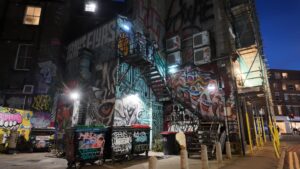
Shoreditch Graffiti, Artist Unknown, Credit: Eva Clark, CityNews
He referenced trains as a prime spot, “because the harder the spot is to get to, the more impressive that you did it, that’s why there’s a big allure around people doing trains, cause trains are inherently harder to get to. Also, if your train runs, you paint an underground train, it can get seen by a couple million people a day, so if it runs for a whole day you’ve basically got a running canvas that millions of people will see”.
Liam speaks profoundly about train carriages, as we continue round Shoreditch and looking at its murals he explains that “I don’t like painting in this area because its so easy to paint it looses its edge, part of it is getting away with it really, and there’s a skill to doing that.”
Shoreditch Graffiti, Artist Unknown, Credit: Eva Clark, CityNews
‘It’s the risk of the game’
But the dangers of graffiti are not just in policing, “every time you get on tracks you’re standing between a rail that will zap you if you touch it and kill you if you fall on it,” Liam says, “I’ve known multiple people who’ve died from doing graff”. I asked him if that puts him off, “It’s the risk of the game” he tells me.
In 2018 three graffiti artists were killed by an oncoming train at Loughborough Junction station, in South London, similar instances have happened since, but Liam emphasises how trains are prime spots, holding elite status within the community, meaning many still take the risk.
“I’ve seen my city in ways other people will never see”
Liam says that his hobby has changed his relationship to London and the way he looks at it “it’s also something that’s allowed me to see places of London that you’d never see as a normal person, I’ve been under tunnels in London that the average person will never see”.
He says one of the key factors of the art is writers “proving they can infiltrate places others can’t”. He’s proud and continues, “I’ve seen my city in ways other people will never see”.
Community
The community of graffiti writers seems to be as anonymous within as it is on the outside. Liam said “you often don’t meet other writers, you do here and there, but its not enough to be the sole reason why you paint, like I think everyone who paints has their own individual reason”.
The one thing tying them together seems to be the crimes involved, he points out an art shop as we’re walking round Shoreditch where the spray paint lives behind the till, he says they moved them there “because all the painters kept nicking them”.
Shoreditch Graffiti, Artist Unknown, Credit: Eva Clark, CityNews
What do TfL say?
TfL commissioner, Andy Lord, told the London Assembly budget and performance Committee that “We’re working very closely with the British Transport Police and our own investigation teams to identify and prevent particularly the hotspot locations where people are gaining access to the trains.” as well as photographing tags before they’re cleaned off, to carry out persecutions.
TfL’s statement in regard to tackling sexual harassment on their website reads.
“Keeping our customers and staff safe and secure is our priority. We work with the Rail Delivery Group (RDG), British Transport Police (BTP), Metropolitan Police Service (MPS), and various partners to keep our network safe.”
“We oppose all forms of sexual offences, sexual harassment and hate crime on London public transport”
Submitted Article
Headline
Short Headline
Standfirst
Published Article
Headline‘TfL punishes graffiti more than gropers’, claims artist
Short Headline'TfL punishes graffiti more than gropers', claims artist
StandfirstCity News speaks to 'Liam' about his love of tagging tube trains - a hobby that costs Londoners £11 million a year to clean up
TfL have revealed they spend up to £11 million annually removing graffiti, but what do the artists behind it think?
I met up with a London based graffiti artist, ‘Liam’ to discuss his thoughts on the revelation. Walking around Shoreditch, known for its abundance of graffiti and street art, he showed me some of his favourite pieces and spoke about trains, culture, crime and community.
“If you get groped on the train BTP [British Transport Police] will send you a f*****g reference number and never follow it up, but do a little tag on the side of a window they’ll follow you home on cameras and come kick your door in.”
Shoreditch Graffiti, Artist Unknown. Credit: Eva Clark, City News
He was passionate about the way graffiti is treated as a crime, discussing the way artists will avoid persecution.
“A lot of people who paint trains won’t paint the same name they paint on streets on the train, they’ll do like a slightly different version of it so then their case files harder to prove its all one person”.
When I mentioned the street artist Banksy, he said, “it’s one rule for one person and another rule for the next.”
“When he painted the inside of that tube and got invited back, it was a bit of a slap in the face for the same people that you’re sending to prison for doing the exact same thing”.
He implied the question of whether crime is okay as long as your famous.
“It’s all in the game, you can’t have one without the other”
Shoreditch Graffiti, Artist Unknown, Credit: Eva Clark, CityNews
Following a freedom of information request, TFL have said they are removing “one tag on average every three minutes”. The tagging of the inside of trains is the more expensive part of the problem.
Liam speaks about larger pieces on the outside of trains which he says “takes them ten minutes to put solvent on it and wash it off with sprayers”.
He explains that tags are a key element of the art form, just as important as the large colour pieces you will see on the outside of trains, “its all in the game, you can’t have one without the other”.
Pointing out a piece of graffiti tagged ‘TenFoot’ he tells me about an artist he admires: “the sheer amount of repetition he does, you can’t fault him for the fact that his work rate is ridiculous, like you can’t turn down two streets in London without seeing a TenFoot tag”.
Why are trains a ‘prime spot’?
“If it runs for a whole day you’ve basically got a running canvas that millions of people will see”
In the UK, graffiti is classed under the Criminal Damage Act 1971 with offences mostly resulting in a fixed penalty notice of £500, but repeated cases and damage of buildings and transport can lead to extensive prison sentences.
I asked Liam if the fact it’s illegal is what makes it authentic. “There’s a lot to be said about the illegality of graffiti because there’s different levels to it, there’s how detailed your piece is and what colours and how good your style is, but then there’s also something to be said about where you paint”.
Shoreditch Graffiti, Artist Unknown, Credit: Eva Clark, CityNews
He referenced trains as a prime spot, “because the harder the spot is to get to, the more impressive that you did it, that’s why there’s a big allure around people doing trains, cause trains are inherently harder to get to. Also, if your train runs, you paint an underground train, it can get seen by a couple million people a day, so if it runs for a whole day you’ve basically got a running canvas that millions of people will see”.
Liam speaks profoundly about train carriages, as we continue round Shoreditch and looking at its murals he explains that “I don’t like painting in this area because its so easy to paint it looses its edge, part of it is getting away with it really, and there’s a skill to doing that.”
Shoreditch Graffiti, Artist Unknown, Credit: Eva Clark, CityNews
‘It’s the risk of the game’
But the dangers of graffiti are not just in policing, “every time you get on tracks you’re standing between a rail that will zap you if you touch it and kill you if you fall on it,” Liam says, “I’ve known multiple people who’ve died from doing graff”. I asked him if that puts him off, “It’s the risk of the game” he tells me.
In 2018 three graffiti artists were killed by an oncoming train at Loughborough Junction station, in South London, similar instances have happened since, but Liam emphasises how trains are prime spots, holding elite status within the community, meaning many still take the risk.
“I’ve seen my city in ways other people will never see”
Liam says that his hobby has changed his relationship to London and the way he looks at it “it’s also something that’s allowed me to see places of London that you’d never see as a normal person, I’ve been under tunnels in London that the average person will never see”.
He says one of the key factors of the art is writers “proving they can infiltrate places others can’t”. He’s proud and continues, “I’ve seen my city in ways other people will never see”.
Community
The community of graffiti writers seems to be as anonymous within as it is on the outside. Liam said “you often don’t meet other writers, you do here and there, but its not enough to be the sole reason why you paint, like I think everyone who paints has their own individual reason”.
The one thing tying them together seems to be the crimes involved, he points out an art shop as we’re walking round Shoreditch where the spray paint lives behind the till, he says they moved them there “because all the painters kept nicking them”.
Shoreditch Graffiti, Artist Unknown, Credit: Eva Clark, CityNews
What do TfL say?
TfL commissioner, Andy Lord, told the London Assembly budget and performance Committee that “We’re working very closely with the British Transport Police and our own investigation teams to identify and prevent particularly the hotspot locations where people are gaining access to the trains.” as well as photographing tags before they’re cleaned off, to carry out persecutions.
TfL’s statement in regard to tackling sexual harassment on their website reads.
“Keeping our customers and staff safe and secure is our priority. We work with the Rail Delivery Group (RDG), British Transport Police (BTP), Metropolitan Police Service (MPS), and various partners to keep our network safe.”
“We oppose all forms of sexual offences, sexual harassment and hate crime on London public transport”
To mark the launch of HBO Max, iconic movie sets land in London for a two-day immersive experience, letting visitors wander through worlds from Friends, Harry Potter, The White Lotus and Superman.
In a rare, candid interview, Blake Fielder-Civil opens up about the relationship that gripped a generation - and why he refuses to carry the guilt alone.
While awards season usually draws celebrities to Los Angeles, several A-listers have instead been spotted working on film and TV sets across the capital.