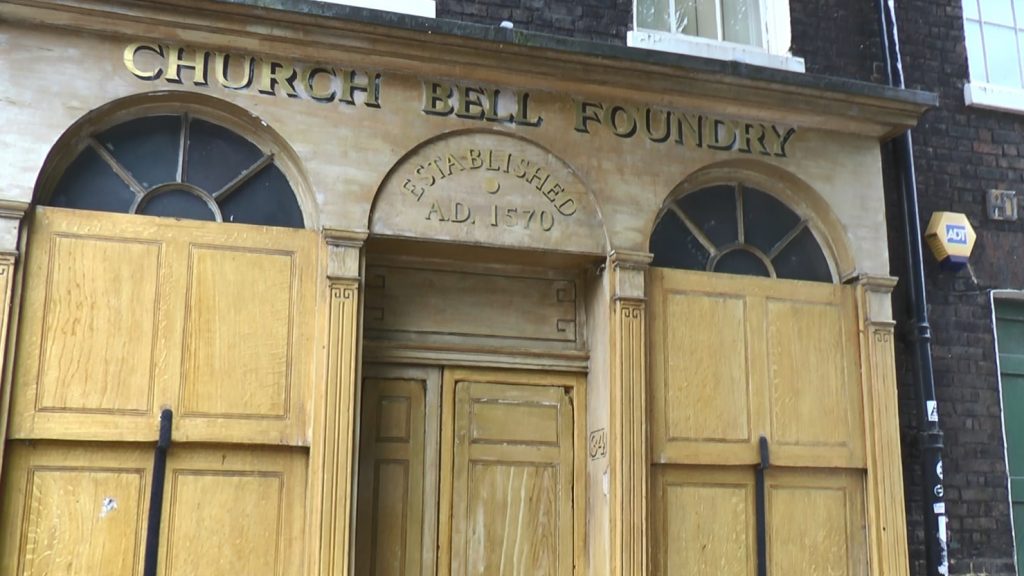
The 450-year-old Whitechapel Bell Foundry will be closed down and converted into a bell-themed boutique hotel by its new owners.
Campaigners maintain there is still hope to save it.
A petition to save the foundry has gained nearly 30,000 signatures.
Whitechapel Bell Foundry is thought to be the oldest manufacturing business in the UK.
It produced Big Ben, the Liberty Bell, bells in Westminster Abbey and St. Pauls, and the Olympic Bell, now housed in Queen Elizabeth Park.
Bells vs boutiques : a history

The debate started in October 2016 when the owner, Alan Hughes, sold the foundry to property developer Vincent Goldstein for 5.1m pounds, as the business was steeped in debt.
Stephen Clarke, chair of charity Re-form, offered to buy out the foundry, writing an open letter to the Times which sparked national support.
Re-form specialise in the restoration and rejuvenation of heritage buildings at risk of decay or demolition.
Clarke founded Project Phoenix, a plan to keep the bell foundry open to make tower bells and artists commissions.
After the plan was submitted to Tower Hamlets council, the council chair cast the deciding vote in favour of Raycliff, the developers.
But, in December 2019, Robert Jenrick and the Ministry of Housing, Communities and Local Government sent a letter to Tower Hamlets council suspending planning approval until a public inquiry had taken place.
After a ten day inquiry took place in October 2020, the government approved plans from Raycliff to turn the foundry into a boutique hotel in May 2021.
Raycliff’s response
The developers in question, Raycliff Capital, declined to comment.
They have previously said they intend to preserve the spirit of the Foundry by introducing a small bell foundry to cast small hand bells embellished with Whitechapel Bell Foundry logo.
They also said they’ll maintain spaces for creatives to work in.
A historian’s perspective
Art and architechtural historian, Charles Saumaurez Smith told City News, “Historic England, to my eternal regret, has decided to support the developer and not support alternative use, preserving and protecting its use.
So they then effectively got in bed with the developer, and they’ve been in support of the developer ever since”.
“I think there is a body of opinion, not merely public opinion and local and community opinion, but political opinion, that everything should be done to try and preserve it. I’ve not completely lost hope. But it depends very much on Robert Jenrick as Secretary of State to find a way around the current situation”.
Yes, the system is heavily weighted in favour of developers who have the money and the expertise and now a seat on the board of Historic England. They can fight a long fight because the pickings are so great at the end. https://t.co/f6K3BlYkUu
— Charles Saumarez Smith (@CSaumarezSmith) May 26, 2021
How will this impact bell-ringing?
London 12-bell Chairman, Steven Mitchell, said ‘It’s a very sad loss. There’s a lot of historic bells around London that were cast at the Whitechapel Bell Foundry.
There’s fundamentally a problem with demand”.
He said when the foundry was opened, “bells were a part of the soundscape,” but demand for bells for new installations has decreased.
Mitchell told City News that support for the history and culture of ringing, and all those who keep it going, will be decimated by the decision.