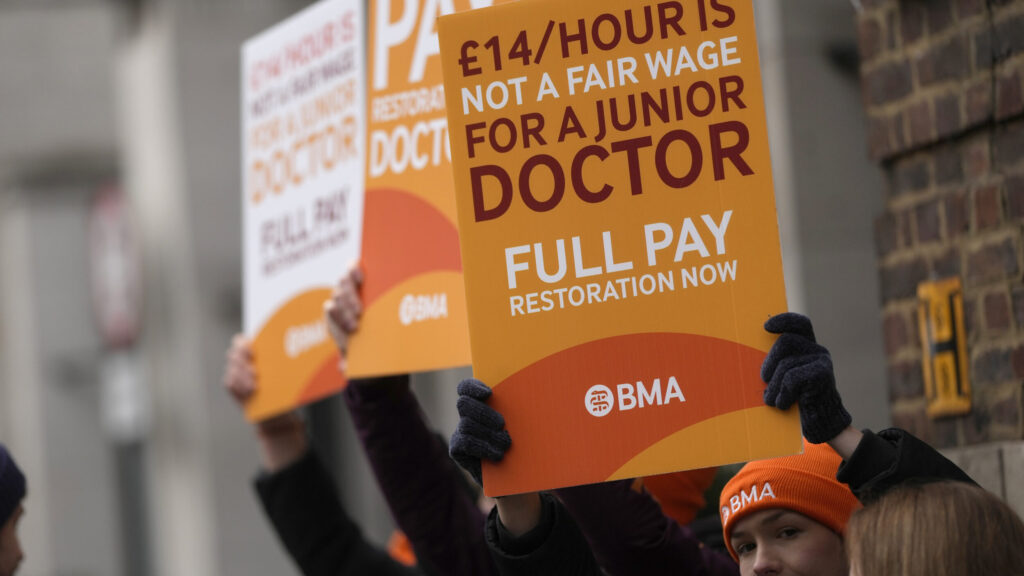
The strikes will take place for 72 hours, from 14 June - 17 June.
SHARE:
Junior doctors will strike for 72 hours, from 14 June – 17 June, after the government’s latest pay offer was rejected.
The British Medical Association (BMA) said the Government’s latest offer of a 5% pay rise for its members was “in no way credible or reasonable”.
In a statement, BMA Junior Doctors Committee co-chairs Dr Vivek Trevedi and Dr Robert Laurenson said they had entered negotiations with the government in April, “seeking a deal that fully restores pay for junior doctors after the 26% drop they have suffered in the last 15 years”.
Such a deal might “stop the haemorrhaging of junior doctors from the NHS”.
But they now say the current offer is “nowhere near addressing pay erosion”, as it “would not even have matched inflation this year.”
The resulting strike will commence at 7am on Wednesday 14 June and last until 7am on Saturday 17. The BMA say that unless the Government changes its position, strikes will continue “throughout the summer”.
‘Surprising and deeply disappointing’
In response, a Government spokesperson described the strike action as “surprising and deeply disappointing”, saying its 5% offer was “fair and reasonable”.
The Government says it will only re-enter negotiations if the strikes are called off.
NHS Providers, a membership organisation for NHS services, said the breakdown in negotiations was “hugely disappointing”. Deputy Chief Executive Saffron Cordery said the strike would “lead to major disruption to patient care”.
Ms. Cordery also pointed to the possible dangers of cumulative strike action, with nurses, radiographers and consultants all currently balloting for strike action.
However, she promised that Trust leaders will “work flat out to ensure disruption is minimised”.
Submitted Article
Headline
Short Headline
Standfirst
Published Article
HeadlineJunior doctors in England to strike for three days in June
Short HeadlineJunior doctors union announces strike for June
StandfirstThe BMA announced the walkout after pay negotiations with ministers broke down
Junior doctors will strike for 72 hours, from 14 June – 17 June, after the government’s latest pay offer was rejected.
The British Medical Association (BMA) said the Government’s latest offer of a 5% pay rise for its members was “in no way credible or reasonable”.
In a statement, BMA Junior Doctors Committee co-chairs Dr Vivek Trevedi and Dr Robert Laurenson said they had entered negotiations with the government in April, “seeking a deal that fully restores pay for junior doctors after the 26% drop they have suffered in the last 15 years”.
Such a deal might “stop the haemorrhaging of junior doctors from the NHS”.
But they now say the current offer is “nowhere near addressing pay erosion”, as it “would not even have matched inflation this year.”
The resulting strike will commence at 7am on Wednesday 14 June and last until 7am on Saturday 17. The BMA say that unless the Government changes its position, strikes will continue “throughout the summer”.
‘Surprising and deeply disappointing’
In response, a Government spokesperson described the strike action as “surprising and deeply disappointing”, saying its 5% offer was “fair and reasonable”.
The Government says it will only re-enter negotiations if the strikes are called off.
NHS Providers, a membership organisation for NHS services, said the breakdown in negotiations was “hugely disappointing”. Deputy Chief Executive Saffron Cordery said the strike would “lead to major disruption to patient care”.
Ms. Cordery also pointed to the possible dangers of cumulative strike action, with nurses, radiographers and consultants all currently balloting for strike action.
However, she promised that Trust leaders will “work flat out to ensure disruption is minimised”.
A 2024 Freedom of Information request showed Bromley Council had £4.5 million invested in arms companies that year with £1.5 million reportedly linked to Israel.
Undercover officers raided three linked shops in Barking town centre, revealing how illicit tobacco is being hidden in walls, ceilings and nearby locations to evade detection.
More than 330,000 people across the UK sought support from the Stop It Now helpline in 2025 over concerns about their own or someone else’s online sexual behaviour towards children, according to new charity data. The anonymous service says contacts by phone, email and webchat rose significantly over the year.