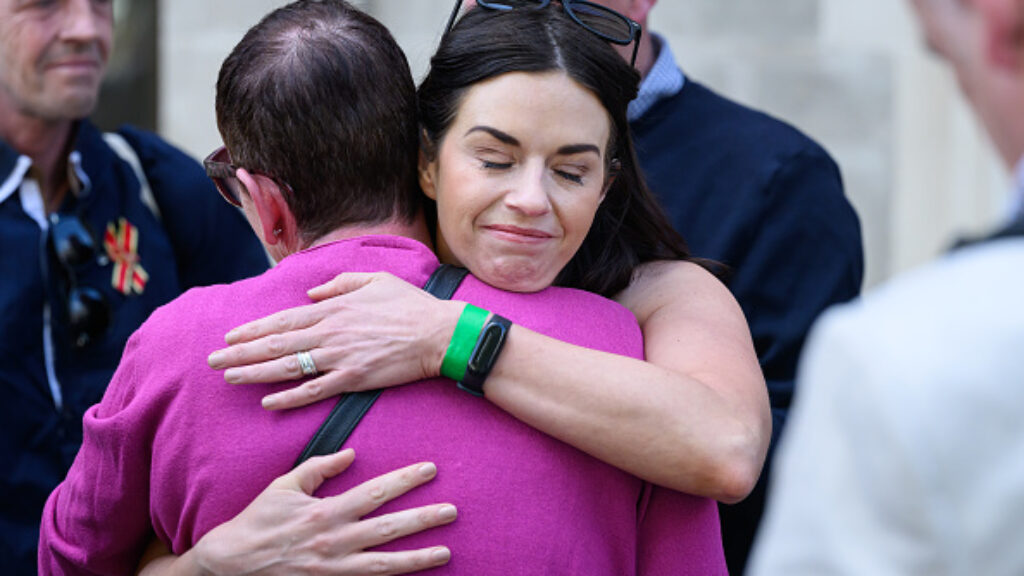
Victims of the scandal from the Conwell family embrace.
SHARE:
The payments for the first victims of the infected blood scandal will start before the end of the year, Cabinet Office minister John Glen has said.
Cabinet Office minister John Glen has announced the scheme the Government is proposing under the Infected Blood Compensation Authority, and said that “all will receive compensation”.
People that will be able to claim compensation under the scheme include people who were “directly or indirectly infected by NHS blood, blood products or tissue contaminated with HIV or hepatitis C, or have developed a chronic infection from blood contaminated with hepatitis B”.
If a person has died, but would have been eligible under these criteria, compensation “will be paid to their estate”. This will include people that were infected with hepatitis B and died during the acute period of infection.
‘Affected loved ones’ will also be able to receive compensation. This includes parents, siblings, partners, children, friends, and those who acted as carers.
The compensation for those living infected or affected people will be offered a single or periodical payments.
Cabinet Office minister John Glen said that the Government will “ensure that all claimants are able to appeal their award, both through an internal review process in the Infected Blood Compensation Authority or an appeal at first tier tribunal.”
The UK Government will be making further interim payments ahead of the establishment of the full scheme. John Glen MP said that “payments of 210,000 pounds will be made to living infected beneficiaries, those registered with existing infected blood support schemes, as well as those who register with a support scheme before the final scheme becomes operational, and the estates of those who pass away between now and payments being made.”
Infected blood inquiry findings
An inquiry published yesterday concluded that thousands of patients were knowingly exposed to Hepatitis C and HIV through blood products and transfusions.
This took place over decades and has led to around 2,900 deaths so far, including children. The inquiry described the scandal as “the worst treatment disaster in NHS history.”
Prime Minister Rishi Sunak delivered an apology in Parliament as families and victims watched on. It is the first time any government has apologised for the scandal. Sir Keir Starmer and other party leaders also issued apologies.
‘We will pay it’
The prime minister insisted that “whatever the cost, we will pay it.” But as for the timeline and amount of compensation, the victims will have to wait for today’s announcement. Ministers have earmarked the figure of £10bn.
Sir Brian Langstaff, who led the inquiry, has criticised the government for not starting the compensation process sooner. His two interim reports in July 2022 and April 2023 recommended compensation options for victims and their families.
The government has already made payments of £100,000 each to about 4,000 survivors and bereaved partners.
‘This was not an accident’
Delivering his findings, Sir Brian told crowds that the infected blood scandal “was not an accident.” He insisted that doctors and medical professionals were aware of the risks to patients.
In the 1970s and 1980s, thousands of patients were infected with HIV and Hepatitis C. At the time, it was understood that there was a risk of transmitting Hepatitis B. But the benefits were thought to outweigh the risks.
What medical professionals were slow to act on, the inquiry found, was the severe risks of HIV and Hepatitis C. Both diseases emerged in the mid-1970s. When the risks became clear, doctors continued to administer contaminated blood.
An average of one victim continues to die every four days.
Submitted Article
Headline
Short Headline
Standfirst
Published Article
HeadlineInfected blood scandal: first victims will be compensated by the end of 2024
Short HeadlineInfected blood scandal victims will be compensated by end of 2024
StandfirstPeople who were "directly or indirectly infected by NHS blood will be compensated, including 'loved ones'
The payments for the first victims of the infected blood scandal will start before the end of the year, Cabinet Office minister John Glen has said.
Cabinet Office minister John Glen has announced the scheme the Government is proposing under the Infected Blood Compensation Authority, and said that “all will receive compensation”.
People that will be able to claim compensation under the scheme include people who were “directly or indirectly infected by NHS blood, blood products or tissue contaminated with HIV or hepatitis C, or have developed a chronic infection from blood contaminated with hepatitis B”.
If a person has died, but would have been eligible under these criteria, compensation “will be paid to their estate”. This will include people that were infected with hepatitis B and died during the acute period of infection.
‘Affected loved ones’ will also be able to receive compensation. This includes parents, siblings, partners, children, friends, and those who acted as carers.
The compensation for those living infected or affected people will be offered a single or periodical payments.
Cabinet Office minister John Glen said that the Government will “ensure that all claimants are able to appeal their award, both through an internal review process in the Infected Blood Compensation Authority or an appeal at first tier tribunal.”
The UK Government will be making further interim payments ahead of the establishment of the full scheme. John Glen MP said that “payments of 210,000 pounds will be made to living infected beneficiaries, those registered with existing infected blood support schemes, as well as those who register with a support scheme before the final scheme becomes operational, and the estates of those who pass away between now and payments being made.”
Infected blood inquiry findings
An inquiry published yesterday concluded that thousands of patients were knowingly exposed to Hepatitis C and HIV through blood products and transfusions.
This took place over decades and has led to around 2,900 deaths so far, including children. The inquiry described the scandal as “the worst treatment disaster in NHS history.”
Prime Minister Rishi Sunak delivered an apology in Parliament as families and victims watched on. It is the first time any government has apologised for the scandal. Sir Keir Starmer and other party leaders also issued apologies.
‘We will pay it’
The prime minister insisted that “whatever the cost, we will pay it.” But as for the timeline and amount of compensation, the victims will have to wait for today’s announcement. Ministers have earmarked the figure of £10bn.
Sir Brian Langstaff, who led the inquiry, has criticised the government for not starting the compensation process sooner. His two interim reports in July 2022 and April 2023 recommended compensation options for victims and their families.
The government has already made payments of £100,000 each to about 4,000 survivors and bereaved partners.
‘This was not an accident’
Delivering his findings, Sir Brian told crowds that the infected blood scandal “was not an accident.” He insisted that doctors and medical professionals were aware of the risks to patients.
In the 1970s and 1980s, thousands of patients were infected with HIV and Hepatitis C. At the time, it was understood that there was a risk of transmitting Hepatitis B. But the benefits were thought to outweigh the risks.
What medical professionals were slow to act on, the inquiry found, was the severe risks of HIV and Hepatitis C. Both diseases emerged in the mid-1970s. When the risks became clear, doctors continued to administer contaminated blood.
An average of one victim continues to die every four days.
A 2024 Freedom of Information request showed Bromley Council had £4.5 million invested in arms companies that year with £1.5 million reportedly linked to Israel.
Undercover officers raided three linked shops in Barking town centre, revealing how illicit tobacco is being hidden in walls, ceilings and nearby locations to evade detection.
More than 330,000 people across the UK sought support from the Stop It Now helpline in 2025 over concerns about their own or someone else’s online sexual behaviour towards children, according to new charity data. The anonymous service says contacts by phone, email and webchat rose significantly over the year.