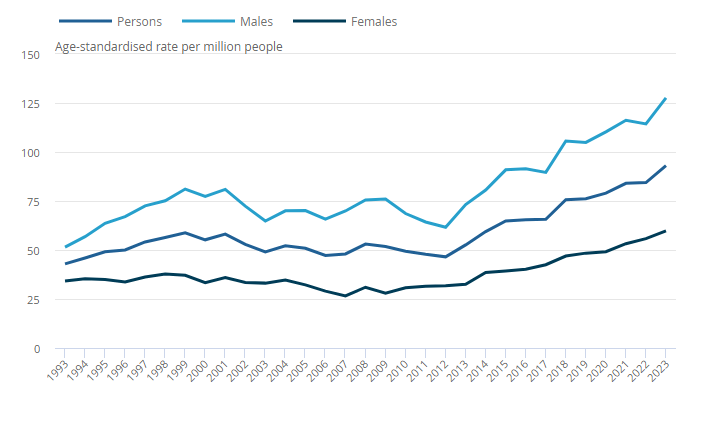
Drug-related deaths have more than doubled since 2012, according to new official stats.
The data from the Office for National Statistics also shows a marked increase from 84.4 per million in 2022 to 93 million in 2023.
Alex Piot, an expert in evidence-based drug policy, told City News this marks a “public health crisis” that is being overlooked.
Age-standardised mortality rates for deaths related to drug poisoning, by sex in England and Wales, registered between 1993 and 2023
Mortality rates for drug poisoning increased for males and females in 2023 (Office for National Statistics)
Hackney Green councillor Zoë Garbett is leading the criticism of past and present drug policy failures.
She calls for harm reduction measures to be introduced at a local level to tackle what she described as 20 unnecessary drug-induced fatalities in the borough.
However, the 1971 Misuse of Drugs Act limits many of these alternatives from being implemented.
The government’s pledge to provide an extra 13,000 police officers into neighbourhoods suggests a focus on helping local areas deal with drug-related crime.
“For too long the Conservatives have sat back and allowed criminal gangs to grow – dealing drugs on the streets, in town centres and even outside schools”
Yvette Cooper, Home Secretary
But Alex Piot’s research for independent charities Drug Science and the Centre for Evidence Based Drug Policy calls for funding to be “shifted away from the police and the criminal justice system and re-invested into drug treatment services”.
He claims that “evidence shows that policies rooted in the normative moral belief that drugs are bad, and people shouldn’t use them are ineffective”.
British politician serving as Home Secretary Yvette Cooper delivers a speech. (AP Photo/Jon Super)
Calling into question the global ‘war on drugs’
Colombia and Mexico have adopted an approach to drug policies that centre on human rights.
These two Latin American countries are perhaps the most well-versed in the fatal effects of what is now a transnational drug industry – one which has only gained dominance and prevalence despite the billions of dollars spent trying to demolish it.
Although the regional contexts are different, campaigners are calling for a similar policy transformation in the UK.
What can be done to reduce the harm of using drugs?
Harm reduction provides options for users to do drugs safely, rather than punishing misuse.
This can include measures such as substitution treatments such as Methadone and Buprenorphine, needle and syringe exchanges, Overdose-Prevention Centres (OPCs) and drug checking services.
“OPCs help help to address the people who use drugs who are the most vulnerable and facing the most intersectional challenges”
Alex Piot, neuroscientist and harm-reduction policy researcher
Harm reduction ‘can keep streets safe’
Mr Piot told City News that there can be positive outcomes of harm-reduction. These include less drug related litter, fewer ambulance callouts, less drug related crime, and less stigma surrounding drug use.
Campaigners, like Hackney councillor Zoe Garbett, think this presents an opportunity to heal communities in London that she says have been “ravaged” by the “epidemic” of drug-related deaths.
With around £20 billion of public money being spent each year dealing with the cost of illegal drugs on the streets, Piot’s suggests that harm-reduction measures would help the government financially too.
“86% [of spending on drug misuse] is attributable to approximately 300,000 heroin and crack users – proper interventions to limit harm of drugs could result in massive, massive savings”
Alex Piot
The Home Affairs Select Committee has made multiple recommendations that mirror the work of charities such as Transform and Drug Science.
It laid out the need for harm-reduction options, such as “the piloting of safe consumption facilities in areas across the UK where there is deemed to be a need”.
Glasgow will become the first area of the UK to trial an overdose prevention facility, which aims to open its doors by the end of the year.
Harm-prevention measures ‘could condone drug abuse’
However, harm-reduction measures are not without its critics.
The then Combating Drugs Minister Chris Philp had questioned whether such policies might lead to “counterproductive” outcomes.
“Illicit drugs are harmful and there is no safe way to take them. For this reason we have concerns about any services that could give users a false impression that their illicit drugs may be safe or which condone drug use, which would be counterproductive to our aim of reducing illicit drug use”
Chris Philp, now Shadow Home Secretary
During its 13 years in power, the Conservative government believed that money would be better spent on treating drug addiction, rather than “facilitating” consumption.
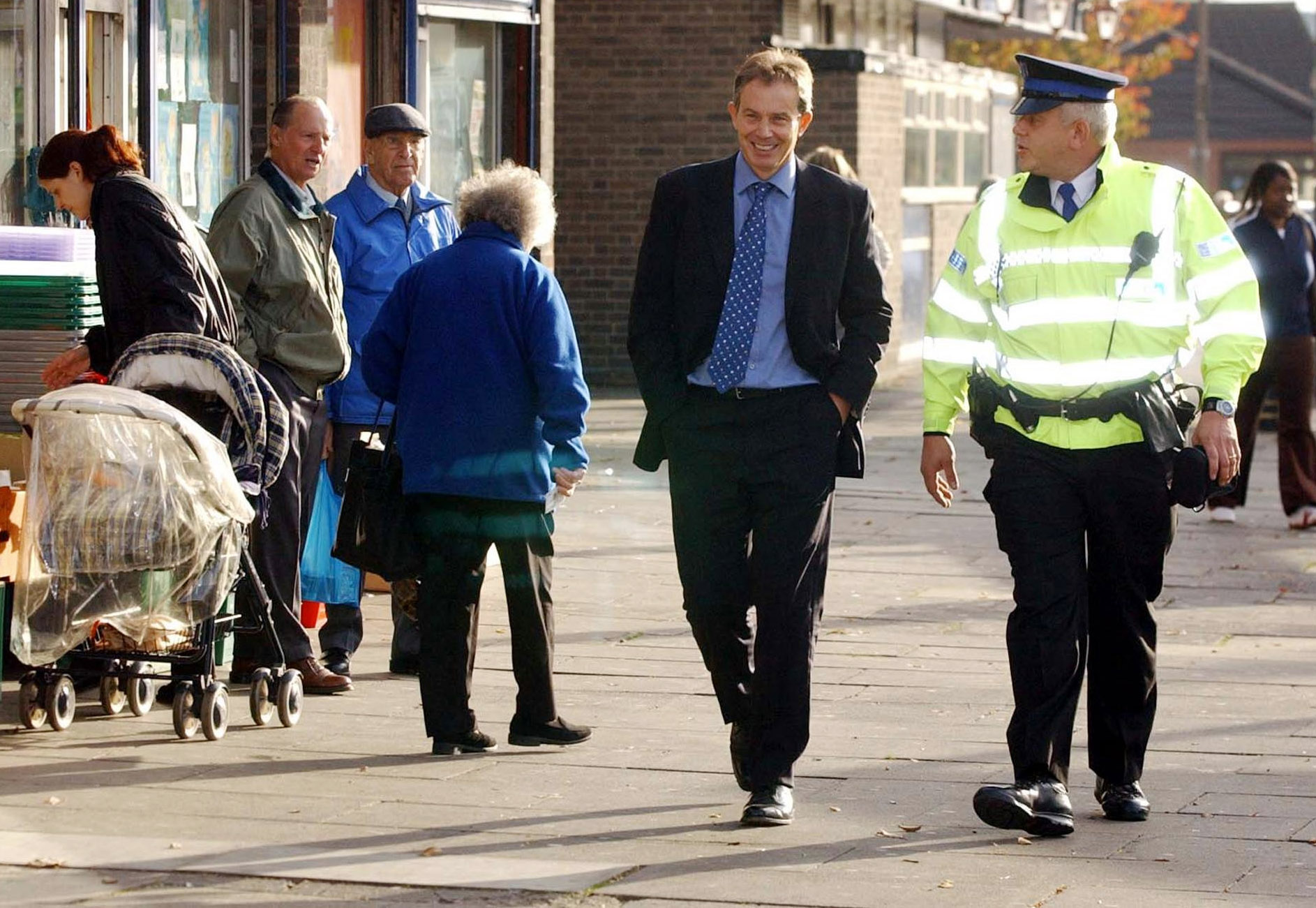
Britain’s former Prime Minister Tony Blair walks with Police Community Support Officer. (AP Photo/Rui Vieira/Pool)
This seems to be an approach Keir Starmer continues to follow, though campaigners point to the slogan of one of his predecessors as Prime Minister, Tony Blair, who vowed not only be “tough on crime” but “tough on the causes of crime”.
Submitted Article
Headline
Short Headline
Standfirst
Published Article
HeadlineAre we on the brink of a ‘public health crisis’ over drug misuse?
Short HeadlineAre we on the brink of a 'public health crisis' over drug misuse?
StandfirstCampaigners are calling for harm-prevention measures to be urgently introduced into London boroughs following the record number of drug-related deaths
Drug-related deaths have more than doubled since 2012, according to new official stats.
The data from the Office for National Statistics also shows a marked increase from 84.4 per million in 2022 to 93 million in 2023.
Alex Piot, an expert in evidence-based drug policy, told City News this marks a “public health crisis” that is being overlooked.
Age-standardised mortality rates for deaths related to drug poisoning, by sex in England and Wales, registered between 1993 and 2023
Mortality rates for drug poisoning increased for males and females in 2023 (Office for National Statistics)
Hackney Green councillor Zoë Garbett is leading the criticism of past and present drug policy failures.
She calls for harm reduction measures to be introduced at a local level to tackle what she described as 20 unnecessary drug-induced fatalities in the borough.
However, the 1971 Misuse of Drugs Act limits many of these alternatives from being implemented.
The government’s pledge to provide an extra 13,000 police officers into neighbourhoods suggests a focus on helping local areas deal with drug-related crime.
“For too long the Conservatives have sat back and allowed criminal gangs to grow – dealing drugs on the streets, in town centres and even outside schools”
Yvette Cooper, Home Secretary
But Alex Piot’s research for independent charities Drug Science and the Centre for Evidence Based Drug Policy calls for funding to be “shifted away from the police and the criminal justice system and re-invested into drug treatment services”.
He claims that “evidence shows that policies rooted in the normative moral belief that drugs are bad, and people shouldn’t use them are ineffective”.
British politician serving as Home Secretary Yvette Cooper delivers a speech. (AP Photo/Jon Super)
Calling into question the global ‘war on drugs’
Colombia and Mexico have adopted an approach to drug policies that centre on human rights.
These two Latin American countries are perhaps the most well-versed in the fatal effects of what is now a transnational drug industry – one which has only gained dominance and prevalence despite the billions of dollars spent trying to demolish it.
Although the regional contexts are different, campaigners are calling for a similar policy transformation in the UK.
What can be done to reduce the harm of using drugs?
Harm reduction provides options for users to do drugs safely, rather than punishing misuse.
This can include measures such as substitution treatments such as Methadone and Buprenorphine, needle and syringe exchanges, Overdose-Prevention Centres (OPCs) and drug checking services.
“OPCs help help to address the people who use drugs who are the most vulnerable and facing the most intersectional challenges”
Alex Piot, neuroscientist and harm-reduction policy researcher
Harm reduction ‘can keep streets safe’
Mr Piot told City News that there can be positive outcomes of harm-reduction. These include less drug related litter, fewer ambulance callouts, less drug related crime, and less stigma surrounding drug use.
Campaigners, like Hackney councillor Zoe Garbett, think this presents an opportunity to heal communities in London that she says have been “ravaged” by the “epidemic” of drug-related deaths.
With around £20 billion of public money being spent each year dealing with the cost of illegal drugs on the streets, Piot’s suggests that harm-reduction measures would help the government financially too.
“86% [of spending on drug misuse] is attributable to approximately 300,000 heroin and crack users – proper interventions to limit harm of drugs could result in massive, massive savings”
Alex Piot
The Home Affairs Select Committee has made multiple recommendations that mirror the work of charities such as Transform and Drug Science.
It laid out the need for harm-reduction options, such as “the piloting of safe consumption facilities in areas across the UK where there is deemed to be a need”.
Glasgow will become the first area of the UK to trial an overdose prevention facility, which aims to open its doors by the end of the year.
Harm-prevention measures ‘could condone drug abuse’
However, harm-reduction measures are not without its critics.
The then Combating Drugs Minister Chris Philp had questioned whether such policies might lead to “counterproductive” outcomes.
“Illicit drugs are harmful and there is no safe way to take them. For this reason we have concerns about any services that could give users a false impression that their illicit drugs may be safe or which condone drug use, which would be counterproductive to our aim of reducing illicit drug use”
Chris Philp, now Shadow Home Secretary
During its 13 years in power, the Conservative government believed that money would be better spent on treating drug addiction, rather than “facilitating” consumption.
Britain’s former Prime Minister Tony Blair walks with Police Community Support Officer. (AP Photo/Rui Vieira/Pool)
This seems to be an approach Keir Starmer continues to follow, though campaigners point to the slogan of one of his predecessors as Prime Minister, Tony Blair, who vowed not only be “tough on crime” but “tough on the causes of crime”.
As the weather turns, City News has spoken to a long-term rough sleeper to see how those on the street feel about Andy Burnham’s plan to end homelessness and the upcoming winter.