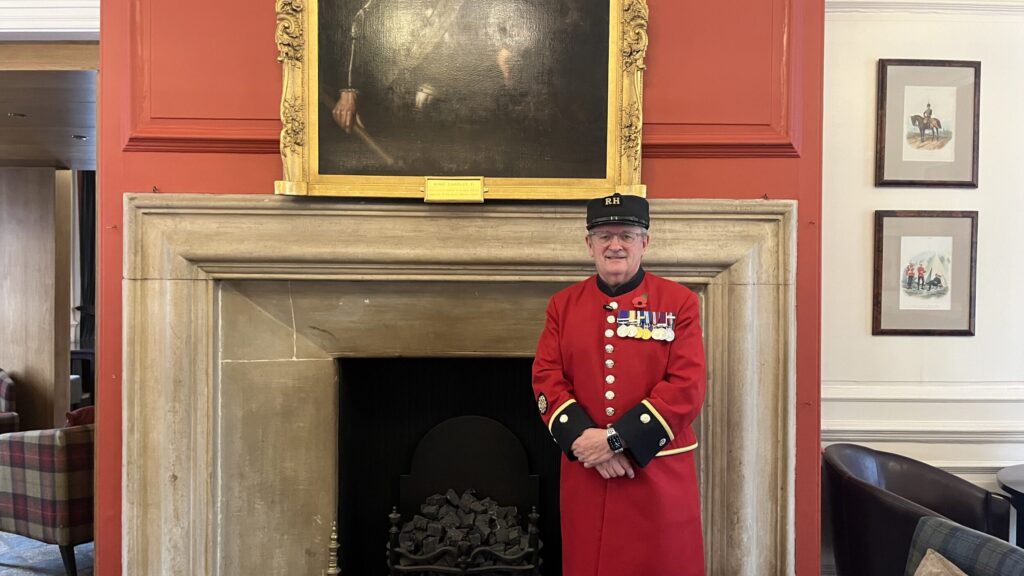
“Back in my parents’ day, you used to feel proud of your country and what it stood for. I think now that’s been slightly lost.”
Captain Albert Weastell, one of London’s Chelsea Pensioners, says he’s seeing fewer people wearing poppies across London.
He fears that we’re losing sight of the significance of Remembrance Day.
“If the guys hadn’t done what they did, and the women, we wouldn’t have the freedoms we have today,” he says.
Emphasizing the need to teach young people about the wars in school, he explains that if we don’t, “in 20 years’ time, people will forget all together.”
Albert retired from the army aged 60 after 43 years of service. After being a “tank driver and gunner” for 12 years, he transferred to the Ordinance Corps as a computer programmer, ending his career with his “soldier service.”
His medals span wars from Kosovo to Iraq, alongside silver and gold jubilee medals marking his years of service and good conduct.
‘It’s a privilege to wear the scarlet tunic’: participating in national events
Representing the Chelsea Pensioners on the Cenotaph is “very moving; tears, everything,” Albert says.
He has pushed fellow Chelsea Pensioners during the national Remembrance Sunday parade for the last four years.
“Once you start the parade, and it’s just thousands of people applauding the Chelsea Pensioners going past, it’s a fantastic day.”
16 pensioners were also chosen to walk across the stage at the Royal British Legion’s Festival of Remembrance in the Royal Albert Hall on Saturday.
Reflecting on how he felt watching this from the audience, he says he “was okay right towards the end”, until the drumhead Service – an initiative brought in during the First World War to conduct church services in the field – appeared, alongside the story “of two children who lost their father in Afghanistan.”
“That got me, I cracked up. It was so emotional. And it always does.”
Source: Royal Hospital Chelsea
Remembrance at the Royal Hospital Chelsea
Opened by King Charles II on 4th February 1692 to care for soldiers no longer able to serve due to age or injury, the Royal Hospital Chelsea is now home to nearly 300 veterans.
Today, the Chelsea Pensioners will gather in their 66-acre grounds to mark Remembrance Day together.
“We’ll have a parade outside. We’ll do a two-minute silence at 11 o’clock, as we always do, and we’ll wear our poppies with pride and our uniforms together, and we’ll have a good day out.”
Poppy prominence
For Albert, remembrance has both a historical and personal significance, ensuring the memory of both those who came before him, and those who served with him, is preserved.
However, he fears that a decline in traditional ways of marking remembrance, such as wearing a poppy, will lead the public to forget about soldiers’ sacrifices.
“I think there’s a lot of people who have forgotten about what goes on. There’s a lot of people I’ve seen throughout London who never buy a poppy.”
The donations from poppy purchases go to the Royal British Legion, a charity which supports members and veterans of the armed forces. According to Albert, if “everybody just bought one poppy for one pound, the Royal British Legion wouldn’t have any problems, it could survive forever.”
Remembrance beyond the world wars
Albert says it’s also important to remember soldiers’ families, as they were “left behind” during the wars. “They didn’t know what was going on […] It was just as bad for the families as it was for the soldiers,” he says.
Alongside the national, historical significance, Remembrance Day is a time for personal reflection. “I think we also remember those we’ve been in conflicts with,” Albert explains, noting those who were lost in Northern Ireland, the Falklands, and Afghanistan.
“It’s not just about the First and Second World Wars. If you look at the parade, you’ll see lots and lots of veterans from the Falklands, from Afghanistan, from Iraq […] They all have the medals on their chest to prove they were there.”
While the main focus is on these two major wars, Albert says “there’s a massive focus on everything that went on, and still goes on now.”
Submitted Article
Headline
Short Headline
Standfirst
Published Article
HeadlineFears of forgetting: Chelsea Pensioner Captain Albert Weastell on Remembrance Day
Short HeadlineFears of forgetting: Chelsea Pensioner on Remembrance Day
StandfirstThe veteran reflects on what Remembrance Day means to him
“Back in my parents’ day, you used to feel proud of your country and what it stood for. I think now that’s been slightly lost.”
Captain Albert Weastell, one of London’s Chelsea Pensioners, says he’s seeing fewer people wearing poppies across London.
He fears that we’re losing sight of the significance of Remembrance Day.
“If the guys hadn’t done what they did, and the women, we wouldn’t have the freedoms we have today,” he says.
Emphasizing the need to teach young people about the wars in school, he explains that if we don’t, “in 20 years’ time, people will forget all together.”
Albert retired from the army aged 60 after 43 years of service. After being a “tank driver and gunner” for 12 years, he transferred to the Ordinance Corps as a computer programmer, ending his career with his “soldier service.”
His medals span wars from Kosovo to Iraq, alongside silver and gold jubilee medals marking his years of service and good conduct.
‘It’s a privilege to wear the scarlet tunic’: participating in national events
Representing the Chelsea Pensioners on the Cenotaph is “very moving; tears, everything,” Albert says.
He has pushed fellow Chelsea Pensioners during the national Remembrance Sunday parade for the last four years.
“Once you start the parade, and it’s just thousands of people applauding the Chelsea Pensioners going past, it’s a fantastic day.”
16 pensioners were also chosen to walk across the stage at the Royal British Legion’s Festival of Remembrance in the Royal Albert Hall on Saturday.
Reflecting on how he felt watching this from the audience, he says he “was okay right towards the end”, until the drumhead Service – an initiative brought in during the First World War to conduct church services in the field – appeared, alongside the story “of two children who lost their father in Afghanistan.”
“That got me, I cracked up. It was so emotional. And it always does.”
Source: Royal Hospital Chelsea
Remembrance at the Royal Hospital Chelsea
Opened by King Charles II on 4th February 1692 to care for soldiers no longer able to serve due to age or injury, the Royal Hospital Chelsea is now home to nearly 300 veterans.
Today, the Chelsea Pensioners will gather in their 66-acre grounds to mark Remembrance Day together.
“We’ll have a parade outside. We’ll do a two-minute silence at 11 o’clock, as we always do, and we’ll wear our poppies with pride and our uniforms together, and we’ll have a good day out.”
Poppy prominence
For Albert, remembrance has both a historical and personal significance, ensuring the memory of both those who came before him, and those who served with him, is preserved.
However, he fears that a decline in traditional ways of marking remembrance, such as wearing a poppy, will lead the public to forget about soldiers’ sacrifices.
“I think there’s a lot of people who have forgotten about what goes on. There’s a lot of people I’ve seen throughout London who never buy a poppy.”
The donations from poppy purchases go to the Royal British Legion, a charity which supports members and veterans of the armed forces. According to Albert, if “everybody just bought one poppy for one pound, the Royal British Legion wouldn’t have any problems, it could survive forever.”
Remembrance beyond the world wars
Albert says it’s also important to remember soldiers’ families, as they were “left behind” during the wars. “They didn’t know what was going on […] It was just as bad for the families as it was for the soldiers,” he says.
Alongside the national, historical significance, Remembrance Day is a time for personal reflection. “I think we also remember those we’ve been in conflicts with,” Albert explains, noting those who were lost in Northern Ireland, the Falklands, and Afghanistan.
“It’s not just about the First and Second World Wars. If you look at the parade, you’ll see lots and lots of veterans from the Falklands, from Afghanistan, from Iraq […] They all have the medals on their chest to prove they were there.”
While the main focus is on these two major wars, Albert says “there’s a massive focus on everything that went on, and still goes on now.”
A 2024 Freedom of Information request showed Bromley Council had £4.5 million invested in arms companies that year with £1.5 million reportedly linked to Israel.
Undercover officers raided three linked shops in Barking town centre, revealing how illicit tobacco is being hidden in walls, ceilings and nearby locations to evade detection.
More than 330,000 people across the UK sought support from the Stop It Now helpline in 2025 over concerns about their own or someone else’s online sexual behaviour towards children, according to new charity data. The anonymous service says contacts by phone, email and webchat rose significantly over the year.