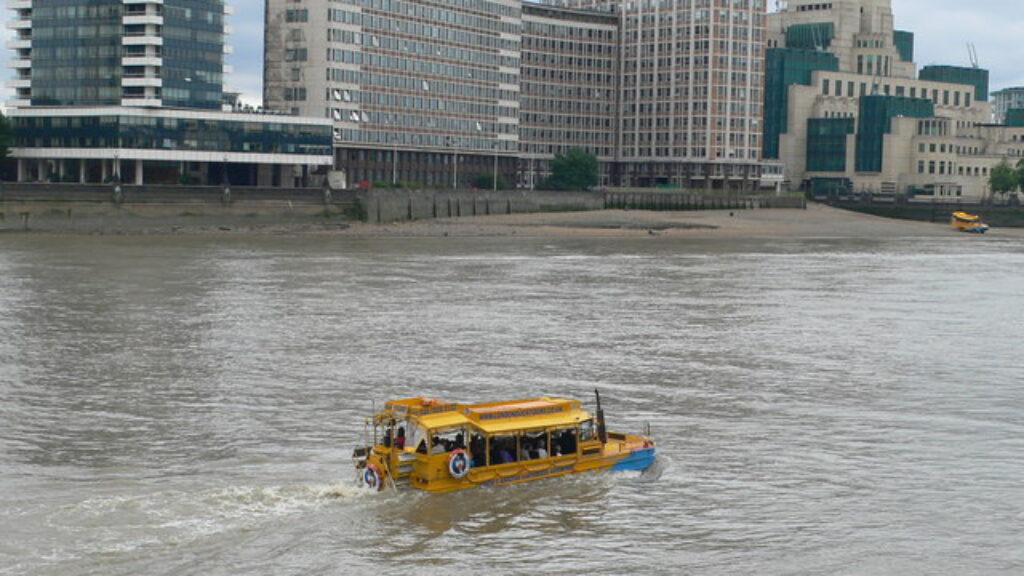
The Thames is about to get splashy! London’s iconic river is welcoming back the infamous “duck boats”.
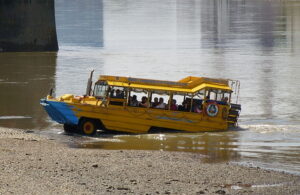
The original Second World War amphibious vehicles, nicknamed ‘DUKWs’, were designed to travel on both land and water. However, they were eventually deemed outdated and unsafe for continued use.
For years, amphibious tours were a quirky fixture of the capital’s tourism scene. But after a series of safety incidents, most notably a 2013 fire that forced passengers to jump overboard, the service was suspended.
Now, following years of redevelopment and regulatory review, it’s making a comeback designed for the modern era.
London Amphibious Tours has secured an exclusive long-term licence from the Duchy of Cornwall to operate from a Thames slipway at Lack’s Dock, beside the MI6 building on Albert Embankment.
The company will run the new amphibious tours in partnership with Big Bus Tours, one of the world’s leading sightseeing operators – a collaboration that marks the official return of London’s famous “duck bus” adventures.
The new vehicles, known as Seahorse Amphibious Passenger Vehicles (APVs), are fully electric, zero-emission and UK-built.
Developed by Seahorse Amphibious Vehicles, they are designed to meet strict maritime and road safety standards, carrying up to 36 passengers and two crew members at speeds of 30 mph on land and eight knots on water. The electric APV marks a shift in the way tourism interacts with the environment.
Source: Wikimedia Commons
“It’s a milestone moment for sustainable tourism in London,” said a spokesperson for British Marine, who confirmed the new licence last week. “This project represents not just innovation, but confidence in the future of responsible travel on the Thames.”
The project also signals a renewed relationship between London’s tourism industry and its river spaces – one that blends adventure with accountability. For the city, it’s another attraction to support the post-pandemic tourism recovery, giving visitors yet another way to experience the capital’s landmarks.
Industry observers say it could mark the start of a broader trend in city tourism.
“If London can prove electric amphibious tours are viable, we’ll see other global destinations follow,” said transport analyst James Rowe. “It’s about merging entertainment, mobility and sustainability into one.”
While no official launch date has been confirmed, testing of the new vehicles is expected to begin in early 2026, with public tours to follow soon after. Seahorse Amphibious Vehicles says it plans to produce up to 24 units a year at its UK facility – suggesting expansion could be on the horizon if London’s model succeeds.
For now, the Thames is preparing for its next wave of innovation. What was once a quirky novelty may soon become a symbol of modern, sustainable tourism – proving that, in London, even the ducks can evolve.
Source: Adobe Stock
Submitted Article
Headline
Short Headline
Standfirst
Published Article
HeadlineAre Duck Boats Back?
Short HeadlineAre Duck Boats Back?
StandfirstElectric amphibious vehicles set to bring back London's famous 'duck bus' tours with a modern, eco-friendly twist on the Thames.
The Thames is about to get splashy! London’s iconic river is welcoming back the infamous “duck boats”.
The original Second World War amphibious vehicles, nicknamed ‘DUKWs’, were designed to travel on both land and water. However, they were eventually deemed outdated and unsafe for continued use.
For years, amphibious tours were a quirky fixture of the capital’s tourism scene. But after a series of safety incidents, most notably a 2013 fire that forced passengers to jump overboard, the service was suspended.
Now, following years of redevelopment and regulatory review, it’s making a comeback designed for the modern era.
London Amphibious Tours has secured an exclusive long-term licence from the Duchy of Cornwall to operate from a Thames slipway at Lack’s Dock, beside the MI6 building on Albert Embankment.
The company will run the new amphibious tours in partnership with Big Bus Tours, one of the world’s leading sightseeing operators – a collaboration that marks the official return of London’s famous “duck bus” adventures.
The new vehicles, known as Seahorse Amphibious Passenger Vehicles (APVs), are fully electric, zero-emission and UK-built.
Developed by Seahorse Amphibious Vehicles, they are designed to meet strict maritime and road safety standards, carrying up to 36 passengers and two crew members at speeds of 30 mph on land and eight knots on water. The electric APV marks a shift in the way tourism interacts with the environment.
Source: Wikimedia Commons
“It’s a milestone moment for sustainable tourism in London,” said a spokesperson for British Marine, who confirmed the new licence last week. “This project represents not just innovation, but confidence in the future of responsible travel on the Thames.”
The project also signals a renewed relationship between London’s tourism industry and its river spaces – one that blends adventure with accountability. For the city, it’s another attraction to support the post-pandemic tourism recovery, giving visitors yet another way to experience the capital’s landmarks.
Industry observers say it could mark the start of a broader trend in city tourism.
“If London can prove electric amphibious tours are viable, we’ll see other global destinations follow,” said transport analyst James Rowe. “It’s about merging entertainment, mobility and sustainability into one.”
While no official launch date has been confirmed, testing of the new vehicles is expected to begin in early 2026, with public tours to follow soon after. Seahorse Amphibious Vehicles says it plans to produce up to 24 units a year at its UK facility – suggesting expansion could be on the horizon if London’s model succeeds.
For now, the Thames is preparing for its next wave of innovation. What was once a quirky novelty may soon become a symbol of modern, sustainable tourism – proving that, in London, even the ducks can evolve.
A 2024 Freedom of Information request showed Bromley Council had £4.5 million invested in arms companies that year with £1.5 million reportedly linked to Israel.
Undercover officers raided three linked shops in Barking town centre, revealing how illicit tobacco is being hidden in walls, ceilings and nearby locations to evade detection.
More than 330,000 people across the UK sought support from the Stop It Now helpline in 2025 over concerns about their own or someone else’s online sexual behaviour towards children, according to new charity data. The anonymous service says contacts by phone, email and webchat rose significantly over the year.