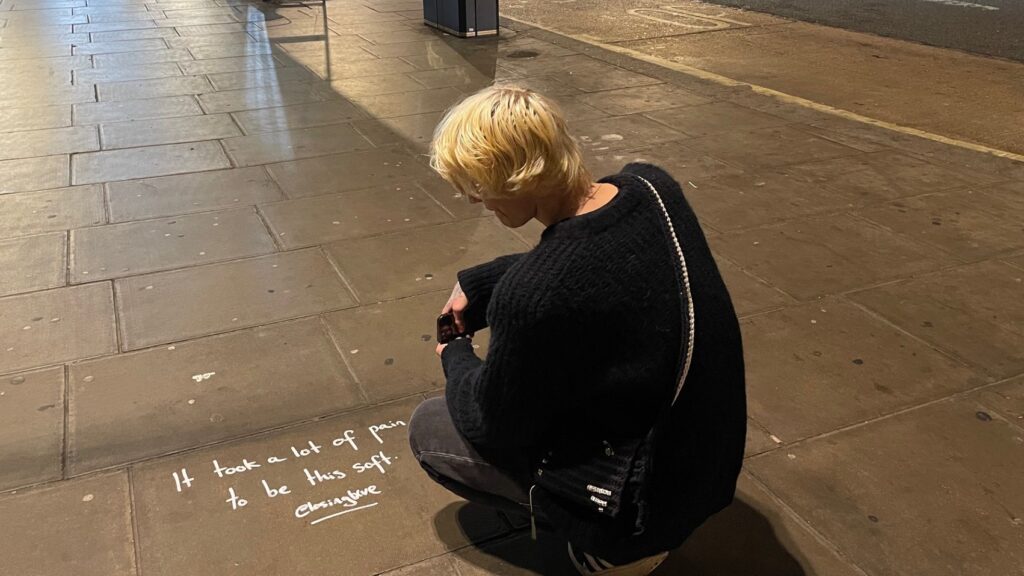
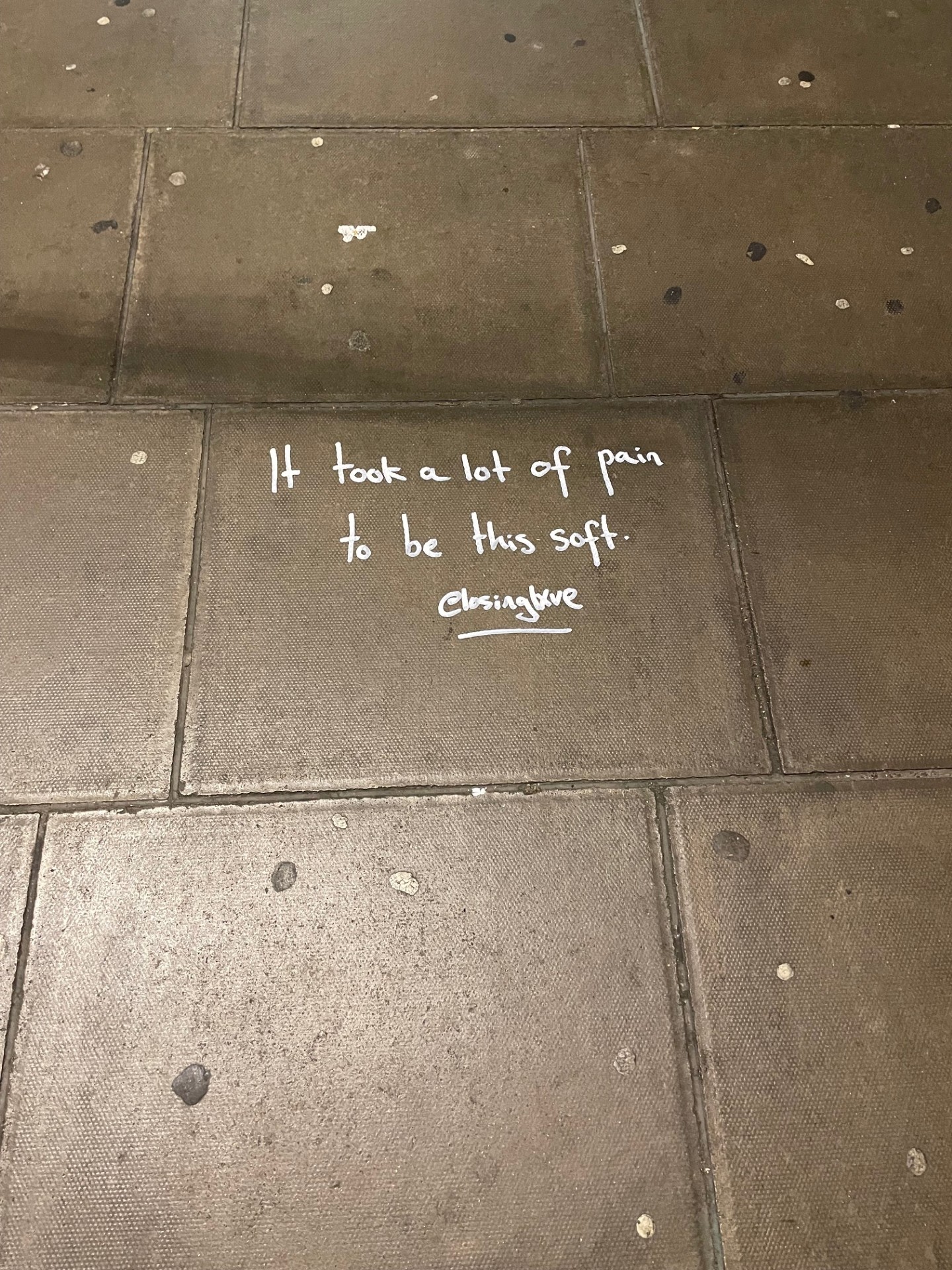
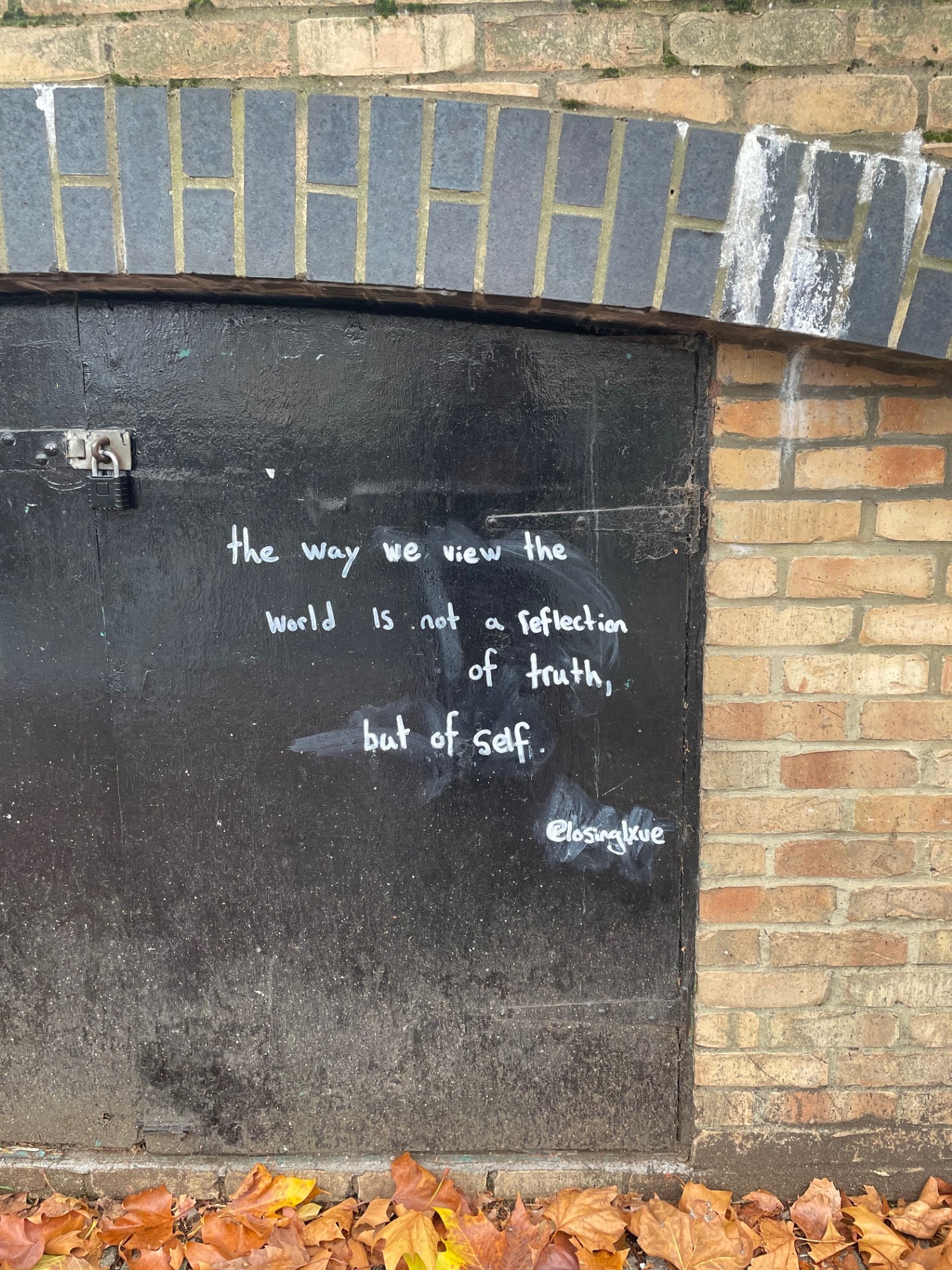
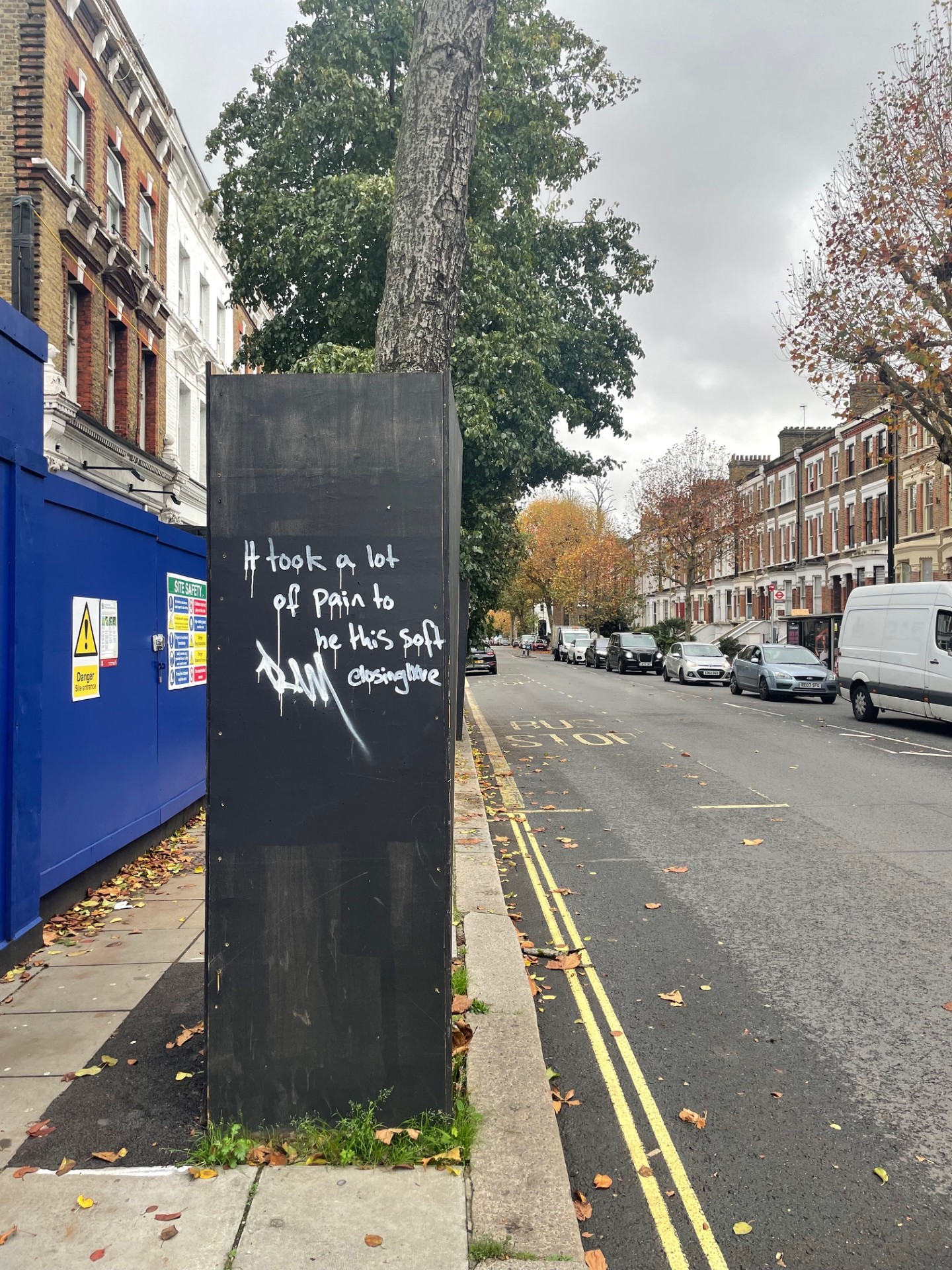
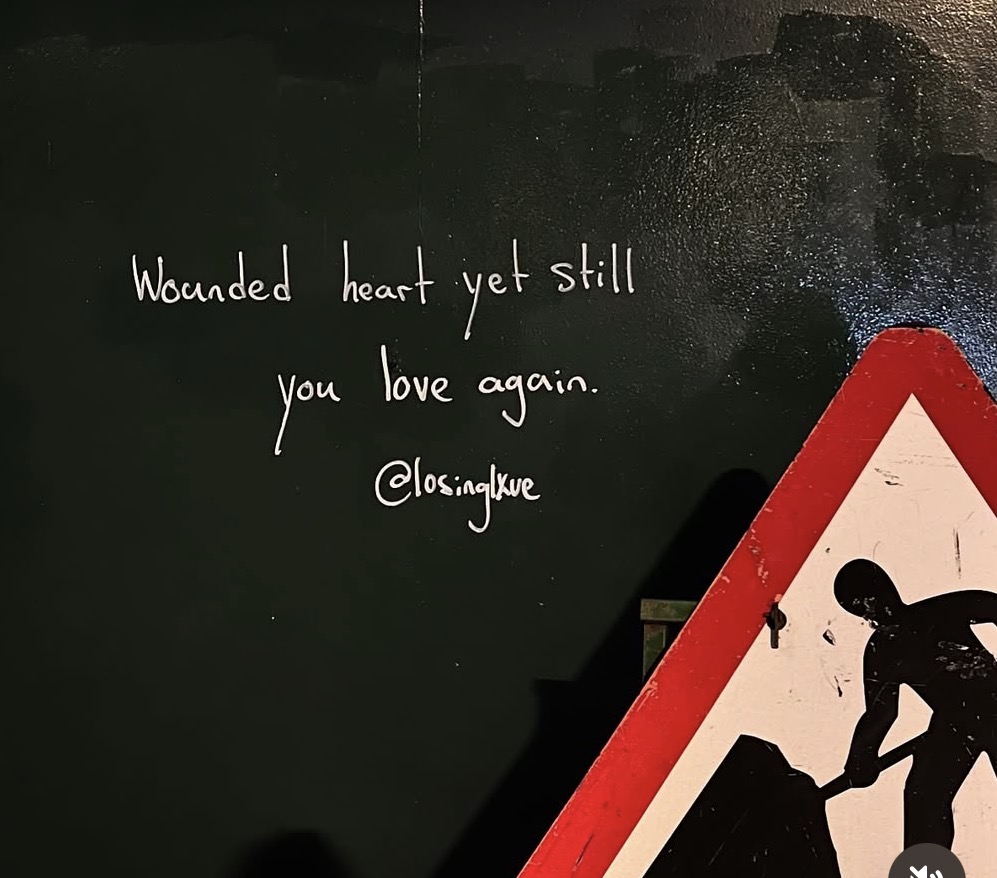
You’ve probably seen them. Across London, small, handwritten notes have been appearing on walls and pavements. In white lowercase, they offer brief, confessional messages to passersby, all of them signed off with the same tag: @LosingLxve.
Graffiti is nothing new in London. But there’s an unusually tender quality to these markings.
“It took a lot of pain to be this soft.”
“Wounded heart yet still you love again.”
“Letting go was my first step towards peace.”
The messages seem to materialise overnight across Zones 1 and 2, from Angel and Maida Vale to Embankment and Brick Lane – always in areas of high footfall where thousands of Londoners are likely to notice them. But who is Losing Lxve, and why are they doing this?
An artist with a purpose
“It started as a fun thing for me to do,” says the artist, who agreed to meet with me in Central London on condition of anonymity. “Initially it was just local, but that became very boring and I wanted to expand.”
Losing Lxve is originally from the United States, and only arrived in London from Arizona in the summer of 2025. His street art became a way to explore his new city. “I thought ‘Okay, let’s see London. I took it as an opportunity to just go out in the early hours of the morning and every day go to a new area. I enjoy that. I enjoy the urban exploration part of it.”
Is he aiming to help people with his messages? “Absolutely. Life is tough and people don’t know how to express their feelings. Being able to put my words out there, that’s just my heart on my sleeve, it kind of opens the door for everyone else to do the same. To pause, reflect, whatever it might be.”
Emotional cost
The disarming vulnerability and emotional openness of Losing Lxve’s work is certainly having an impact on some viewers. His Instagram account shows the many messages he has received, not just from Londoners, but from visitors from all over the world who have taken his words to heart. “I saw your message on a paving stone on Upper Street and I felt like it had been written for me […] you gave me a lot of comfort on a dark and rainy evening,’ says one. Losing Lxve is pleased by the responses – “It’s a beautiful thing to touch so many people’s hearts”, he says.
London’s authorities are unlikely to take such a receptive stance. Local councils are responsible for removing markings from public surfaces in their jurisdictions, and they spend millions doing so each year.
Figures vary by borough, but a Freedom of Information request from last year showed that Southwark Council spent more than £500,000 a year to get rid of graffiti, with Camden spending £300,000.
London graffiti isn’t just costly to remove; it’s also illegal. In the U.K., graffiti is treated as criminal damage under the Criminal Damage Act 1971. While the offence is defined nationally, enforcement across London is handled locally, and varies by borough.
In Islington, police can issue fixed-penalty notices of £80 for graffiti offences. Tower Hamlets – one of very few boroughs to have an official Graffiti and Street Art Policy – takes a tougher line, with fixed penalties of £500 for minor cases and fines of up to £5,000 or six months’ imprisonment for more serious incidents.
The rationale is that graffiti is inherently offensive and negatively impacts the local area. As Tower Hamlets Council puts it, “Graffiti is vandalism – pure and simple”.
‘Good’ and ‘bad’ graffiti
At the same time, Tower Hamlets’ policy does allow for some interpretation when it comes to street art, acknowledging that “Some residents and businesses believe street art can positively contribute to the appearance of an area, attract visitors and is good for business. Less priority has been given to removing street art in those areas where it is more welcome.”
So how does London decide what constitutes harmful ‘graffiti’ vs. welcome ‘street art’? In Tower Hamlets, a marking may remain if it is not “offensive in its nature, gang related, racially aggravating, [or] inappropriate for the location” or if it doesn’t contribute to an area’s “saturation” of images. Cases that are harder to judge are reviewed by an evaluation panel of council officers, who apply these criteria to decide whether a piece can stay.
Credit: Losing Lxve
Dr. Susan Hansen, Co-Chair of the Arts-based and Visual Methods Group at Middlesex University, questions this differentiation. “There is some research that says that street art can make us feel more connected to community.
There’s also a perception that somehow “offensive” or “ugly” graffiti has the opposite effect – that graffiti makes people feel unsafe and that it’s a sign there’s crime in an area – but this is very old, very dodgy research and a now debunked theory.
Research shows that if people understand graffiti more then they have a more positive appreciation of it. There’s a real hierarchy in terms of the aesthetic worth of marks we see on the street.”
As for how to tell if something is graffiti or street art? “One gets erased and one doesn’t.” Susan says.
What do we lose when we clean the city?
London’s approach to graffiti remains fragmented and inconsistent across the city, and even in cases where defined policies have been attempted, it seems there is still a significant degree of interpretation at play as to when, if ever, street markings are considered legitimate.
Losing Lxve’s work, with its tension between civic rules and emotional resonance, raises the question: what do we lose when we clean the city?
Submitted Article
Headline
Short Headline
Standfirst
Published Article
HeadlineBetween love and the law: London’s emotional graffiti artist
Short HeadlineLondon's emotional graffiti artist
StandfirstMysterious aphorisms have been appearing all over London. But what do they reveal about the city's approach to graffiti?
You’ve probably seen them. Across London, small, handwritten notes have been appearing on walls and pavements. In white lowercase, they offer brief, confessional messages to passersby, all of them signed off with the same tag: @LosingLxve.
Graffiti is nothing new in London. But there’s an unusually tender quality to these markings.
“It took a lot of pain to be this soft.”
“Wounded heart yet still you love again.”
“Letting go was my first step towards peace.”
The messages seem to materialise overnight across Zones 1 and 2, from Angel and Maida Vale to Embankment and Brick Lane – always in areas of high footfall where thousands of Londoners are likely to notice them. But who is Losing Lxve, and why are they doing this?
An artist with a purpose
“It started as a fun thing for me to do,” says the artist, who agreed to meet with me in Central London on condition of anonymity. “Initially it was just local, but that became very boring and I wanted to expand.”
Losing Lxve is originally from the United States, and only arrived in London from Arizona in the summer of 2025. His street art became a way to explore his new city. “I thought ‘Okay, let’s see London. I took it as an opportunity to just go out in the early hours of the morning and every day go to a new area. I enjoy that. I enjoy the urban exploration part of it.”
Is he aiming to help people with his messages? “Absolutely. Life is tough and people don’t know how to express their feelings. Being able to put my words out there, that’s just my heart on my sleeve, it kind of opens the door for everyone else to do the same. To pause, reflect, whatever it might be.”
Emotional cost
The disarming vulnerability and emotional openness of Losing Lxve’s work is certainly having an impact on some viewers. His Instagram account shows the many messages he has received, not just from Londoners, but from visitors from all over the world who have taken his words to heart. “I saw your message on a paving stone on Upper Street and I felt like it had been written for me […] you gave me a lot of comfort on a dark and rainy evening,’ says one. Losing Lxve is pleased by the responses – “It’s a beautiful thing to touch so many people’s hearts”, he says.
London’s authorities are unlikely to take such a receptive stance. Local councils are responsible for removing markings from public surfaces in their jurisdictions, and they spend millions doing so each year.
Figures vary by borough, but a Freedom of Information request from last year showed that Southwark Council spent more than £500,000 a year to get rid of graffiti, with Camden spending £300,000.
London graffiti isn’t just costly to remove; it’s also illegal. In the U.K., graffiti is treated as criminal damage under the Criminal Damage Act 1971. While the offence is defined nationally, enforcement across London is handled locally, and varies by borough.
In Islington, police can issue fixed-penalty notices of £80 for graffiti offences. Tower Hamlets – one of very few boroughs to have an official Graffiti and Street Art Policy – takes a tougher line, with fixed penalties of £500 for minor cases and fines of up to £5,000 or six months’ imprisonment for more serious incidents.
The rationale is that graffiti is inherently offensive and negatively impacts the local area. As Tower Hamlets Council puts it, “Graffiti is vandalism – pure and simple”.
‘Good’ and ‘bad’ graffiti
At the same time, Tower Hamlets’ policy does allow for some interpretation when it comes to street art, acknowledging that “Some residents and businesses believe street art can positively contribute to the appearance of an area, attract visitors and is good for business. Less priority has been given to removing street art in those areas where it is more welcome.”
So how does London decide what constitutes harmful ‘graffiti’ vs. welcome ‘street art’? In Tower Hamlets, a marking may remain if it is not “offensive in its nature, gang related, racially aggravating, [or] inappropriate for the location” or if it doesn’t contribute to an area’s “saturation” of images. Cases that are harder to judge are reviewed by an evaluation panel of council officers, who apply these criteria to decide whether a piece can stay.
Credit: Losing Lxve
Dr. Susan Hansen, Co-Chair of the Arts-based and Visual Methods Group at Middlesex University, questions this differentiation. “There is some research that says that street art can make us feel more connected to community.
There’s also a perception that somehow “offensive” or “ugly” graffiti has the opposite effect – that graffiti makes people feel unsafe and that it’s a sign there’s crime in an area – but this is very old, very dodgy research and a now debunked theory.
Research shows that if people understand graffiti more then they have a more positive appreciation of it. There’s a real hierarchy in terms of the aesthetic worth of marks we see on the street.”
As for how to tell if something is graffiti or street art? “One gets erased and one doesn’t.” Susan says.
What do we lose when we clean the city?
London’s approach to graffiti remains fragmented and inconsistent across the city, and even in cases where defined policies have been attempted, it seems there is still a significant degree of interpretation at play as to when, if ever, street markings are considered legitimate.
Losing Lxve’s work, with its tension between civic rules and emotional resonance, raises the question: what do we lose when we clean the city?
City news has spoken to a long-term rough sleeper to see how those on the street feel about the Andy Burham’s plan to end homelessness and the upcoming winter.