An original 1932 Harry Beck tube map draft is being auctioned this December.
Christie’s Auction House have announced they are selling the map on the 11th of December for between an expected £70,000-£100,000. Millions of people encounter the London Tube map every day. But who is the man behind the design?
Who is Harry Beck?
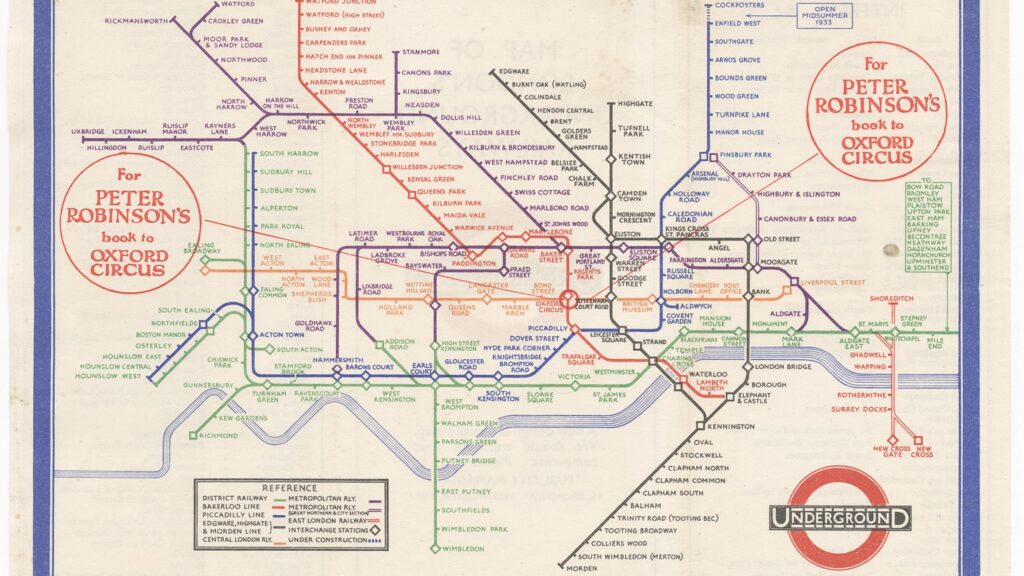
In 1931, Harry Beck created the first topological map still known to us today. His initial design was rejected for being “too radical”. The map was reconsidered in 1933 after a few edits and was sold for an estimated five guineas. The design was printed as pocket maps and in stations. A draft plan of the 1933 map is going up for auction.
“Too radical” – his 1931 map was rejected.
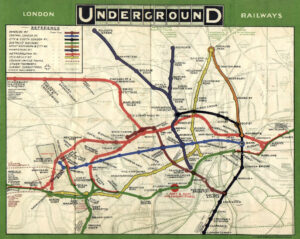
Prior the 20th century, there was no one single tube map as each line was privately owned. The first map of the network is thought to have been produced in 1908. This map had several difficulties. It was geographical rather than topological, the middle of the map almost illegible, with so many stations marked in the centre of London. The lines were not easy to follow, because they followed the real geography of London.
1908 Geographical Tube Map. Credit: WikiCommons
Beck’s 1931 design overcame the challenges of visual overcrowding and readability. He enlarged the centre of the design giving more space for station names. He only depicted lines at right angle and 45-degree angles.
Emiritus Professor of Public Transport Systems Peter White stated that Beck’s map had: “a wide influence on other transport maps” including that of the Sydney Rail Network.
But Prof. White also said “people don’t realise the distance on the ground between stations”. Whilst Beck’s map is visually understandable, it warps the distance perception between stations, potentially causing some confusion.
Where is Beck from?
Beck grew up in North London’s Highgate Village, eventually settling in Finchley. Beck started working for London Transport (LT) in the 1920s as a technical draughtsman in the London Underground Signals Office. Part of his job included drawing electrical circuits, which influenced his topological design.
“It is a significant attempt at a diagrammetic map” – Prof. White.
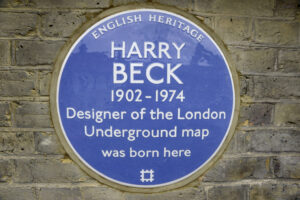
In 2003 a blue plaque was installed outside his Finchley home by the Finchley Society as well as a commemorative plaque dedicated to him at Finchley Tube Station.
Harry Beck’s Leyton place of birth. Credit: English Heritage
His 1933 map was just the beginning of his cartographic journey: Beck was commissioned to create tube maps until 1950, including the tube map in 1941 after the London Blitz. He finished working for London Transport in 1960. His final map in 1950 included a separate colour for the circle line in yellow. This colour is still in use today.
In the meantime, Prof. White hopes that the map will “ideally be in a museum”, due to its historic and national significance. The auction will take place on the 11th of December.
Submitted Article
Headline
Short Headline
Standfirst
Published Article
HeadlineHarry Beck: The man behind the tube map
Short HeadlineHarry Beck's 1932 tube map draft is being auctioned this December.
StandfirstAn original draft of Harry Beck's iconic tube map is up for sale at Christie's auction house
An original 1932 Harry Beck tube map draft is being auctioned this December.
Christie’s Auction House have announced they are selling the map on the 11th of December for between an expected £70,000-£100,000. Millions of people encounter the London Tube map every day. But who is the man behind the design?
Who is Harry Beck?
In 1931, Harry Beck created the first topological map still known to us today. His initial design was rejected for being “too radical”. The map was reconsidered in 1933 after a few edits and was sold for an estimated five guineas. The design was printed as pocket maps and in stations. A draft plan of the 1933 map is going up for auction.
“Too radical” – his 1931 map was rejected.
Prior the 20th century, there was no one single tube map as each line was privately owned. The first map of the network is thought to have been produced in 1908. This map had several difficulties. It was geographical rather than topological, the middle of the map almost illegible, with so many stations marked in the centre of London. The lines were not easy to follow, because they followed the real geography of London.
1908 Geographical Tube Map. Credit: WikiCommons
Beck’s 1931 design overcame the challenges of visual overcrowding and readability. He enlarged the centre of the design giving more space for station names. He only depicted lines at right angle and 45-degree angles.
Emiritus Professor of Public Transport Systems Peter White stated that Beck’s map had: “a wide influence on other transport maps” including that of the Sydney Rail Network.
But Prof. White also said “people don’t realise the distance on the ground between stations”. Whilst Beck’s map is visually understandable, it warps the distance perception between stations, potentially causing some confusion.
Where is Beck from?
Beck grew up in North London’s Highgate Village, eventually settling in Finchley. Beck started working for London Transport (LT) in the 1920s as a technical draughtsman in the London Underground Signals Office. Part of his job included drawing electrical circuits, which influenced his topological design.
“It is a significant attempt at a diagrammetic map” – Prof. White.
In 2003 a blue plaque was installed outside his Finchley home by the Finchley Society as well as a commemorative plaque dedicated to him at Finchley Tube Station.
Harry Beck’s Leyton place of birth. Credit: English Heritage
His 1933 map was just the beginning of his cartographic journey: Beck was commissioned to create tube maps until 1950, including the tube map in 1941 after the London Blitz. He finished working for London Transport in 1960. His final map in 1950 included a separate colour for the circle line in yellow. This colour is still in use today.
In the meantime, Prof. White hopes that the map will “ideally be in a museum”, due to its historic and national significance. The auction will take place on the 11th of December.
A 2024 Freedom of Information request showed Bromley Council had £4.5 million invested in arms companies that year with £1.5 million reportedly linked to Israel.
Undercover officers raided three linked shops in Barking town centre, revealing how illicit tobacco is being hidden in walls, ceilings and nearby locations to evade detection.
More than 330,000 people across the UK sought support from the Stop It Now helpline in 2025 over concerns about their own or someone else’s online sexual behaviour towards children, according to new charity data. The anonymous service says contacts by phone, email and webchat rose significantly over the year.