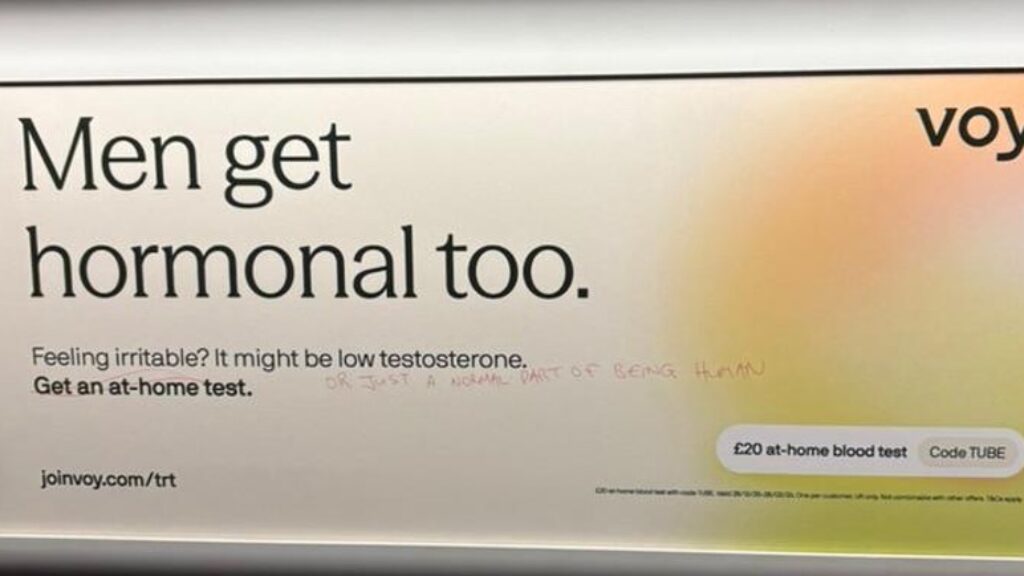
If you’ve been on the Tube recently, you’ve probably seen them; bold posters stating, “It’s not him, it’s his hormones”, asking men whether their hormones are “getting the better of them”. The testosterone testing campaign by private health company Voy, has been hard to miss and hasn’t gone unnoticed online.
Voy’s tube ad
On social media, particularly TikTok, the ads have sparked a backlash. Critics have accused them of ragebait, recycling language long used to dismiss women, and oversimplifying complex behaviour.
TikTok commentTikTok commentTikTok comment
Katie Cook, a content creator who focuses on women’s health awareness, says she’s seen the campaign on her feed. While she welcomes conversations around men’s health, she says the messaging is “frustrating for women who live with persistent hormonal issues”.
Katie adds that many women still struggle to have their symptoms taken seriously. “I think we need a more balanced conversation on hormonal health”, perhaps one that doesn’t pit men’s health against women’s, but recognises the different realities.
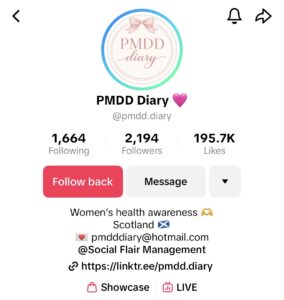
Kate Cook’s PMDD social media home page
But beyond the controversy, a question remains: do men really get hormonal?
Medically speaking, yes – but perhaps not in the way the slogan might suggest.
According to Professor Channa Jayasena, a reproductive endocrinologist, testosterone is the key hormone responsible for male puberty, muscle development, sexual function and sperm production.
Testosterone levels in men fluctuate daily rather than monthly, typically peaking in the early morning before gradually declining throughout the day.
Over a lifetime, testosterone also declines gradually with age, usually from around the age of 40, by roughly 1% per year on average. Lifestyle factors such as poor sleep, obesity, illness and certain medications can also temporarily suppress levels.
However, experts are clear this is fundamentally different from the hormonal cycles experienced by women.
“Men do not have a cyclical hormonal pattern comparable to the menstrual cycle,” Professor Jayasena explains. “It’s unhelpful to draw comparisons – women’s hormonal cycles are designed around ovulation and menstruation, whereas men produce sperm continuously.”
What symptoms are actually linked to low testosterone?
Low testosterone, also known as hypogonadism, can be associated with reduced libido, erectile dysfunction, loss of muscle mass, increased body fat, fatigue, low mood and difficulty concentrating.
But stress, depression, and poor lifestyle habits can produce similar effects, which is where experts warn slogans can become misleading. And clinically, low testosterone is far less common than marketing claims suggest.
In younger men under 40, Professor Jayasena says it is “very uncommon” and usually linked to serious medical conditions such as testicular cancer or pituitary disorders.
He says among older men, particularly those with obesity or type 2 diabetes, low levels are more common, but this still does not indicate that treatment is necessary.
Around 2% of men meet the criteria for testosterone deficiency that requires treatment, according to expert estimates.
“That distinction matters,” Professor Jayasena says, “otherwise you risk fearmongering and encouraging men to seek treatment they don’t need.”
So what about the ads?
Voy Health says the campaign aims to reduce stigma and encourage men to engage with their health, citing claims that “one in four men” experience low testosterone and that many cases go undiagnosed.
Experts agree men can be reluctant to seek help for sexual or hormonal health issues. But Professor Jayasena believes the campaign distracts from more effective health messaging.
“Instead of asking men if they feel ‘hormonal’, we should be asking clear, medical questions – like whether they’ve experienced unexplained loss of erections – and encouraging those men to see a doctor.”
Men do have hormones, and in some cases, low testosterone can genuinely affect health and quality of life.
But male and female hormones are not comparable, and many are arguing that a provocative tube slogan is not a productive way to shape the conversation.
Submitted Article
Headline
Short Headline
Standfirst
Published Article
HeadlineLondon-wide male hormone ads questioned by critics and experts
If you’ve been on the Tube recently, you’ve probably seen them; bold posters stating, “It’s not him, it’s his hormones”, asking men whether their hormones are “getting the better of them”. The testosterone testing campaign by private health company Voy, has been hard to miss and hasn’t gone unnoticed online.
Voy’s tube ad
On social media, particularly TikTok, the ads have sparked a backlash. Critics have accused them of ragebait, recycling language long used to dismiss women, and oversimplifying complex behaviour.
TikTok commentTikTok commentTikTok comment
Katie Cook, a content creator who focuses on women’s health awareness, says she’s seen the campaign on her feed. While she welcomes conversations around men’s health, she says the messaging is “frustrating for women who live with persistent hormonal issues”.
Katie adds that many women still struggle to have their symptoms taken seriously. “I think we need a more balanced conversation on hormonal health”, perhaps one that doesn’t pit men’s health against women’s, but recognises the different realities.
Kate Cook’s PMDD social media home page
But beyond the controversy, a question remains: do men really get hormonal?
Medically speaking, yes – but perhaps not in the way the slogan might suggest.
According to Professor Channa Jayasena, a reproductive endocrinologist, testosterone is the key hormone responsible for male puberty, muscle development, sexual function and sperm production.
Testosterone levels in men fluctuate daily rather than monthly, typically peaking in the early morning before gradually declining throughout the day.
Over a lifetime, testosterone also declines gradually with age, usually from around the age of 40, by roughly 1% per year on average. Lifestyle factors such as poor sleep, obesity, illness and certain medications can also temporarily suppress levels.
However, experts are clear this is fundamentally different from the hormonal cycles experienced by women.
“Men do not have a cyclical hormonal pattern comparable to the menstrual cycle,” Professor Jayasena explains. “It’s unhelpful to draw comparisons – women’s hormonal cycles are designed around ovulation and menstruation, whereas men produce sperm continuously.”
What symptoms are actually linked to low testosterone?
Low testosterone, also known as hypogonadism, can be associated with reduced libido, erectile dysfunction, loss of muscle mass, increased body fat, fatigue, low mood and difficulty concentrating.
But stress, depression, and poor lifestyle habits can produce similar effects, which is where experts warn slogans can become misleading. And clinically, low testosterone is far less common than marketing claims suggest.
In younger men under 40, Professor Jayasena says it is “very uncommon” and usually linked to serious medical conditions such as testicular cancer or pituitary disorders.
He says among older men, particularly those with obesity or type 2 diabetes, low levels are more common, but this still does not indicate that treatment is necessary.
Around 2% of men meet the criteria for testosterone deficiency that requires treatment, according to expert estimates.
“That distinction matters,” Professor Jayasena says, “otherwise you risk fearmongering and encouraging men to seek treatment they don’t need.”
So what about the ads?
Voy Health says the campaign aims to reduce stigma and encourage men to engage with their health, citing claims that “one in four men” experience low testosterone and that many cases go undiagnosed.
Experts agree men can be reluctant to seek help for sexual or hormonal health issues. But Professor Jayasena believes the campaign distracts from more effective health messaging.
“Instead of asking men if they feel ‘hormonal’, we should be asking clear, medical questions – like whether they’ve experienced unexplained loss of erections – and encouraging those men to see a doctor.”
Men do have hormones, and in some cases, low testosterone can genuinely affect health and quality of life.
But male and female hormones are not comparable, and many are arguing that a provocative tube slogan is not a productive way to shape the conversation.
A 2024 Freedom of Information request showed Bromley Council had £4.5 million invested in arms companies that year with £1.5 million reportedly linked to Israel.
Undercover officers raided three linked shops in Barking town centre, revealing how illicit tobacco is being hidden in walls, ceilings and nearby locations to evade detection.
More than 330,000 people across the UK sought support from the Stop It Now helpline in 2025 over concerns about their own or someone else’s online sexual behaviour towards children, according to new charity data. The anonymous service says contacts by phone, email and webchat rose significantly over the year.