Women are being left out of the hair transplant conversation
Despite more women getting hair transplants, many are finding that they are both under-represented in the industry. City News hears from female patients who have been affected by the issue.
Hair transplant adverts are everywhere across London, where nearly 40% of all hair transplants performed in the UK are done in the capital. And they often have one demographic in mind: Men.
One of the most prominent examples is a 12-month-long London Underground campaign by Elithair – a Turkish-based hair transplant clinic that has partnered with Premier League football club Tottenham Hotspur.
As part of the official partnership, Elithair has a range of campaigns with the club. This includes a minute-long promotional video featuring a Tottenham Hotspur supporter and father who undergoes a hair transplant. In the film, the procedure is portrayed as positively impacting his relationship with his young son. “I wanted to wear my Spurs cap to show my support, not cover up my hairline,” the man says.
Elithair’s Tube print campaign also draws heavily on football imagery. One poster displays Tottenham Hotspur players warming up alongside the slogan “Hair Transplant Window Now Open” – a phrase that intentionally mirrors the language used during the Premier League transfer windows.
Masculinity is a central theme in both campaigns. Whether framed through fatherhood or athletic performance, the advertisement, and by extension the procedure, is clearly catered towards a male audience.
Sid McGrath, founder of London-based advertising agency Karmarama, said the partnership with a football club serves a specific purpose. “I think the reason why they’re tying up with a football team is clear,” he said. “It destigmatises the territory of hair transplants for men.”
McGrath drew a comparison with Viagra’s first major advertising campaign in 2002, which featured Brazilian footballer Pelé. “If you wanted someone who could be seen as a bastion of manhood talking about the need to have something like that, that was a really good match,” he said. “So I buy the fact that Elithair would want to partner with a football team.”
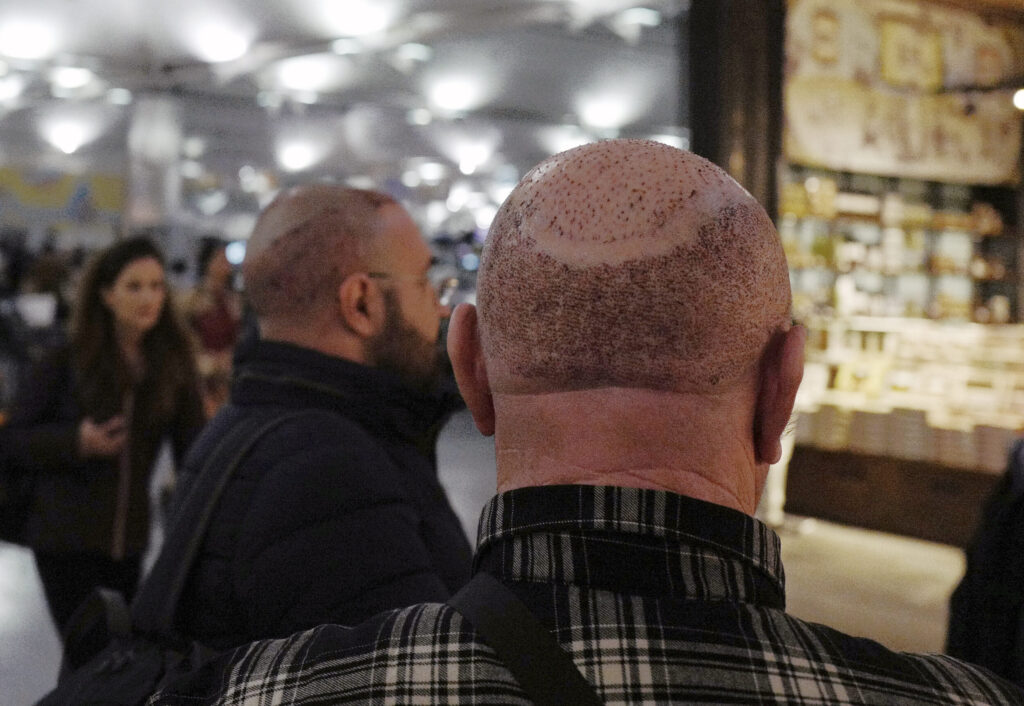
A foreigner who underwent hair transplant waits for his flight at Ataturk Airport, Turkey, Friday, Feb. 22, 2019. Turkey has become a major destination for successful hair transplants, attracting foreigners who want hair transplants at cheap prices ( (AP Photo/Burhan Ozbilici)
However, solely focusing on masculinity runs the risk of isolating a growing number of consumers of hair transplants.
Between 2021 and 2024, the number of women receiving hair transplants grew by 16.5%, according to the International Society of Hair Restoration Surgery. Despite men making up 87% of all hair transplants, women are increasingly seeking out the procedure to treat a range of conditions, including postpartum hair loss, hormonal changes and medical conditions such as alopecia.
Marie-Royce Book, a Trichologist and Hair Restoration Specialist for the London-based Wimpole Clinic, underscores the fact that women often arrive with gender-specific concerns.
“When I look at the women I see in the clinic, hair loss is often closely linked to lifestyle and styling choices, not just genetics,” she said.
“We’ve seen this for years with things like braids, hair extensions and tight styling, where traction alopecia becomes a common reason women start looking into hair transplants.”
As a female surgeon herself, Book says gendered assumptions have historically extended beyond advertising: “For years, the industry was very male-focused – male-doctors, male patients – because male hair loss is more familiar and easy to treat. As a result, a lot of women were, in my opinion, written off or told they weren’t suitable.”
She added that change has been gradual: “clinics have had to adapt, learn, and become more considered in how they assess and plan for women, rather than defaulting or catering for men.”
For Yasmine Labidi, a content creator from Nottingham, deciding to undergo a hair transplant was the result of years of insecurity about thinning on the side of her forehead. However, the decision was made more difficult as she felt underrepresented in the industry: “People were very shocked when I got a hair transplant, mainly because I’m a woman. Lots of people get hair transplants but people think it’s only men that do this.”
For Samantha Evans, a business owner from Northamptonshire, losing her hair was a highly emotional experience.
“It made me feel like a man…I lost all my hair because female hair loss is not spoken about.”
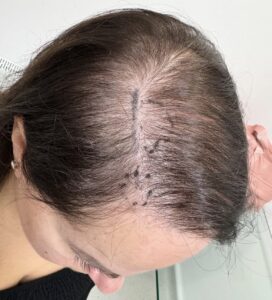
After noticing specific patches of thinning, she decides to seek out support from numerous London clinics. After two years of deliberation, she decided to go through with the procedure however, was left disappointed after realising that hair grafts had been taken from an already thinning part of her hair.
Source: Instagram @hairlosswarrior_sam
Evans believes that her diagnosis of Polycystic Ovary Syndrome (PCOS) – a medical condition that affects a woman’s reproductive organs and known to impact hair growth – contributed to the failure of her transplant was not fully considered by medical professionals: [I was] never told that PCOS was even a risk factor.”
Her experience spotlights the wider issue within the industry around a lack of understanding and awareness around the specifics of female hair loss: “Nobody really understands it and I think women’s hair loss is a lot more complex.” For Samantha, solace was eventually found in wigs which led her to launch her own wig company – Loss and Lace – which is designed to offer women an alternative to an expensive and unreliable procedure.
Source: Instagram @hairlosswarrior_sam
Despite often offering an important solution to the stresses of hair loss, broader gaps still exist in the hair restoration industry in the UK around the inclusion of women. While conversations around female hair loss are emerging, meaningful change is still required across the industry. An important starting place would be to address how female hair restoration is both represented and communicated to the public.
Both Tottenham Hotspur and Elithair were approached by City News who have so far not responded.
Submitted Article
Headline
Short Headline
Standfirst
Published Article
HeadlineWomen are being left out of the hair transplant conversation
Short HeadlineWomen Left Out of Hair Transplant Conversation
StandfirstDespite more women getting hair transplants, many are finding that they are both under-represented in the industry. City News hears from female patients who have been affected by the issue.
Hair transplant adverts are everywhere across London, where nearly 40% of all hair transplants performed in the UK are done in the capital. And they often have one demographic in mind: Men.
One of the most prominent examples is a 12-month-long London Underground campaign by Elithair – a Turkish-based hair transplant clinic that has partnered with Premier League football club Tottenham Hotspur.
As part of the official partnership, Elithair has a range of campaigns with the club. This includes a minute-long promotional video featuring a Tottenham Hotspur supporter and father who undergoes a hair transplant. In the film, the procedure is portrayed as positively impacting his relationship with his young son. “I wanted to wear my Spurs cap to show my support, not cover up my hairline,” the man says.
Elithair’s Tube print campaign also draws heavily on football imagery. One poster displays Tottenham Hotspur players warming up alongside the slogan “Hair Transplant Window Now Open” – a phrase that intentionally mirrors the language used during the Premier League transfer windows.
Masculinity is a central theme in both campaigns. Whether framed through fatherhood or athletic performance, the advertisement, and by extension the procedure, is clearly catered towards a male audience.
Sid McGrath, founder of London-based advertising agency Karmarama, said the partnership with a football club serves a specific purpose. “I think the reason why they’re tying up with a football team is clear,” he said. “It destigmatises the territory of hair transplants for men.”
McGrath drew a comparison with Viagra’s first major advertising campaign in 2002, which featured Brazilian footballer Pelé. “If you wanted someone who could be seen as a bastion of manhood talking about the need to have something like that, that was a really good match,” he said. “So I buy the fact that Elithair would want to partner with a football team.”
A foreigner who underwent hair transplant waits for his flight at Ataturk Airport, Turkey, Friday, Feb. 22, 2019. Turkey has become a major destination for successful hair transplants, attracting foreigners who want hair transplants at cheap prices ( (AP Photo/Burhan Ozbilici)
However, solely focusing on masculinity runs the risk of isolating a growing number of consumers of hair transplants.
Between 2021 and 2024, the number of women receiving hair transplants grew by 16.5%, according to the International Society of Hair Restoration Surgery. Despite men making up 87% of all hair transplants, women are increasingly seeking out the procedure to treat a range of conditions, including postpartum hair loss, hormonal changes and medical conditions such as alopecia.
Marie-Royce Book, a Trichologist and Hair Restoration Specialist for the London-based Wimpole Clinic, underscores the fact that women often arrive with gender-specific concerns.
“When I look at the women I see in the clinic, hair loss is often closely linked to lifestyle and styling choices, not just genetics,” she said.
“We’ve seen this for years with things like braids, hair extensions and tight styling, where traction alopecia becomes a common reason women start looking into hair transplants.”
As a female surgeon herself, Book says gendered assumptions have historically extended beyond advertising: “For years, the industry was very male-focused – male-doctors, male patients – because male hair loss is more familiar and easy to treat. As a result, a lot of women were, in my opinion, written off or told they weren’t suitable.”
She added that change has been gradual: “clinics have had to adapt, learn, and become more considered in how they assess and plan for women, rather than defaulting or catering for men.”
For Yasmine Labidi, a content creator from Nottingham, deciding to undergo a hair transplant was the result of years of insecurity about thinning on the side of her forehead. However, the decision was made more difficult as she felt underrepresented in the industry: “People were very shocked when I got a hair transplant, mainly because I’m a woman. Lots of people get hair transplants but people think it’s only men that do this.”
For Samantha Evans, a business owner from Northamptonshire, losing her hair was a highly emotional experience.
“It made me feel like a man…I lost all my hair because female hair loss is not spoken about.”
After noticing specific patches of thinning, she decides to seek out support from numerous London clinics. After two years of deliberation, she decided to go through with the procedure however, was left disappointed after realising that hair grafts had been taken from an already thinning part of her hair.
Source: Instagram @hairlosswarrior_sam
Evans believes that her diagnosis of Polycystic Ovary Syndrome (PCOS) – a medical condition that affects a woman’s reproductive organs and known to impact hair growth – contributed to the failure of her transplant was not fully considered by medical professionals: [I was] never told that PCOS was even a risk factor.”
Her experience spotlights the wider issue within the industry around a lack of understanding and awareness around the specifics of female hair loss: “Nobody really understands it and I think women’s hair loss is a lot more complex.” For Samantha, solace was eventually found in wigs which led her to launch her own wig company – Loss and Lace – which is designed to offer women an alternative to an expensive and unreliable procedure.
Source: Instagram @hairlosswarrior_sam
Despite often offering an important solution to the stresses of hair loss, broader gaps still exist in the hair restoration industry in the UK around the inclusion of women. While conversations around female hair loss are emerging, meaningful change is still required across the industry. An important starting place would be to address how female hair restoration is both represented and communicated to the public.
Both Tottenham Hotspur and Elithair were approached by City News who have so far not responded.
A 2024 Freedom of Information request showed Bromley Council had £4.5 million invested in arms companies that year with £1.5 million reportedly linked to Israel.
Undercover officers raided three linked shops in Barking town centre, revealing how illicit tobacco is being hidden in walls, ceilings and nearby locations to evade detection.
More than 330,000 people across the UK sought support from the Stop It Now helpline in 2025 over concerns about their own or someone else’s online sexual behaviour towards children, according to new charity data. The anonymous service says contacts by phone, email and webchat rose significantly over the year.