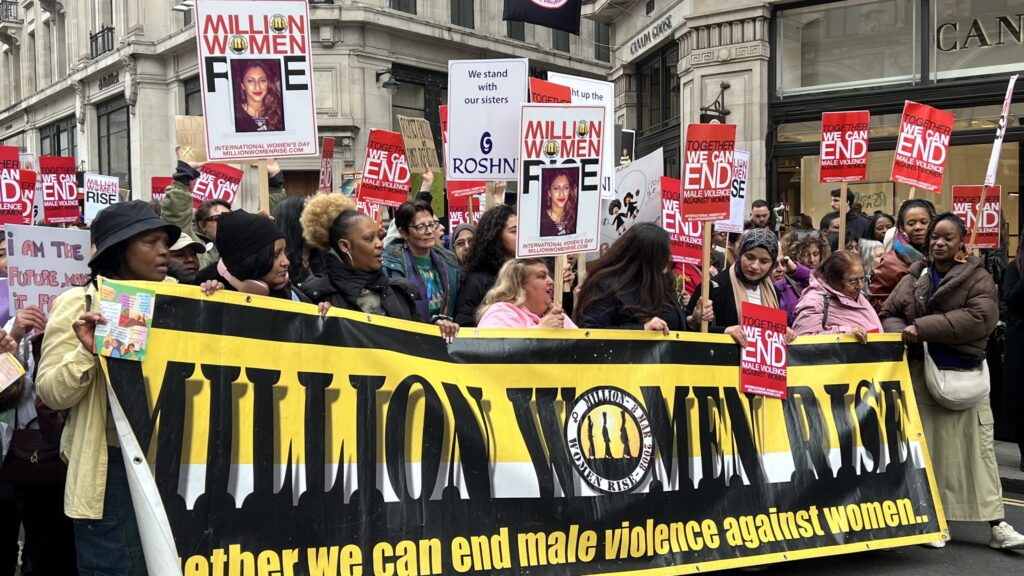
Last weekend, London hosted marches and events for International Women’s Day, as tens of thousands joined demonstrations, workshops, and discussions across the city.
While the celebrations highlighted women’s achievements, recent data shows that significant inequalities in pay and employment continue to shape women’s lives in the capital and across the UK.
New analysis from the Living Wage Foundation, based on figures from the Office for National Statistics, shows that millions of women remain in low-paid or insecure work.
Key statistics from the report include:
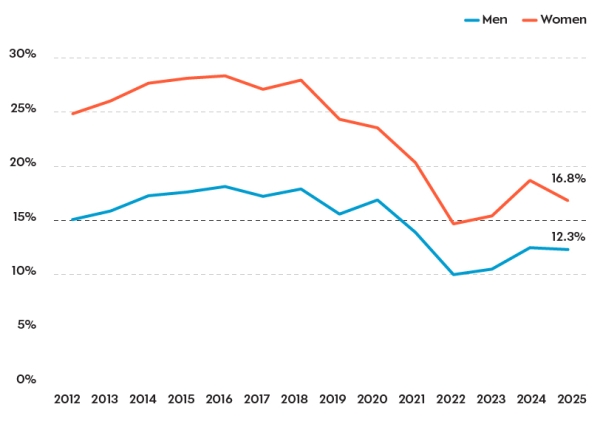
16.8% of jobs held by women in the UK are paid below the real Living Wage, compared with 12.3% of jobs held by men.
This represents 2.5 million women in low-paid work, around 700,000 more than men.
Women hold 58.6% of all low-paid jobs across the UK.
1.6 million women hold low-paid part-time roles, more than twice the number of men in similar positions.
“This year’s data shows that progress is possible. The low pay gender gap has narrowed to its lowest level on record, which is encouraging,” said Katherine Chapman, British labor policy leader and the Executive Director of the Living Wage Foundation.
Figure: Proportion of jobs below the real Living Wage by gender, 2012-2025. [Source: London Living Foundation]
“But millions of women are still earning less than they need to meet everyday costs. Women continue to be overrepresented in low-paid and part-time work, which affects their financial security both now and in the long term.”
Analysis by the Trades Union Congress paints a broader picture of pay inequality.
Based on official pay data, the union estimates that the UK gender pay gap will not close until 2056 if current trends continue.
The average difference between men’s and women’s earnings stands at 12.8%, equivalent to £2,548 per year.
The government has stated that it is working to address the root causes of the gap and to support women’s advancement in the workplace.
Disparities are also evident in London employment. According to the London Assembly:
71% of women aged 16 to 64 in London are employed, compared with 79% of men.
The gender employment gap in the capital stands at eight percentage points, wider than the national average.
Part of the gap is linked to differences in employment between parents and those without dependent children.
“I’ve been working in luxury retail for nearly a decade,” said Alessia H., a 33-year-old assistant manager based in London, “and I know for a fact that men in the same role as me get paid more.”
She adds, “It makes you feel underappreciated. You put in the same hours and efforts, but still feel like your work is valued less.”
Trades Union Congress reports that in wholesale and retail, the earnings gap is 10.5%, meaning that the average woman effectively works for free for 38 days.
As London reflects on International Women’s Day, and Women’s History Month continues, the latest statistics provide a snapshot of the economic and social challenges shaping women’s lives in the capital and across the UK.
Submitted Article
Headline
Short Headline
Standfirst
Published Article
HeadlineWomen in the UK still facing pay inequality
Short HeadlineUK Women Still Waiting for Equality
StandfirstWomen in the UK continue to face disparities in pay and employment, with the gender pay gap projected to last decades.
Last weekend, London hosted marches and events for International Women’s Day, as tens of thousands joined demonstrations, workshops, and discussions across the city.
While the celebrations highlighted women’s achievements, recent data shows that significant inequalities in pay and employment continue to shape women’s lives in the capital and across the UK.
New analysis from the Living Wage Foundation, based on figures from the Office for National Statistics, shows that millions of women remain in low-paid or insecure work.
Key statistics from the report include:
16.8% of jobs held by women in the UK are paid below the real Living Wage, compared with 12.3% of jobs held by men.
This represents 2.5 million women in low-paid work, around 700,000 more than men.
Women hold 58.6% of all low-paid jobs across the UK.
1.6 million women hold low-paid part-time roles, more than twice the number of men in similar positions.
“This year’s data shows that progress is possible. The low pay gender gap has narrowed to its lowest level on record, which is encouraging,” said Katherine Chapman, British labor policy leader and the Executive Director of the Living Wage Foundation.
Figure: Proportion of jobs below the real Living Wage by gender, 2012-2025. [Source: London Living Foundation]
“But millions of women are still earning less than they need to meet everyday costs. Women continue to be overrepresented in low-paid and part-time work, which affects their financial security both now and in the long term.”
Analysis by the Trades Union Congress paints a broader picture of pay inequality.
Based on official pay data, the union estimates that the UK gender pay gap will not close until 2056 if current trends continue.
The average difference between men’s and women’s earnings stands at 12.8%, equivalent to £2,548 per year.
The government has stated that it is working to address the root causes of the gap and to support women’s advancement in the workplace.
Disparities are also evident in London employment. According to the London Assembly:
71% of women aged 16 to 64 in London are employed, compared with 79% of men.
The gender employment gap in the capital stands at eight percentage points, wider than the national average.
Part of the gap is linked to differences in employment between parents and those without dependent children.
“I’ve been working in luxury retail for nearly a decade,” said Alessia H., a 33-year-old assistant manager based in London, “and I know for a fact that men in the same role as me get paid more.”
She adds, “It makes you feel underappreciated. You put in the same hours and efforts, but still feel like your work is valued less.”
Trades Union Congress reports that in wholesale and retail, the earnings gap is 10.5%, meaning that the average woman effectively works for free for 38 days.
As London reflects on International Women’s Day, and Women’s History Month continues, the latest statistics provide a snapshot of the economic and social challenges shaping women’s lives in the capital and across the UK.
A 2024 Freedom of Information request showed Bromley Council had £4.5 million invested in arms companies that year with £1.5 million reportedly linked to Israel.
Undercover officers raided three linked shops in Barking town centre, revealing how illicit tobacco is being hidden in walls, ceilings and nearby locations to evade detection.
More than 330,000 people across the UK sought support from the Stop It Now helpline in 2025 over concerns about their own or someone else’s online sexual behaviour towards children, according to new charity data. The anonymous service says contacts by phone, email and webchat rose significantly over the year.