Fresh ONS figures show unemployment is rising, while pay growth is starting to lose steam.
The UK jobless rate crept up from 5.1% in August to October 2025 to 5.2% in November 2025 to January 2026.
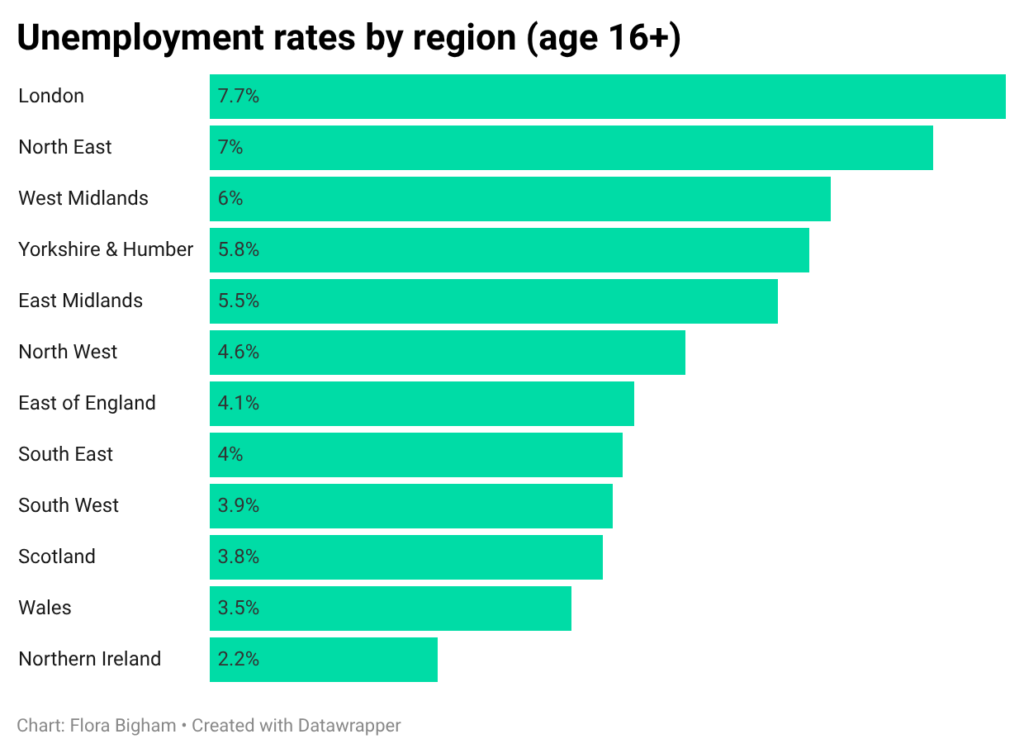
London stands out for the wrong reasons. The capital has the highest unemployment rate in the UK at 7.7%, ahead of the North East at 7.0% and the West Midlands at 6.0%.
Unemployment rates by region
Nationally, young people are bearing the brunt. Unemployment among 18 to 24-year-olds has climbed to 14.5%, up from 10.6% two years ago.
Aman Navani, senior research and policy analyst at Lancaster University’s Work Foundation, said the rise is being driven by a mix of factors. These include more young people struggling with mental health, a higher youth minimum wage and AI potentially squeezing some entry-level roles.
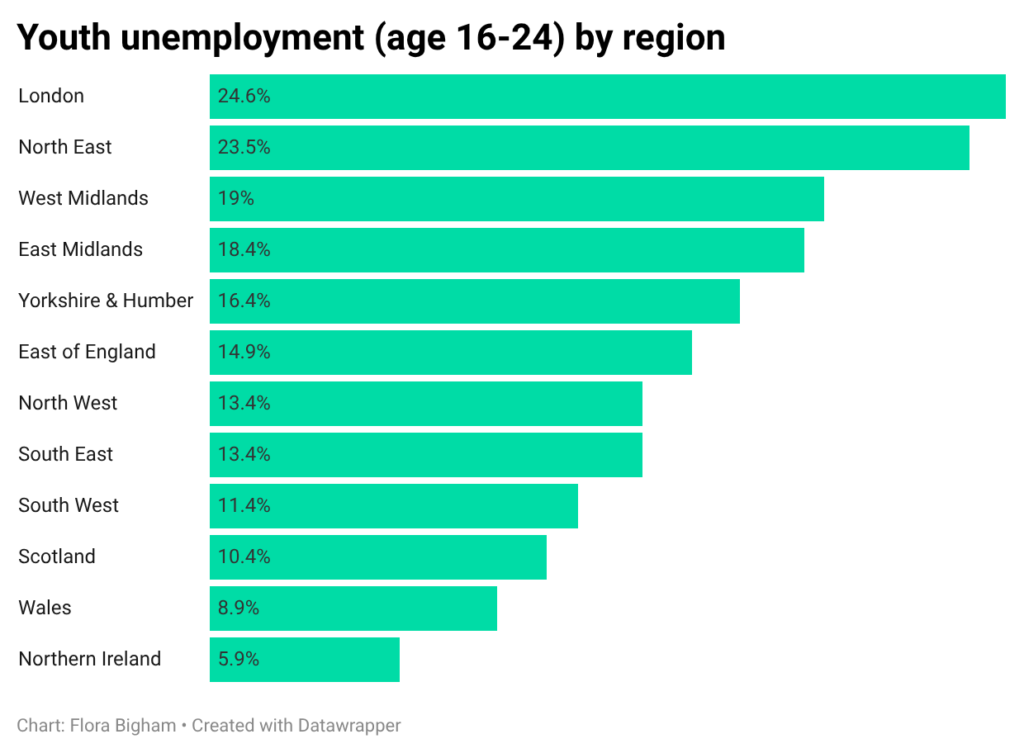
The picture is even worse in London. Nearly a quarter of 16 to 24-year-olds in the capital are unemployed, with the rate now at 24.6% — the highest of any UK region.
Professor Christopher Warhurst, director of Warwick University’s Institute for Employment Research, said London’s labour market is full of contradictions.
“It has the highest wages in the UK, but it also has the highest unemployment rate,” he said.
He said one reason is the capital’s punishing cost of living.
“low level jobs have been disrupted by the pandemic and I don’t think we’ve seen a full recovery yet”.
Prof Warhurst said the problem has been “compounded by residual hybrid working”, meaning fewer people are working in central London than before the pandemic.
He said a stronger return to the office would have a knock-on effect for sectors such as cleaning and hospitality.
Another issue is long-term sickness, which is more heavily concentrated in big cities. Prof Warhurst said that makes it a bigger problem for London than elsewhere.
The figures also show average earnings growth slowed to 3.8%, down from 4.2% — the weakest rate of wage growth in five years.
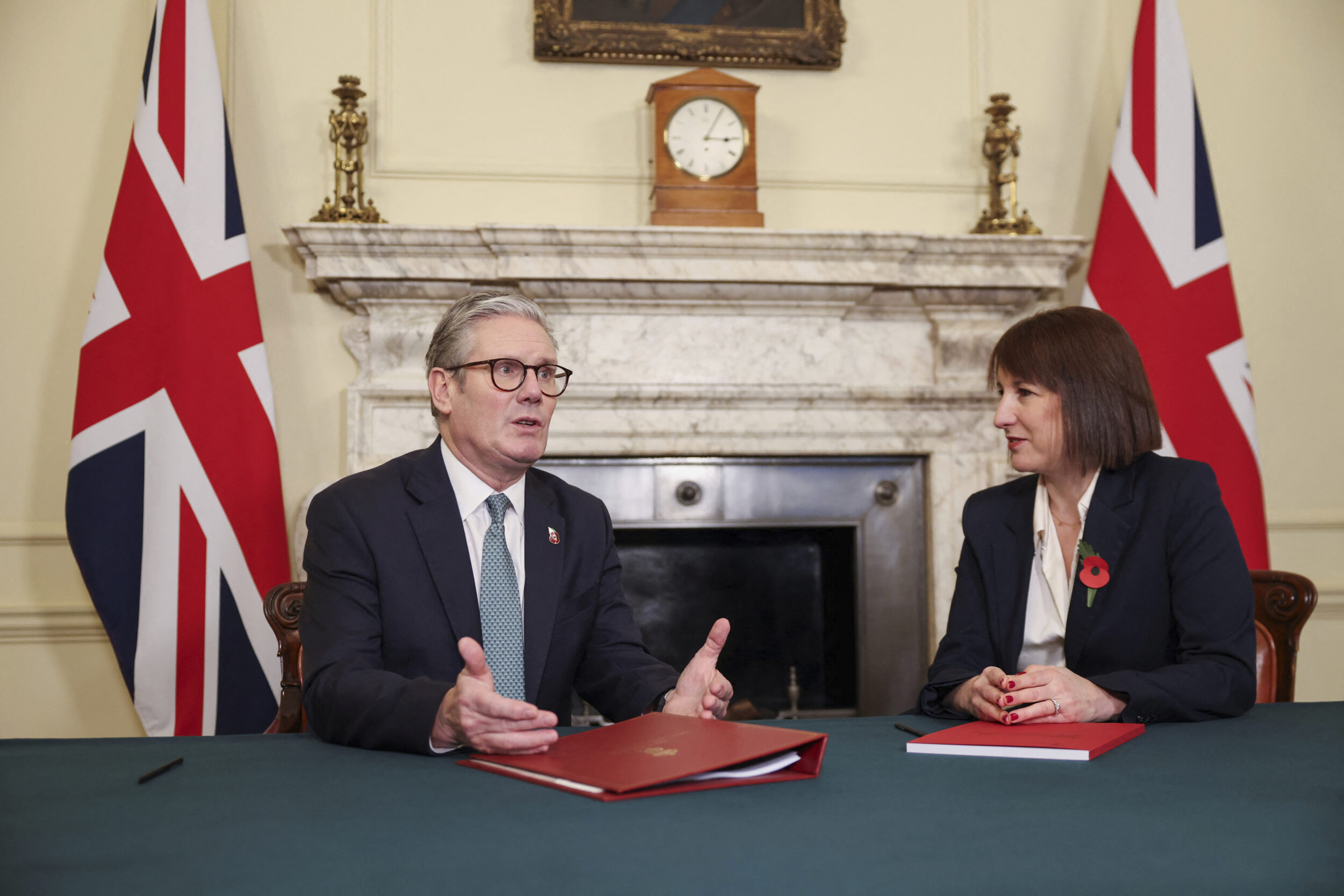
Britain’s Prime Minister Keir Starmer and Britain’s Chancellor of the Exchequer Rachel Reeves interact days before the announcement on the first budget of the new Labour government, at Downing Street, London on Monday, Oct. 28, 2024.
Pay is still rising slightly faster than inflation, which stood at 3.75%, meaning workers have some chance to claw back lost spending power. But Prof Warhurst said relative earnings have been falling for the past 10 to 12 years.
There was one brighter sign in the data. Economic inactivity fell to 20.7%, down 0.8 percentage points on last year.
Economic inactivity refers to people who are not in work and have not looked for a job in the last four weeks, or cannot start within the next two weeks.
Aman Navani said the rise in unemployment may be linked to that fall, with more people now looking for work but struggling to find it.
Professor Warhurst emphasised that while unemployment has slightly risen,
“the rate of employment has remained high at over 75%. We’ve got more people in work than ever before.”
The ONS recommends using these estimates as part of a “suite of labour market indicators, alongside workforce jobs, Claimant Count and Pay As You Earn (PAYE) Real Time Information (RTI) estimates.”
In response to the release, Secretary of State for Work and Pensions Pat McFadden said:
“Today’s figures show there are 388,000 more people in work than there was this time last year. While this is encouraging, we know there is more to do to get people, particularly young people, into work.
“That’s why we’re investing £2.5 billion to create up to 500,000 opportunities for young people to earn or learn, transform the welfare state into a working state – including a new £3,000 Youth Jobs Grant for businesses who take on eligible young people and expanding the Jobs Guarantee to cover 18- to 24-year-olds.
“We’re also delivering the biggest reforms to apprenticeships in a decade – giving employers more flexibility and expanding foundation apprenticeships into the hospitality and retail sectors.”
Submitted Article
Headline
Short Headline
Standfirst
Published Article
HeadlineLondon named unemployment capital of Britain as youth jobless rate soars
Short HeadlineLondon has UK’s highest unemployment rate
StandfirstAccording to the latest ONS figures, unemployment in London has risen to 7.7%, giving the capital the highest jobless rate in the UK
Fresh ONS figures show unemployment is rising, while pay growth is starting to lose steam.
The UK jobless rate crept up from 5.1% in August to October 2025 to 5.2% in November 2025 to January 2026.
London stands out for the wrong reasons. The capital has the highest unemployment rate in the UK at 7.7%, ahead of the North East at 7.0% and the West Midlands at 6.0%.
Unemployment rates by region
Nationally, young people are bearing the brunt. Unemployment among 18 to 24-year-olds has climbed to 14.5%, up from 10.6% two years ago.
Aman Navani, senior research and policy analyst at Lancaster University’s Work Foundation, said the rise is being driven by a mix of factors. These include more young people struggling with mental health, a higher youth minimum wage and AI potentially squeezing some entry-level roles.
The picture is even worse in London. Nearly a quarter of 16 to 24-year-olds in the capital are unemployed, with the rate now at 24.6% — the highest of any UK region.
Professor Christopher Warhurst, director of Warwick University’s Institute for Employment Research, said London’s labour market is full of contradictions.
“It has the highest wages in the UK, but it also has the highest unemployment rate,” he said.
He said one reason is the capital’s punishing cost of living.
“low level jobs have been disrupted by the pandemic and I don’t think we’ve seen a full recovery yet”.
Prof Warhurst said the problem has been “compounded by residual hybrid working”, meaning fewer people are working in central London than before the pandemic.
He said a stronger return to the office would have a knock-on effect for sectors such as cleaning and hospitality.
Another issue is long-term sickness, which is more heavily concentrated in big cities. Prof Warhurst said that makes it a bigger problem for London than elsewhere.
The figures also show average earnings growth slowed to 3.8%, down from 4.2% — the weakest rate of wage growth in five years.
Britain’s Prime Minister Keir Starmer and Britain’s Chancellor of the Exchequer Rachel Reeves interact days before the announcement on the first budget of the new Labour government, at Downing Street, London on Monday, Oct. 28, 2024.
Pay is still rising slightly faster than inflation, which stood at 3.75%, meaning workers have some chance to claw back lost spending power. But Prof Warhurst said relative earnings have been falling for the past 10 to 12 years.
There was one brighter sign in the data. Economic inactivity fell to 20.7%, down 0.8 percentage points on last year.
Economic inactivity refers to people who are not in work and have not looked for a job in the last four weeks, or cannot start within the next two weeks.
Aman Navani said the rise in unemployment may be linked to that fall, with more people now looking for work but struggling to find it.
Professor Warhurst emphasised that while unemployment has slightly risen,
“the rate of employment has remained high at over 75%. We’ve got more people in work than ever before.”
The ONS recommends using these estimates as part of a “suite of labour market indicators, alongside workforce jobs, Claimant Count and Pay As You Earn (PAYE) Real Time Information (RTI) estimates.”
In response to the release, Secretary of State for Work and Pensions Pat McFadden said:
“Today’s figures show there are 388,000 more people in work than there was this time last year. While this is encouraging, we know there is more to do to get people, particularly young people, into work.
“That’s why we’re investing £2.5 billion to create up to 500,000 opportunities for young people to earn or learn, transform the welfare state into a working state – including a new £3,000 Youth Jobs Grant for businesses who take on eligible young people and expanding the Jobs Guarantee to cover 18- to 24-year-olds.
“We’re also delivering the biggest reforms to apprenticeships in a decade – giving employers more flexibility and expanding foundation apprenticeships into the hospitality and retail sectors.”
A 2024 Freedom of Information request showed Bromley Council had £4.5 million invested in arms companies that year with £1.5 million reportedly linked to Israel.
Undercover officers raided three linked shops in Barking town centre, revealing how illicit tobacco is being hidden in walls, ceilings and nearby locations to evade detection.
More than 330,000 people across the UK sought support from the Stop It Now helpline in 2025 over concerns about their own or someone else’s online sexual behaviour towards children, according to new charity data. The anonymous service says contacts by phone, email and webchat rose significantly over the year.