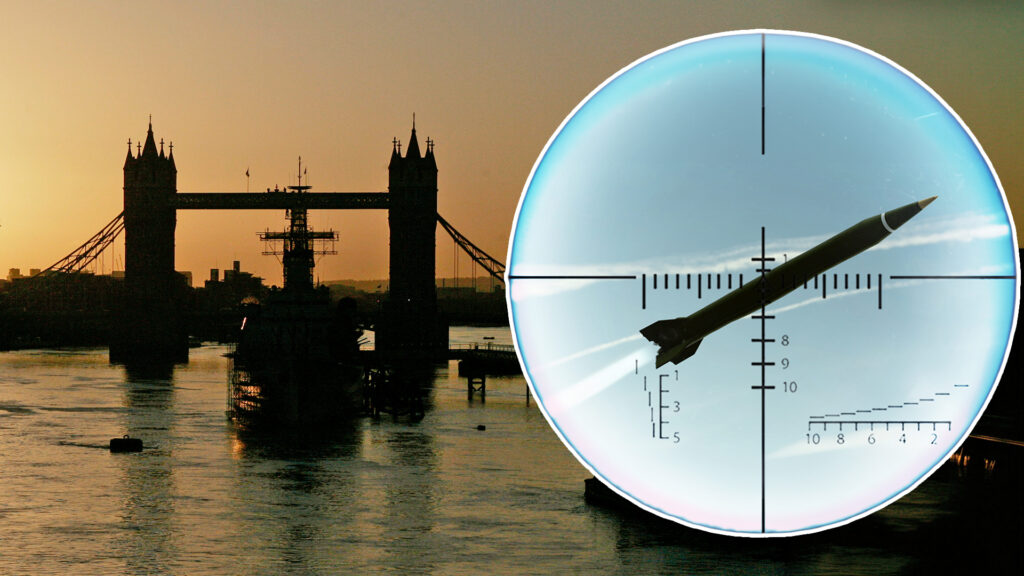
Could Iran strike London – and what would they target?
News that Iran fired two missiles at the joint UK–US military base Diego Garcia has prompted fears that the regime has been dishonest about its capabilities and that London could now be in reach.
The government has been warned that Iranian missiles can reach London after Iran targeted a joint UK–US base.
Last week, the government confirmed that Iran fired two ballistic missiles at Diego Garcia, the joint UK–US military base located on the Chagos Islands, roughly 2,400 miles from Iran. One missile was intercepted by a US warship, while the other failed mid-flight. Israeli officials say the attack used the Khorramshahr-4 missile, believed to have a range of up to 2,500 miles, far beyond Iran’s previously declared limit for its weapons.
If accurate, this would place major European cities, including London, within reach, while Portsmouth, home to much of the Royal Navy, would sit near the edge of the missile’s potential strike radius.
The attempted strike follows tensions over the UK’s role in the latest conflict in the Middle East, after the US and Israel jointly attacked Iran nearly a month ago. Ministers had initially rejected US requests to launch operations from British facilities before allowing their use for “defensive purposes.”
Questions have been raised over the UK’s ability to defend itself. The Royal Navy’s six Type 45 destroyers do have ballistic missile defence, but most are currently in maintenance. Only HMS Dragon, currently defending Cyprus, and HMS Duncan, docked in Portsmouth, are thought to be operational. The UK also lacks a ground-based missile defence system, meaning it would likely rely on NATO allies to intercept any incoming threat.
FILE – This image released by the U.S. Navy shows an aerial view of Diego Garcia. (U.S. Navy via AP, File)
What has the government said?
Communities Secretary Steve Reed dismissed threats of an Iranian strike, saying, “I’m not aware of any assessment at all that they are even trying to target Europe, let alone that they could if they tried.” He added, “Even if they did, we have the necessary military capability to defend this country.”
But former Senior British Military Intelligence Officer and NATO Planner, Philip Ingram, has accused Mr Reed of misleading the public. He told City News, “The trouble is whether he’s being mis-briefed or lying through his teeth. He is a government minister, and he is misleading the general public as to the state of defence in the UK.”
Mr Ingram downplays the ability of European allies to protect Britain should it come under attack. Apart from the limited availability of Type 45 destroyers, he states the country has little to defend itself.
“Have we got anything else that can deal with the ballistic missile threat in the UK? No. And therefore, the commentary that we’ve seen from government ministers in the last few days describing that we have a layered air defence system that can deal with any of the threats that come in is, frankly, lies.”
The incident is likely to fuel debate over Britain’s defence spending and its preparedness for war. Last year, the UK allocated roughly 2.3% of GDP to defence. The government has pledged to increase this to 2.5% by 2027, and to 3% should they be re-elected.
Mr Ingram argues that successive governments have underdelivered on defence spending, despite signs of a “clear path to global conflict.”
“Too many governments have for years seen the defence budget as a pool of money to dip into to be able to turn around and give to departments that are much more in the public eye.”
When asked whether he considers an Iranian attack on London plausible, Mr Ingram responds that it is “theoretically possible.” But he describes the attack on Diego Garcia as more “psychological” and suggests Iran is employing a “physical capability in the information sphere” to generate fear across Europe.
What would a strike look like?
To test how credible these fears are, we asked AI what a potential Iranian strike might target. Here’s a summary of what it said:
Any Iranian strike would likely focus on military and command infrastructure, such as the Ministry of Defence, RAF bases, or naval headquarters, reflecting Tehran’s pattern of targeting perceived participants in actions against it. NATO-linked sites or UK–US cooperation hubs could also be framed as legitimate targets. Political leadership was mentioned, but only in extreme, highly escalatory scenarios.
However, limited missile accuracy at long range makes a direct hit on London unlikely. Iran might instead aim for offshore or sparsely populated areas to demonstrate capability while limiting casualties. Overall, the threat is evolving, but a direct strike on London remains unlikely, with NATO defences adding further protection.
Similar assessments highlighted potential targets including Northwood Headquarters, the MOD, Portsmouth naval facilities, and critical infrastructure, while emphasising layered NATO missile defences and the high risk of interception. Any attack on London would likely trigger NATO’s Article 5, risking overwhelming retaliation. The chance of a successful strike is considered very low, with debris from interceptions posing a more realistic risk than a direct hit.
The key shift is not imminent danger to London, but a weakening of assumptions about Iran’s range. The real takeaway is strategic: UK defence planning must now seriously consider long-range missile threats, NATO reliance, and national resilience.
A broader threat
Mr Ingram argues the more immediate danger may not come from missiles at all. Having worked on intelligence operations targeting Iranian proxies, he states the real threat is not in the skies but on the streets.
“They’ve got sleeper cells they can stand up, and they could if they wanted to have a military effect or a bigger political effect, stimulate a lot of coordinated terrorist attacks across the UK, that would have a much more significant impact on the ground than a missile being fired from Iran.”
View at burnt Ambulances in a car park at Golders Green in London, Monday, March 23, 2026 after an apparent arson attack on four vehicles belonging to a Jewish ambulance service, Hatzola Northwest, in London.(AP Photo/Alberto Pezzali)
Mr Ingram says recent arrests are evidence of this broader threat.
Yesterday, two men were arrested on suspicion of arson with intent to endanger life after four Hatzolah ambulances were set alight in North London, in what’s being treated as an antisemitic attack. An Iranian-linked terror group has claimed responsibility. Separately, two men recently appeared in court, accused of spying on the London Jewish community for Iran.
Submitted Article
Headline
Short Headline
Standfirst
Published Article
HeadlineCould Iran strike London – and what would they target?
Short HeadlineCould Iranian missiles really reach London?
StandfirstNews that Iran fired two missiles at the joint UK–US military base Diego Garcia has prompted fears that the regime has been dishonest about its capabilities and that London could now be in reach.
The government has been warned that Iranian missiles can reach London after Iran targeted a joint UK–US base.
Last week, the government confirmed that Iran fired two ballistic missiles at Diego Garcia, the joint UK–US military base located on the Chagos Islands, roughly 2,400 miles from Iran. One missile was intercepted by a US warship, while the other failed mid-flight. Israeli officials say the attack used the Khorramshahr-4 missile, believed to have a range of up to 2,500 miles, far beyond Iran’s previously declared limit for its weapons.
If accurate, this would place major European cities, including London, within reach, while Portsmouth, home to much of the Royal Navy, would sit near the edge of the missile’s potential strike radius.
The attempted strike follows tensions over the UK’s role in the latest conflict in the Middle East, after the US and Israel jointly attacked Iran nearly a month ago. Ministers had initially rejected US requests to launch operations from British facilities before allowing their use for “defensive purposes.”
Questions have been raised over the UK’s ability to defend itself. The Royal Navy’s six Type 45 destroyers do have ballistic missile defence, but most are currently in maintenance. Only HMS Dragon, currently defending Cyprus, and HMS Duncan, docked in Portsmouth, are thought to be operational. The UK also lacks a ground-based missile defence system, meaning it would likely rely on NATO allies to intercept any incoming threat.
FILE – This image released by the U.S. Navy shows an aerial view of Diego Garcia. (U.S. Navy via AP, File)
What has the government said?
Communities Secretary Steve Reed dismissed threats of an Iranian strike, saying, “I’m not aware of any assessment at all that they are even trying to target Europe, let alone that they could if they tried.” He added, “Even if they did, we have the necessary military capability to defend this country.”
But former Senior British Military Intelligence Officer and NATO Planner, Philip Ingram, has accused Mr Reed of misleading the public. He told City News, “The trouble is whether he’s being mis-briefed or lying through his teeth. He is a government minister, and he is misleading the general public as to the state of defence in the UK.”
Mr Ingram downplays the ability of European allies to protect Britain should it come under attack. Apart from the limited availability of Type 45 destroyers, he states the country has little to defend itself.
“Have we got anything else that can deal with the ballistic missile threat in the UK? No. And therefore, the commentary that we’ve seen from government ministers in the last few days describing that we have a layered air defence system that can deal with any of the threats that come in is, frankly, lies.”
The incident is likely to fuel debate over Britain’s defence spending and its preparedness for war. Last year, the UK allocated roughly 2.3% of GDP to defence. The government has pledged to increase this to 2.5% by 2027, and to 3% should they be re-elected.
Mr Ingram argues that successive governments have underdelivered on defence spending, despite signs of a “clear path to global conflict.”
“Too many governments have for years seen the defence budget as a pool of money to dip into to be able to turn around and give to departments that are much more in the public eye.”
When asked whether he considers an Iranian attack on London plausible, Mr Ingram responds that it is “theoretically possible.” But he describes the attack on Diego Garcia as more “psychological” and suggests Iran is employing a “physical capability in the information sphere” to generate fear across Europe.
What would a strike look like?
To test how credible these fears are, we asked AI what a potential Iranian strike might target. Here’s a summary of what it said:
Any Iranian strike would likely focus on military and command infrastructure, such as the Ministry of Defence, RAF bases, or naval headquarters, reflecting Tehran’s pattern of targeting perceived participants in actions against it. NATO-linked sites or UK–US cooperation hubs could also be framed as legitimate targets. Political leadership was mentioned, but only in extreme, highly escalatory scenarios.
However, limited missile accuracy at long range makes a direct hit on London unlikely. Iran might instead aim for offshore or sparsely populated areas to demonstrate capability while limiting casualties. Overall, the threat is evolving, but a direct strike on London remains unlikely, with NATO defences adding further protection.
Similar assessments highlighted potential targets including Northwood Headquarters, the MOD, Portsmouth naval facilities, and critical infrastructure, while emphasising layered NATO missile defences and the high risk of interception. Any attack on London would likely trigger NATO’s Article 5, risking overwhelming retaliation. The chance of a successful strike is considered very low, with debris from interceptions posing a more realistic risk than a direct hit.
The key shift is not imminent danger to London, but a weakening of assumptions about Iran’s range. The real takeaway is strategic: UK defence planning must now seriously consider long-range missile threats, NATO reliance, and national resilience.
A broader threat
Mr Ingram argues the more immediate danger may not come from missiles at all. Having worked on intelligence operations targeting Iranian proxies, he states the real threat is not in the skies but on the streets.
“They’ve got sleeper cells they can stand up, and they could if they wanted to have a military effect or a bigger political effect, stimulate a lot of coordinated terrorist attacks across the UK, that would have a much more significant impact on the ground than a missile being fired from Iran.”
View at burnt Ambulances in a car park at Golders Green in London, Monday, March 23, 2026 after an apparent arson attack on four vehicles belonging to a Jewish ambulance service, Hatzola Northwest, in London.(AP Photo/Alberto Pezzali)
Mr Ingram says recent arrests are evidence of this broader threat.
Yesterday, two men were arrested on suspicion of arson with intent to endanger life after four Hatzolah ambulances were set alight in North London, in what’s being treated as an antisemitic attack. An Iranian-linked terror group has claimed responsibility. Separately, two men recently appeared in court, accused of spying on the London Jewish community for Iran.
A 2024 Freedom of Information request showed Bromley Council had £4.5 million invested in arms companies that year with £1.5 million reportedly linked to Israel.
Undercover officers raided three linked shops in Barking town centre, revealing how illicit tobacco is being hidden in walls, ceilings and nearby locations to evade detection.
More than 330,000 people across the UK sought support from the Stop It Now helpline in 2025 over concerns about their own or someone else’s online sexual behaviour towards children, according to new charity data. The anonymous service says contacts by phone, email and webchat rose significantly over the year.