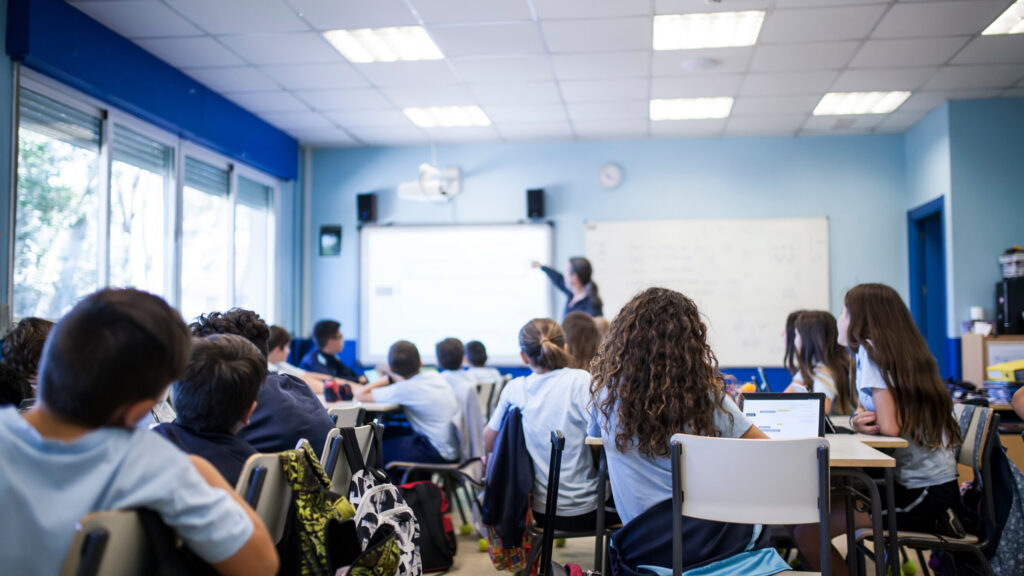
Teachers and students have told City News digital poverty is creating a hidden divide in London’s schools.
In boroughs such as Newham and Barking and Dagenham, where many students are from poorer backgrounds, research suggests the lack of access to reliable devices, broadband, or digital skills, risks students falling behind those in wealthier parts of the capital.
The Shift Online
Since the pandemic, much of the learning in secondary schools has moved online.
The Digital Poverty Alliance reports that one in five children in the UK lacks a suitable digital device, while 58% rely mainly on smartphones to complete schoolwork.
The Greater London Authority estimates around 270,000 Londoners are completely offline, with another two million having limited digital access.
Laptops or Lost Learning
For Mejia, a Year 11 student in Newham preparing for her GCSEs, access to a device isn’t optional, it’s essential.
“Without a device, you simply wouldn’t be able to complete it. In preparation for my exams, I’m using the iPad for at least 4–5 hours per day.”
At Mejia’s school, School 21 in Stratford, even subjects like English, which is traditionally reliant on paper texts, provide practice exams, poetry anthologies, and comprehension exercises digitally.
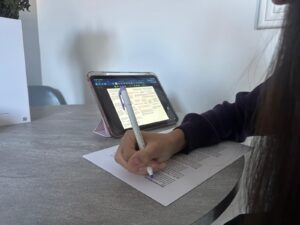
Meija doing her homework
At home, Mejia shares one iPad with her parents and younger sister, Alyssia, a Year 5 student, who also completes most of her homework online.
School 21 provides Chromebooks from Year 7, but they are often pre-used and fragile.
“Once they break or have issues, repairs and replacements are limited. It can leave students weeks or even months without a device,” Mejia told CityNews.
Students said they often have to borrow devices, share with siblings, or work late in communal libraries, which can be stressful.
A Two-Tier Classroom
Teachers see the divide first hand as Denise Allen, a secondary school teacher in Dagenham, explains:
“It’s created a two-tier system. Children from families with money for technology have access to resources that help with homework, research, and revision. Children without access are at a huge disadvantage.”
Teachers now double-plan lessons, creating both digital and printed resources – work that Allen describes as exhausting.
“Most departments now use ‘Digital First’ platforms because they’re easier to track. We tell students the school library is open until 4pm, but for a child who must pick up siblings or whose parents work late, that’s not a real solution.”
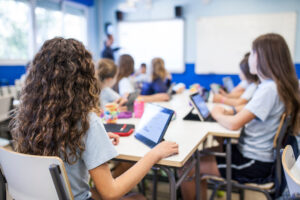
Photo Credit: Dave fuentes
The consequences extend beyond school.
Allen warns of a “digital underclass” emerging in East London, and says students who struggle with online applications or basic software may already be locked out of the job market.
The Scale of the Problem
20% of children in the UK lack a suitable digital device (Digital Poverty Alliance)
15% of young people aged 8–25 lack home broadband (Good Things Foundation)
Elizabeth Anderson, CEO of the Digital Poverty Alliance, stresses the link between access and achievement:
“Educational success is now directly tied to digital access. Students without devices struggle with homework, coursework, and exams. Phones are not sufficient.”
Closing the Gap
According to the Digital Poverty Alliance, nearly one million 16-24-year-olds in the UK are not in education, employment, or training.
Some initiatives aim to help.
EasyJet, in partnership with the Digital Poverty Alliance, has promised to donate around 500 iPads to schools in deprived areas. Local borough programmes, such as Get Online London, provide digital skills workshops, free data, and device loans.
For students like Mejia, these resources could mean more reliable devices and stronger digital skills, helping her keep up with homework, research, and revision.
“One-off donations or training sessions are helpful, but they cannot fully resolve structural inequalities,” warns Denise Allen.
“We need to stop treating a laptop like a luxury and Government funding for one-to-one devices is the only way to level the field” Allen added.
Submitted Article
Headline
Short Headline
Standfirst
Published Article
HeadlineThe “Two-Tier” Classroom: How Digital Poverty is Shaping London Education
Short HeadlineTeachers say a digital divide is leaving some London students behind
StandfirstStudents across London risk falling behind as access to laptops, Wi-Fi and digital skills becomes essential to learning.
Teachers and students have told City News digital poverty is creating a hidden divide in London’s schools.
In boroughs such as Newham and Barking and Dagenham, where many students are from poorer backgrounds, research suggests the lack of access to reliable devices, broadband, or digital skills, risks students falling behind those in wealthier parts of the capital.
The Shift Online
Since the pandemic, much of the learning in secondary schools has moved online.
The Digital Poverty Alliance reports that one in five children in the UK lacks a suitable digital device, while 58% rely mainly on smartphones to complete schoolwork.
The Greater London Authority estimates around 270,000 Londoners are completely offline, with another two million having limited digital access.
Laptops or Lost Learning
For Mejia, a Year 11 student in Newham preparing for her GCSEs, access to a device isn’t optional, it’s essential.
“Without a device, you simply wouldn’t be able to complete it. In preparation for my exams, I’m using the iPad for at least 4–5 hours per day.”
At Mejia’s school, School 21 in Stratford, even subjects like English, which is traditionally reliant on paper texts, provide practice exams, poetry anthologies, and comprehension exercises digitally.
Meija doing her homework
At home, Mejia shares one iPad with her parents and younger sister, Alyssia, a Year 5 student, who also completes most of her homework online.
School 21 provides Chromebooks from Year 7, but they are often pre-used and fragile.
“Once they break or have issues, repairs and replacements are limited. It can leave students weeks or even months without a device,” Mejia told CityNews.
Students said they often have to borrow devices, share with siblings, or work late in communal libraries, which can be stressful.
A Two-Tier Classroom
Teachers see the divide first hand as Denise Allen, a secondary school teacher in Dagenham, explains:
“It’s created a two-tier system. Children from families with money for technology have access to resources that help with homework, research, and revision. Children without access are at a huge disadvantage.”
Teachers now double-plan lessons, creating both digital and printed resources – work that Allen describes as exhausting.
“Most departments now use ‘Digital First’ platforms because they’re easier to track. We tell students the school library is open until 4pm, but for a child who must pick up siblings or whose parents work late, that’s not a real solution.”
Photo Credit: Dave fuentes
The consequences extend beyond school.
Allen warns of a “digital underclass” emerging in East London, and says students who struggle with online applications or basic software may already be locked out of the job market.
The Scale of the Problem
20% of children in the UK lack a suitable digital device (Digital Poverty Alliance)
15% of young people aged 8–25 lack home broadband (Good Things Foundation)
Elizabeth Anderson, CEO of the Digital Poverty Alliance, stresses the link between access and achievement:
“Educational success is now directly tied to digital access. Students without devices struggle with homework, coursework, and exams. Phones are not sufficient.”
Closing the Gap
According to the Digital Poverty Alliance, nearly one million 16-24-year-olds in the UK are not in education, employment, or training.
Some initiatives aim to help.
EasyJet, in partnership with the Digital Poverty Alliance, has promised to donate around 500 iPads to schools in deprived areas. Local borough programmes, such as Get Online London, provide digital skills workshops, free data, and device loans.
For students like Mejia, these resources could mean more reliable devices and stronger digital skills, helping her keep up with homework, research, and revision.
“One-off donations or training sessions are helpful, but they cannot fully resolve structural inequalities,” warns Denise Allen.
“We need to stop treating a laptop like a luxury and Government funding for one-to-one devices is the only way to level the field” Allen added.
A 2024 Freedom of Information request showed Bromley Council had £4.5 million invested in arms companies that year with £1.5 million reportedly linked to Israel.
Undercover officers raided three linked shops in Barking town centre, revealing how illicit tobacco is being hidden in walls, ceilings and nearby locations to evade detection.
More than 330,000 people across the UK sought support from the Stop It Now helpline in 2025 over concerns about their own or someone else’s online sexual behaviour towards children, according to new charity data. The anonymous service says contacts by phone, email and webchat rose significantly over the year.