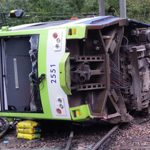
Seven people were killed and more than 50 injured when the tram derailed and overturned during the morning rush hour on 9 November 2016.
SHARE:
No charges will be brought against the driver or the operator of a tram which crashed in Croydon in 2016, killing seven people.
The driver of the tram will not be charged with gross negligence manslaughter and no charge for corporate manslaughter will be brought against operator Tram Operations Limited, British Transport Police (BTP) said.
Seven people were killed and more than 50 injured when the tram derailed and overturned during the morning rush hour on 9 November 2016.
The driver, Alfred Dorris, from southeast London, was arrested at the scene in the immediate aftermath.
The Rail Accident Investigation Branch (RAIB) said the driver may have fallen into “microsleep” before speeding around a bend near Sandilands at 45mph – four times the speed limit – causing the tram to derail.
Moreover, neither TfL nor Trams Operations Ltd, a subsidiary of FirstGroup, have been charged for corporate manslaughter.
According to British Transport Police (BTP) “every scrap of possible evidence has been scrutinised and, after lengthy consultation with the Crown Prosecution Service, it has been concluded that the threshold to bring charges of manslaughter against the tram driver, TfL and Tram Operations Ltd, have not been met.”
RAIB have said that it is “probable” Mr Dorris “lost awareness” whilst driving along a straight section of track, falling into a “microsleep” for just shy of a minute, causing the tram to career around a sharp bend close to the Sandilands stop close to Croydon town centre.
The head of the Crown Prosecution Service Special Crime and Counter Terrorism Division, Jenny Hopkins said that “tram crash has had a devastating effect on the local community, especially the families and friends of the seven people who so tragically lost their lives.”
However, she concluded that on the basis of the evidence, prosecutions could not be supported. In her statement, she addressed the families of the seven people killed, conceding that the police “fully recognise the impact this decision will have”.
Submitted Article
Headline
Short Headline
Standfirst
Published Article
HeadlineNo charges for driver and operator in 2016 Croydon tram crash case which killed seven
Short HeadlineNo charges for 2016 Croydon tram crash
StandfirstBritish Transport Police says the evidence did not support a gross negligence manslaughter charge.
Alfred Dorris, the driver in the Croydon tram crash will not face gross negligence manslaughter charges, say police.
Mr Dorris was arrested at the scene in the immediate aftermath of the crash on 9 November 2016, in which seven people were killed and fifty-one were injured. The Rail Accident Investigation Branch (RAIB) say the driver may have fallen into ‘microsleep’ before speeding around a bend near Sandilands at 45mph – four times the speed limit – causing the tram to derail.
Moreover, neither TFL nor Trams Operations Ltd, a subsidiary of FirstGroup, have been charged for corporate manslaughter. According to British Transport Police (BTP) “every scrap of possible evidence has been scrutinised and, after lengthy consultation with the CPS, it has been concluded that the threshold to bring charges of manslaughter against the tram driver, TfL and Tram Operations Ltd, have not been met.”
RAIB have said that it is “probable” Mr Dorris “lost awareness” whilst driving along a straight section of track, falling into a “microsleep” for just shy of a minute, causing the tram to career around a sharp bend close to the Sandilands stop close to Croydon town centre.
The head of the Crown Prosecution Service Special Crime and Counter Terrorism Division, Jenny Hopkins said that “tram crash has had a devastating effect on the local community, especially the families and friends of the seven people who so tragically lost their lives.” However, she concluded that on the basis of the evidence, prosecutions could not be supported. In her statement, she addressed the families of the seven people killed, conceding that the police “fully recognise the impact this decision will have”.
No charges will be brought against the driver or the operator of a tram which crashed in Croydon in 2016, killing seven people.
The driver of the tram will not be charged with gross negligence manslaughter and no charge for corporate manslaughter will be brought against operator Tram Operations Limited, British Transport Police (BTP) said.
Seven people were killed and more than 50 injured when the tram derailed and overturned during the morning rush hour on 9 November 2016.
The driver, Alfred Dorris, from southeast London, was arrested at the scene in the immediate aftermath.
The Rail Accident Investigation Branch (RAIB) said the driver may have fallen into “microsleep” before speeding around a bend near Sandilands at 45mph – four times the speed limit – causing the tram to derail.
Moreover, neither TfL nor Trams Operations Ltd, a subsidiary of FirstGroup, have been charged for corporate manslaughter.
According to British Transport Police (BTP) “every scrap of possible evidence has been scrutinised and, after lengthy consultation with the Crown Prosecution Service, it has been concluded that the threshold to bring charges of manslaughter against the tram driver, TfL and Tram Operations Ltd, have not been met.”
RAIB have said that it is “probable” Mr Dorris “lost awareness” whilst driving along a straight section of track, falling into a “microsleep” for just shy of a minute, causing the tram to career around a sharp bend close to the Sandilands stop close to Croydon town centre.
The head of the Crown Prosecution Service Special Crime and Counter Terrorism Division, Jenny Hopkins said that “tram crash has had a devastating effect on the local community, especially the families and friends of the seven people who so tragically lost their lives.”
However, she concluded that on the basis of the evidence, prosecutions could not be supported. In her statement, she addressed the families of the seven people killed, conceding that the police “fully recognise the impact this decision will have”.
Internationally renowned for transforming her life into confessional art, the exhibition offers an intimate and unapologetic glimpse into one of Britain’s most influential contemporary artists.
As e-bike riders weave through London’s busiest junctions, red lights are increasingly treated as optional. One software engineer says the problem may be baked into how hire firms charge users