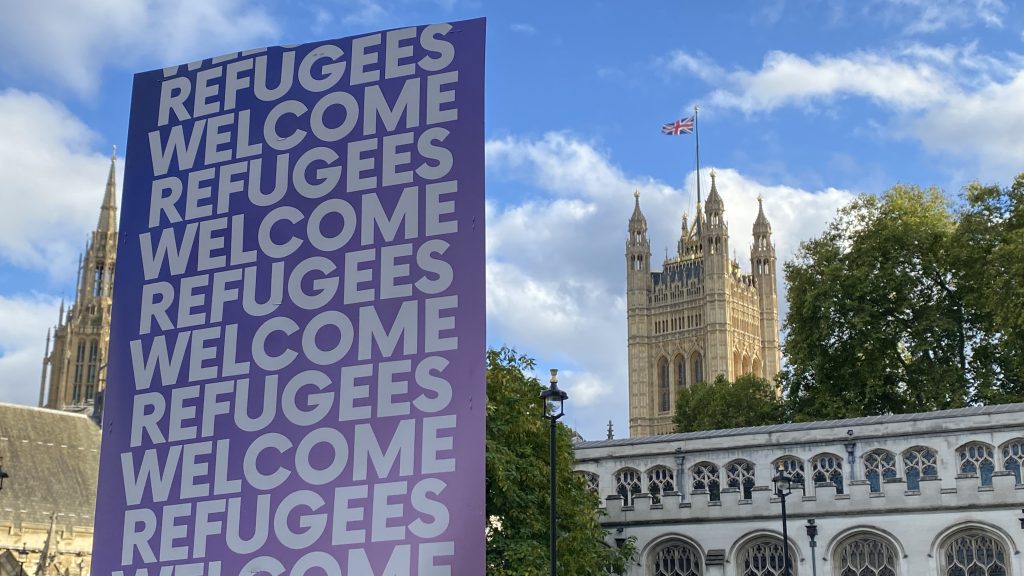
The government hopes the nationality and borders bill will deter people from entering the UK illegally. Tom Numan/ City News.
SHARE:
A proposed asylum law will not stop people attempting to reach the UK, according to migrants who have made the journey.
MPs will debate the Nationality and Borders Bill on Thursday after hundreds protested outside Parliament on Wednesday afternoon.
The government says its new plan for migration will increase the fairness of the asylum system and deter people from attempting dangerous border crossings.
Protesters called on the government to grant anyone crosses borders a “fair hearing and a chance to rebuild their lives.” Tash Montague/ City News.
Mohammed, a Yemeni asylum seeker, said those trying to get to the UK “don’t understand the UK’s laws” when they travel, and “the new law is not going to prevent people from coming.”
He and other asylum seekers also spoke about their long waits to be granted refugee status.
London has seen a particular increase in recent years, with people receiving interim financial aid while applying for refugee status rising sharply since March this year.
Our firm but fair Borders Bill is back in the Commons today. It will help minimise delays in our immigration system by preventing repeated appeals in cases the courts have ruled to be without merit.
The government hopes the Nationality and Borders Bill will reduce illegal migration to the UK by those seeking asylum. It has been described as the “cornerstone” of the governments new plan for immigration which includes a four year prison sentence for people who enter the UK through illegal means.
Labour peer and former Battersea MP Alf Dubs says the bill has “nasty features” which are a “fundamental breach of human rights”.
He added, “I think it’s a very nasty piece of work.”
Lord Dubs’ concerns echo the United Nations Refugee Agency, which said the bill would create a “discriminatory two-tier asylum system” and undermine the 1951 Refugee Convention.
Lord Dubs is a former director of the Refugee Council. Source: Getty
There are also practical concerns about the bill’s impact on the UK asylum system if it is enforced. It gives the government the power to return asylum seekers to ‘“safe” countries that migrants have passed though but the UK currently has no agreements with other countries to enforce this.
Asylum Seeker Application Backlogs
There is currently a large backlog in asylum applications being processed, with over 100,000 cases still being pending at the end of 2020.
Ahmad, who lives in Wembley and is awaiting asylum, said he had lived in London for over a year and has still not had his substantive interview, a crucial step towards being granted asylum.
“I feel I am nothing to this country. I feel we sit here for months”, he said.
Home Office data shows that the number of asylum cases still being processed almost trebled from June 2012 to June 2021. The biggest rise was in people still awaiting an initial decision. That number sat at 57,100 in June.
The most significant rise was in applications awaiting an initial decision. Source: House of Commons Library
Waleed Zuoriki from East London was recently granted asylum, two years after applying after fleeing Yemen.
He said he and others were “waiting for two years, one year, waiting for a substantive interview. For what? We don’t have any reasons.”
London refugee applications up
The asylum caseload in London has grown significantly this year.
In the capital, the number of people on section 95 support rose 94% between June 2017 and June 2021. That figure included a 21% increase between March and June this year.
Thousands have attempted to cross the English Channel this year. Source: AP
The rising numbers in London reflect a recent spate of channel crossings.
More than 19,400 people have crossed the English Channel, with 3,879 of those making the journey in September. 800 migrants reached Kent in small boats last weekend alone.
The government hopes the new law will deter people from attempting to enter the UK illegally, including crossing the Channel.
Will the bill pass?
The Nationality and Borders Bill is in its committee stage in the House of Commons, where MPs scrutinise the proposed law line-by-line.
The bill passed its second reading in June with 366 votes to 265. Conservative and DUP MPs were the only parties to back the government.
After passing the committee stage, MPs will debate and vote on the bill a final time. Given the government’s parliamentary majority, Lord Dubs said opponents are hoping to amend the bill rather than voting it down in its entirety.
Submitted Article
Headline
Short Headline
Standfirst
Published Article
HeadlineAsylum law won’t put migrants off travelling to UK, refugee protesters warn
Short HeadlineAsylum law won't stop migrant flow, say protestors
StandfirstMPs are debating the Nationality and Borders Bill as the number of asylum applicants receiving financial aid in London grows by 94%.
A proposed asylum law will not stop people attempting to reach the UK, according to migrants who have made the journey.
MPs will debate the Nationality and Borders Bill on Thursday after hundreds protested outside Parliament on Wednesday afternoon.
The government says its new plan for migration will increase the fairness of the asylum system and deter people from attempting dangerous border crossings.
Protesters called on the government to grant anyone crosses borders a “fair hearing and a chance to rebuild their lives.” Tash Montague/ City News.
Mohammed, a Yemeni asylum seeker, said those trying to get to the UK “don’t understand the UK’s laws” when they travel, and “the new law is not going to prevent people from coming.”
He and other asylum seekers also spoke about their long waits to be granted refugee status.
London has seen a particular increase in recent years, with people receiving interim financial aid while applying for refugee status rising sharply since March this year.
Our firm but fair Borders Bill is back in the Commons today. It will help minimise delays in our immigration system by preventing repeated appeals in cases the courts have ruled to be without merit.
The government hopes the Nationality and Borders Bill will reduce illegal migration to the UK by those seeking asylum. It has been described as the “cornerstone” of the governments new plan for immigration which includes a four year prison sentence for people who enter the UK through illegal means.
Labour peer and former Battersea MP Alf Dubs says the bill has “nasty features” which are a “fundamental breach of human rights”.
He added, “I think it’s a very nasty piece of work.”
Lord Dubs’ concerns echo the United Nations Refugee Agency, which said the bill would create a “discriminatory two-tier asylum system” and undermine the 1951 Refugee Convention.
Lord Dubs is a former director of the Refugee Council. Source: Getty
There are also practical concerns about the bill’s impact on the UK asylum system if it is enforced. It gives the government the power to return asylum seekers to ‘“safe” countries that migrants have passed though but the UK currently has no agreements with other countries to enforce this.
Asylum Seeker Application Backlogs
There is currently a large backlog in asylum applications being processed, with over 100,000 cases still being pending at the end of 2020.
Ahmad, who lives in Wembley and is awaiting asylum, said he had lived in London for over a year and has still not had his substantive interview, a crucial step towards being granted asylum.
“I feel I am nothing to this country. I feel we sit here for months”, he said.
Home Office data shows that the number of asylum cases still being processed almost trebled from June 2012 to June 2021. The biggest rise was in people still awaiting an initial decision. That number sat at 57,100 in June.
The most significant rise was in applications awaiting an initial decision. Source: House of Commons Library
Waleed Zuoriki from East London was recently granted asylum, two years after applying after fleeing Yemen.
He said he and others were “waiting for two years, one year, waiting for a substantive interview. For what? We don’t have any reasons.”
London refugee applications up
The asylum caseload in London has grown significantly this year.
In the capital, the number of people on section 95 support rose 94% between June 2017 and June 2021. That figure included a 21% increase between March and June this year.
Thousands have attempted to cross the English Channel this year. Source: AP
The rising numbers in London reflect a recent spate of channel crossings.
More than 19,400 people have crossed the English Channel, with 3,879 of those making the journey in September. 800 migrants reached Kent in small boats last weekend alone.
The government hopes the new law will deter people from attempting to enter the UK illegally, including crossing the Channel.
Will the bill pass?
The Nationality and Borders Bill is in its committee stage in the House of Commons, where MPs scrutinise the proposed law line-by-line.
The bill passed its second reading in June with 366 votes to 265. Conservative and DUP MPs were the only parties to back the government.
After passing the committee stage, MPs will debate and vote on the bill a final time. Given the government’s parliamentary majority, Lord Dubs said opponents are hoping to amend the bill rather than voting it down in its entirety.
Internationally renowned for transforming her life into confessional art, the exhibition offers an intimate and unapologetic glimpse into one of Britain’s most influential contemporary artists.
As e-bike riders weave through London’s busiest junctions, red lights are increasingly treated as optional. One software engineer says the problem may be baked into how hire firms charge users