Months after the Odeon Covent Garden rolled its final credits, the old Saville Theatre on Shaftesbury Avenue is being revived as a new venue called lost.
The people behind it are the team who built Secret Cinema, the company that turned screenings into immersive, theatrical experiences.
They have moved into a building where The Beatles, Jimi Hendrix and The Rolling Stones once played, followed by a 25 year stint as the ODEON – a site dripping with history now being prepared for a very different kind of crowd.
So far, hardly anyone knows what’s inside.
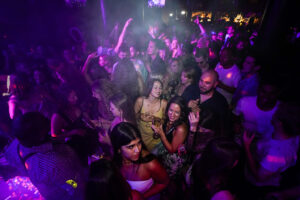
London’s nights aren’t dead yet – club crowds like this could soon be stepping into lost. (AP Photo/Alberto Pezzali)
The ominous website describes lost as “a collective that occupies buildings for performance, cinema and nightlife.” It is coming at a make-or-break time for all three in London.
While lost’s creators have built success from experience-based culture, the city’s film and nightlife scenes are under mounting pressure.
London’s film scene gets stranger
The timing for this shift could hardly be better. The BFI London Film Festival wrapped last weekend, and this secretive project has suddenly slipped into view.
So, is the capital’s screen scene shifting from the cinema seat to the dancefloor?
It appears lost has already hosted a run of private residencies. Their Instagram hints at past test events featuring Duran Duran, Mark Ronson and even a surprise appearance by Grammy Award winner Miley Cyrus earlier this year.
Each event reportedly took place behind closed doors, leaving only whispers from those who attended. It sounds like less of a gig and more like a social experiment – but maybe that is the point.
This new project, billed as lost world, is said to be much larger in scale. Each night will centre on a different artist or theme, with dress codes and immersive designs to match.
A spokesperson for lost told the Standard:
“The mystery and secrecy around rave culture is the inspiration. You would get an email, go to a mysterious place, gather with friends and have extraordinary experiences.”
And now the secret is about to get a date. lost’s first official night is set for Halloween, October 31 – fitting for a project built on mystery. Insiders say the launch will mark the start of a full public run.
The buzz around town
Reports from the first lost world test event in the ex-ODEON venue describe an uncanny mix of installation and live performance, with art pieces scattered around the auditorium, lyrics being composed on stage in real time and a crowd dressed as if they had stepped out of a futuristic nightclub.
Phones were even locked in zip pouches, encouraging people to talk rather than record.
As cinemas close and dancefloors disappear, Londoners are chasing connection wherever they can find it. (AP Photo/Victor R. Caivano)
With more Londoners taking voluntary breaks from their phones, the appetite for face-to-face connection is growing. lost seems to be banking on that craving for social interaction, where gigs don’t go far enough.
The spokesperson added:
“If you go to a Charli XCX concert, she’s a great performer, but it’s just a wall of phones. The phones are becoming walls between us and the culture.”
London nightlife
Since the pandemic, nearly a hundred clubs and late-night bars have vanished across the capital, victims of soaring rents and the cost-of-living crunch. Even Soho has seen doors slam shut before midnight.
According to the Night Time Industries Association, London’s pool of late-night venues has dropped from 433 in 2020 to just 343 today – that’s a staggering one in five gone. Across Britain, almost 800 venues have disappeared.
Cinemas are feeling the squeeze too. The 90-year-old Curzon Mayfair announced it was shutting down in May, while smaller independents across London – such as Peckhamplex and the Rio in Dalston – warn of rising costs and dwindling audiences.
A film programmer at a central London independent, who asked not to be named, told City News:
“Streaming changed everything, so what we are seeing now is a hunger for experience. I think that people still want stories – but want new ways to watch them. It sounds like [lost is] tapping into that”.
As cinemas face extinction and nightlife fights to survive, this mysterious ‘lost world’ could be London’s next big resurrection – or the final roll of the dice for both its cinema and nightlife scene.
Submitted Article
Headline
Short Headline
Standfirst
Published Article
HeadlineIs all hope for London cinemas ‘lost’? – What’s REALLY Going On in Covent Garden?
Short HeadlineIs all hope for London cinemas ‘lost’?
StandfirstSomething strange is stirring in the heart of London, and nobody quite knows what to call it.
Months after the Odeon Covent Garden rolled its final credits, the old Saville Theatre on Shaftesbury Avenue is being revived as a new venue called lost.
The people behind it are the team who built Secret Cinema, the company that turned screenings into immersive, theatrical experiences.
They have moved into a building where The Beatles, Jimi Hendrix and The Rolling Stones once played, followed by a 25 year stint as the ODEON – a site dripping with history now being prepared for a very different kind of crowd.
So far, hardly anyone knows what’s inside.
London’s nights aren’t dead yet – club crowds like this could soon be stepping into lost. (AP Photo/Alberto Pezzali)
The ominous website describes lost as “a collective that occupies buildings for performance, cinema and nightlife.” It is coming at a make-or-break time for all three in London.
While lost’s creators have built success from experience-based culture, the city’s film and nightlife scenes are under mounting pressure.
London’s film scene gets stranger
The timing for this shift could hardly be better. The BFI London Film Festival wrapped last weekend, and this secretive project has suddenly slipped into view.
So, is the capital’s screen scene shifting from the cinema seat to the dancefloor?
It appears lost has already hosted a run of private residencies. Their Instagram hints at past test events featuring Duran Duran, Mark Ronson and even a surprise appearance by Grammy Award winner Miley Cyrus earlier this year.
Each event reportedly took place behind closed doors, leaving only whispers from those who attended. It sounds like less of a gig and more like a social experiment – but maybe that is the point.
This new project, billed as lost world, is said to be much larger in scale. Each night will centre on a different artist or theme, with dress codes and immersive designs to match.
A spokesperson for lost told the Standard:
“The mystery and secrecy around rave culture is the inspiration. You would get an email, go to a mysterious place, gather with friends and have extraordinary experiences.”
And now the secret is about to get a date. lost’s first official night is set for Halloween, October 31 – fitting for a project built on mystery. Insiders say the launch will mark the start of a full public run.
The buzz around town
Reports from the first lost world test event in the ex-ODEON venue describe an uncanny mix of installation and live performance, with art pieces scattered around the auditorium, lyrics being composed on stage in real time and a crowd dressed as if they had stepped out of a futuristic nightclub.
Phones were even locked in zip pouches, encouraging people to talk rather than record.
As cinemas close and dancefloors disappear, Londoners are chasing connection wherever they can find it. (AP Photo/Victor R. Caivano)
With more Londoners taking voluntary breaks from their phones, the appetite for face-to-face connection is growing. lost seems to be banking on that craving for social interaction, where gigs don’t go far enough.
The spokesperson added:
“If you go to a Charli XCX concert, she’s a great performer, but it’s just a wall of phones. The phones are becoming walls between us and the culture.”
London nightlife
Since the pandemic, nearly a hundred clubs and late-night bars have vanished across the capital, victims of soaring rents and the cost-of-living crunch. Even Soho has seen doors slam shut before midnight.
According to the Night Time Industries Association, London’s pool of late-night venues has dropped from 433 in 2020 to just 343 today – that’s a staggering one in five gone. Across Britain, almost 800 venues have disappeared.
Cinemas are feeling the squeeze too. The 90-year-old Curzon Mayfair announced it was shutting down in May, while smaller independents across London – such as Peckhamplex and the Rio in Dalston – warn of rising costs and dwindling audiences.
A film programmer at a central London independent, who asked not to be named, told City News:
“Streaming changed everything, so what we are seeing now is a hunger for experience. I think that people still want stories – but want new ways to watch them. It sounds like [lost is] tapping into that”.
As cinemas face extinction and nightlife fights to survive, this mysterious ‘lost world’ could be London’s next big resurrection – or the final roll of the dice for both its cinema and nightlife scene.
To mark the launch of HBO Max, iconic movie sets land in London for a two-day immersive experience, letting visitors wander through worlds from Friends, Harry Potter, The White Lotus and Superman.
In a rare, candid interview, Blake Fielder-Civil opens up about the relationship that gripped a generation - and why he refuses to carry the guilt alone.
While awards season usually draws celebrities to Los Angeles, several A-listers have instead been spotted working on film and TV sets across the capital.