How London shaped Tracey Emin – and how she shaped it right back
Ahead of the landmark exhibition at the Tate Modern celebrating Tracey Emin’s 40 year career, we look back on how Britain’s “enfant terrible” has already left her mark on the capital.
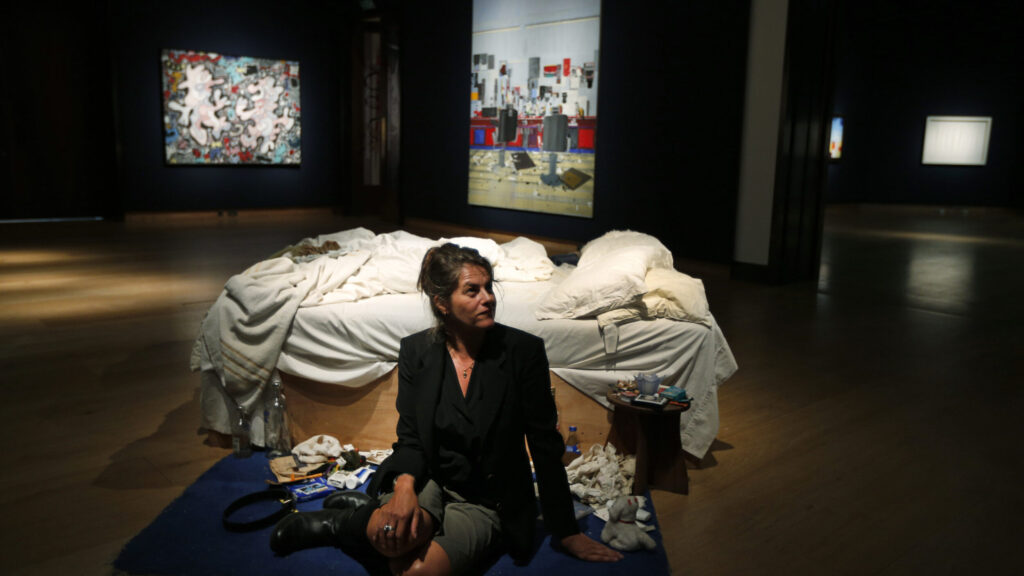
British artist Tracey Emin poses for photographers next her 1998 artpiece, entitled 'My Bed'. (AP Photo/Lefteris Pitarakis)
SHARE:
A rebel with a cause, Tracey Emin is often considered one of the most important contemporary artists in Britain. A retrospective of her career is set to open at the Tate Modern this week. It’s their largest exhibition dedicated to one artist, bringing together over 90 of Emin’s works including one infamous bed.
Tracey Emin made a name for herself in London in the 1990s with her own brand of confessional, autobiographical art.
Today, her unapologetic originality is set to be on full display at an exhibition slated to be one of the greatest art shows of 2026.
Whether it’s a tent, a bed, or neon signs found in a station (or a skip), Emin’s work forces audiences to stare, and she is always staring right back.
Emin’s return to London
Born in Croydon, Emin grew up in Margate before leaving school and returning to London at 15. She lived in a squat on Warren Street mingling with fashion designers and musicians.
She went on to attend the Royal College of Art in South Kensington where she obtained her MA in painting in 1987. Of her time there Emin said, “What I got from being there is my life, I’m a painter and that’s where I learned to paint.”
In 1993, Emin held a solo exhibition at the White Cube gallery in St James’s calling it My Major Retrospective believing that, at 30, the most significant things had already happened.
The show was made up of hundreds of objects she had collected over the years, from teenage diaries to photographs of the art-school paintings she had destroyed after an ‘emotional suicide’.
From the start, Emin was showing her audience every side of her whether they wanted to see it or not.
Whilst studying, she became a leading artist of the Young British Artists group, or ‘Britart’. Alongside other up and comers , notably Damien Hirst, the group dominated the British art scene in the 1990s.
They were known to attract media attention with their “shock tactics” and Emin was given the self-explanatory name “enfant terrible”, which was just the beginning of her enduring image inside the art world and out.
Emin’s first foray into the public eye came when businessman Charles Saatchi chose to include her work in an exhibition held at the Royal Academy in 1997.
The work chosen was titled Everyone I Have Ever Slept With 1963-1995 and it had a fairly simple premise. It was a tent which Emin had appliquéd the names of everyone she had ever slept with in her life as of 1995.
Whilst the title had been subject to misinterpretations as a euphemism for sexual activity, Emin meant it literally.
The names inside the tent range from family members to ex-boyfriends and even two numbered foetuses (Emin experienced two traumatic abortions during her time at the Royal Academy.)
She wanted to confront the viewer, who anticipated entering the tent only to learn the intimate details of her sex life.
The tent was destroyed in a fire at an art warehouse in East London in 2004 to which the Daily Mail reported, “Didn’t millions cheer as this ‘rubbish’ went up in flames?”
Emin criticised the British public for laughing at the disaster and explained that it would be impossible to create the emotion she felt when she created the work.
Emin considers the tent to be one of the two seminal pieces of her career. The other is her most controversial: her bed.
In 1998, Emin went through a depressive episode following a break-up when she stayed in bed for four days without eating and only drinking alcohol.
In her raw unrestrained fashion, Emin displayed the bed as she left it, making the stained sheets and underwear, empty bottles and cigarettes an unlikely sculpture.
Simply named My Bed, it became the artist’s most famous and reviled work. Many argued that it wasn’t even art, that anyone could have presented an unmade bed. To these critics Emin said defiantly, “Well, they didn’t, did they?”
A detail of My Bed (AP Photo/Lefteris Pitarakis)
My Bed was exhibited at the Tate Gallery as a shortlisted work for the Turner Prize in 1999. Despite not winning the prize, the media attention and notoriety has followed Emin nearly 30 years later.
It will be on display as part of the new retrospective to greet a whole new audience. In an interview last year with Vikas Shah, Emin spoke of her dedication to the piece, “Had I not defended it and stood by it, I think it could have disappeared into history.”
Charles Saatchi bought and displayed the bed in his own home as well as at the Saatchi Gallery in Lambeth. When he sold it in 2014 for 2.5 million pounds, it became one of the ten most expensive works by a living artist.
From the skip to the station: Emin’s neon sculptures
Tracey Emin stands in front of some of her neon artwork at the Hayward Gallery, London. (AP Photo/Kirsty Wigglesworth)
“Neon is emotional for everybody.” Emin had begun experimenting with neon gas lights in the early 1990s, finding another medium to share her unflinching honesty.
Previously saying she often begins the creative process by writing, Emin decided to scale up her thoughts. Using her own handwriting in a form of self-portrait, the signs capture a spectrum of emotion which are altogether personal and relatable.
In fact, in anticipation of her upcoming exhibition, billboards displaying Emin’s neon messaging have begun appearing at across 11 London boroughs to mark the opening.
Tracey Emin A Second Life billboard, Spitalfields Commerical St, 2026. Image courtesy Tate and Jack Arts
The glow of the neon light also makes them hard to miss as one lucky member of the public once found. In an entirely “Emin-esque” turn of events, back in 2004 in Spitalfields, a piece of neon art was found in a skip by a passerby.
The piece was a Tracey Emin original. The sign read “Moss Kin”, and was made by Emin as a gift to model Kate Moss who never claimed the work so it was thrown away. The estimated value was £100,000.
Outside of the rubbish, the signs have resonated across the world, having been commissioned to bring them to Times Square in 2013 to celebrate Valentine’s Day.
Closer to home, Emin’s largest text piece ever has been on display at London St Pancras, installed to celebrate the 150th anniversary of the station.
Travellers have been greeted by Emin’s message of love since 2018. (AP Photo/Alberto Pezzali)
The 20 metre sentence glows “I Want My Time With You” and faces the platforms, addressing the thousands who arrive from Europe every day. In the wake of Brexit, Emin wanted to ensure that Europe could still feel the love.
Back to Margate
Ten years after Emin’s tent was displayed there, the Royal Academy elected Emin as a Royal Academician, a testament to her work and legacy.
She is no longer the woman who appeared drunk and stormed off during a live television broadcast. Her diagnosis of cancer in 2020 and the near death experience that followed means she has been sober for six years and has permanently relocated to Margate.
Emin recently said that her advice to aspiring artists is to get out of London and that it isn’t a good creative place anymore.
In recent years she set up the Tracey Emin Foundation in Margate, buying flats for artists to live in and studios to work at both for low rent. Despite her departure, she left behind a legacy which can be traced across the capital.
In a BBC interview last year, she said: “No one was telling me I was good at anything and then suddenly I was being told that I was good at art and that stayed with me.” It seems certain that her art will stay with London the same way.
Tracey Emin: A Second Life at Tate Modern, 27 February – 31 August. Buy tickets here.
Submitted Article
Headline
Short Headline
Standfirst
Published Article
HeadlineHow London shaped Tracey Emin – and how she shaped it right back
Short HeadlineHow London shaped Tracey Emin
StandfirstAhead of the landmark exhibition at the Tate Modern celebrating Tracey Emin’s 40 year career, we look back on how Britain’s “enfant terrible” has already left her mark on the capital.
A rebel with a cause, Tracey Emin is often considered one of the most important contemporary artists in Britain. A retrospective of her career is set to open at the Tate Modern this week. It’s their largest exhibition dedicated to one artist, bringing together over 90 of Emin’s works including one infamous bed.
Tracey Emin made a name for herself in London in the 1990s with her own brand of confessional, autobiographical art.
Today, her unapologetic originality is set to be on full display at an exhibition slated to be one of the greatest art shows of 2026.
Whether it’s a tent, a bed, or neon signs found in a station (or a skip), Emin’s work forces audiences to stare, and she is always staring right back.
Emin’s return to London
Born in Croydon, Emin grew up in Margate before leaving school and returning to London at 15. She lived in a squat on Warren Street mingling with fashion designers and musicians.
She went on to attend the Royal College of Art in South Kensington where she obtained her MA in painting in 1987. Of her time there Emin said, “What I got from being there is my life, I’m a painter and that’s where I learned to paint.”
In 1993, Emin held a solo exhibition at the White Cube gallery in St James’s calling it My Major Retrospective believing that, at 30, the most significant things had already happened.
The show was made up of hundreds of objects she had collected over the years, from teenage diaries to photographs of the art-school paintings she had destroyed after an ‘emotional suicide’.
From the start, Emin was showing her audience every side of her whether they wanted to see it or not.
Whilst studying, she became a leading artist of the Young British Artists group, or ‘Britart’. Alongside other up and comers , notably Damien Hirst, the group dominated the British art scene in the 1990s.
They were known to attract media attention with their “shock tactics” and Emin was given the self-explanatory name “enfant terrible”, which was just the beginning of her enduring image inside the art world and out.
Emin’s first foray into the public eye came when businessman Charles Saatchi chose to include her work in an exhibition held at the Royal Academy in 1997.
The work chosen was titled Everyone I Have Ever Slept With 1963-1995 and it had a fairly simple premise. It was a tent which Emin had appliquéd the names of everyone she had ever slept with in her life as of 1995.
Whilst the title had been subject to misinterpretations as a euphemism for sexual activity, Emin meant it literally.
The names inside the tent range from family members to ex-boyfriends and even two numbered foetuses (Emin experienced two traumatic abortions during her time at the Royal Academy.)
She wanted to confront the viewer, who anticipated entering the tent only to learn the intimate details of her sex life.
The tent was destroyed in a fire at an art warehouse in East London in 2004 to which the Daily Mail reported, “Didn’t millions cheer as this ‘rubbish’ went up in flames?”
Emin criticised the British public for laughing at the disaster and explained that it would be impossible to create the emotion she felt when she created the work.
Emin considers the tent to be one of the two seminal pieces of her career. The other is her most controversial: her bed.
In 1998, Emin went through a depressive episode following a break-up when she stayed in bed for four days without eating and only drinking alcohol.
In her raw unrestrained fashion, Emin displayed the bed as she left it, making the stained sheets and underwear, empty bottles and cigarettes an unlikely sculpture.
Simply named My Bed, it became the artist’s most famous and reviled work. Many argued that it wasn’t even art, that anyone could have presented an unmade bed. To these critics Emin said defiantly, “Well, they didn’t, did they?”
A detail of My Bed (AP Photo/Lefteris Pitarakis)
My Bed was exhibited at the Tate Gallery as a shortlisted work for the Turner Prize in 1999. Despite not winning the prize, the media attention and notoriety has followed Emin nearly 30 years later.
It will be on display as part of the new retrospective to greet a whole new audience. In an interview last year with Vikas Shah, Emin spoke of her dedication to the piece, “Had I not defended it and stood by it, I think it could have disappeared into history.”
Charles Saatchi bought and displayed the bed in his own home as well as at the Saatchi Gallery in Lambeth. When he sold it in 2014 for 2.5 million pounds, it became one of the ten most expensive works by a living artist.
From the skip to the station: Emin’s neon sculptures
Tracey Emin stands in front of some of her neon artwork at the Hayward Gallery, London. (AP Photo/Kirsty Wigglesworth)
“Neon is emotional for everybody.” Emin had begun experimenting with neon gas lights in the early 1990s, finding another medium to share her unflinching honesty.
Previously saying she often begins the creative process by writing, Emin decided to scale up her thoughts. Using her own handwriting in a form of self-portrait, the signs capture a spectrum of emotion which are altogether personal and relatable.
In fact, in anticipation of her upcoming exhibition, billboards displaying Emin’s neon messaging have begun appearing at across 11 London boroughs to mark the opening.
Tracey Emin A Second Life billboard, Spitalfields Commerical St, 2026. Image courtesy Tate and Jack Arts
The glow of the neon light also makes them hard to miss as one lucky member of the public once found. In an entirely “Emin-esque” turn of events, back in 2004 in Spitalfields, a piece of neon art was found in a skip by a passerby.
The piece was a Tracey Emin original. The sign read “Moss Kin”, and was made by Emin as a gift to model Kate Moss who never claimed the work so it was thrown away. The estimated value was £100,000.
Outside of the rubbish, the signs have resonated across the world, having been commissioned to bring them to Times Square in 2013 to celebrate Valentine’s Day.
Closer to home, Emin’s largest text piece ever has been on display at London St Pancras, installed to celebrate the 150th anniversary of the station.
Travellers have been greeted by Emin’s message of love since 2018. (AP Photo/Alberto Pezzali)
The 20 metre sentence glows “I Want My Time With You” and faces the platforms, addressing the thousands who arrive from Europe every day. In the wake of Brexit, Emin wanted to ensure that Europe could still feel the love.
Back to Margate
Ten years after Emin’s tent was displayed there, the Royal Academy elected Emin as a Royal Academician, a testament to her work and legacy.
She is no longer the woman who appeared drunk and stormed off during a live television broadcast. Her diagnosis of cancer in 2020 and the near death experience that followed means she has been sober for six years and has permanently relocated to Margate.
Emin recently said that her advice to aspiring artists is to get out of London and that it isn’t a good creative place anymore.
In recent years she set up the Tracey Emin Foundation in Margate, buying flats for artists to live in and studios to work at both for low rent. Despite her departure, she left behind a legacy which can be traced across the capital.
In a BBC interview last year, she said: “No one was telling me I was good at anything and then suddenly I was being told that I was good at art and that stayed with me.” It seems certain that her art will stay with London the same way.
Tracey Emin: A Second Life at Tate Modern, 27 February – 31 August. Buy tickets here.
To mark the launch of HBO Max, iconic movie sets land in London for a two-day immersive experience, letting visitors wander through worlds from Friends, Harry Potter, The White Lotus and Superman.
In a rare, candid interview, Blake Fielder-Civil opens up about the relationship that gripped a generation - and why he refuses to carry the guilt alone.
While awards season usually draws celebrities to Los Angeles, several A-listers have instead been spotted working on film and TV sets across the capital.