The Revival and Reinvention of the Renaissance, Rococo and Regency period
This fantasy period, which it has been dubbed online, often encompasses themes from all three eras, and is a mythical period which exists with the beautiful clothes but no disease or death.
Search “born in the wrong era” on TikTok, the results show a highly standardised trend. It shows frescoed ceilings, gilded cornices, and exorbitant luxury in a pastoral retreat, untouched by modern pressures.
It’s called the Fantasy TikTok trend.
Regency silhouettes appear alongside Rococo detailing and Renaissance-inspired sleeves creating a composite past that is not tied to any specific historical moment.
Influencers are staging videos in lace and tulle, filming themselves moving slowly through candlelit interiors, historic homes or styled domestic spaces designed to resemble castles and salons.
Analyse or @ageminifairy on TikTok is one of these creators.
She posts fantasy costumes detailing handmade corsetry and showcasing vintage styling. This account has more than 1 million followers and her content appears almost daily.
However, cultural commentators and academics are quick to point it out as an escapism to the present rather than a fixation on the past.
This appetite for softened historical escapism has been amplified by mainstream entertainment.
Bridgerton
The fourth season of Bridgerton, which premiered first episodes on 29th of January, was met with widespread enthusiasm.
Credit: Netflix Poster of the new season of Bridgerton.
Caroline Siede, writing on Substack, described the series as
“a [g]oofy bit of romantic escapism from the harshness of the real-world”.
Online audiences echoed this response, with Reddit users characterising the season as “a warm exhale: romantic, thoughtful, and intimately human,” filled with “soft swoons and grounded emotion”.
The show’s aesthetic choices are central to its reception.
It has been described as a Regency-era Gossip Girl, Bridgerton removes modern technology while retaining contemporary emotional rhythms.
Pastel and jewel tones dominate the screen; social rituals unfold in powder-blue drawing rooms where tea, cakes and matchmaking conversations take precedence over political or economic realities.
FrockMe Vintage Fair Bridgerton inspired stall
For some viewers, the lack of historical accuracy is not a flaw but a key feature.
University student Kervina Dubovsky, who studies Art History at UAL, argues that selective representation makes the period more accessible.
“Bridgerton embodies the beauty and culture of the regency period in a soft and comforting way,” she said.
“It’s not historically accurate but rather that adds to the charm…I love the costumes and why would I want to watch something that is racist and homophobic [in] like real life.”
This reframing of history is not limited to television. Offline, it is shaping consumer behaviour and cultural spaces.
FrockMe Vintage Fair
Once a month, Chelsea Town Hall hosts FrockMe, a vintage fair specialising in clothing spanning from the 17th to the 20th century.
Chelsea Town Hall, where FrockMe’s vintage fair is held.
Long frequented by costume designers and film producers, the fair now attracts visitors seeking alternatives to mass-produced fashion.
More than 60 exhibitors take part, many of them former costume designers or specialists in archival dress.
Claire Hassell, a stall owner who specialises in Ottoman Empire pieces, links the fair’s growing popularity to a desire for distinction.
“People want [more] unique pieces,” she said.
“Sourcing these pieces take months, but you’ll never find something else like it.”
Historically, Ottoman textiles were highly prized by European elites, with materials such as silk, velvet and brocade imported in large quantities during the Renaissance period.
Hassell suggests that contemporary fashion’s reliance on synthetic fibres has renewed interest in natural materials and historical craftsmanship.
“As more and more fashion retailers bring out the same polyester jumpers and jeans, you want something that stands alone.”
V&A Marie Antoinette Exhibition
Museums, too, have responded to this resurgence of interest.
At the V&A, home to the world’s largest fashion collection, attention has recently centred on the sold-out Marie Antoinette exhibition, which closes on 22nd of March.
Replica of the controversial necklace that was rumoured to have caused the late Queen’s usurping.
While the museum’s holdings span centuries, the sustained demand for the exhibition has positioned the French queen once again as a focal point of cultural fascination.
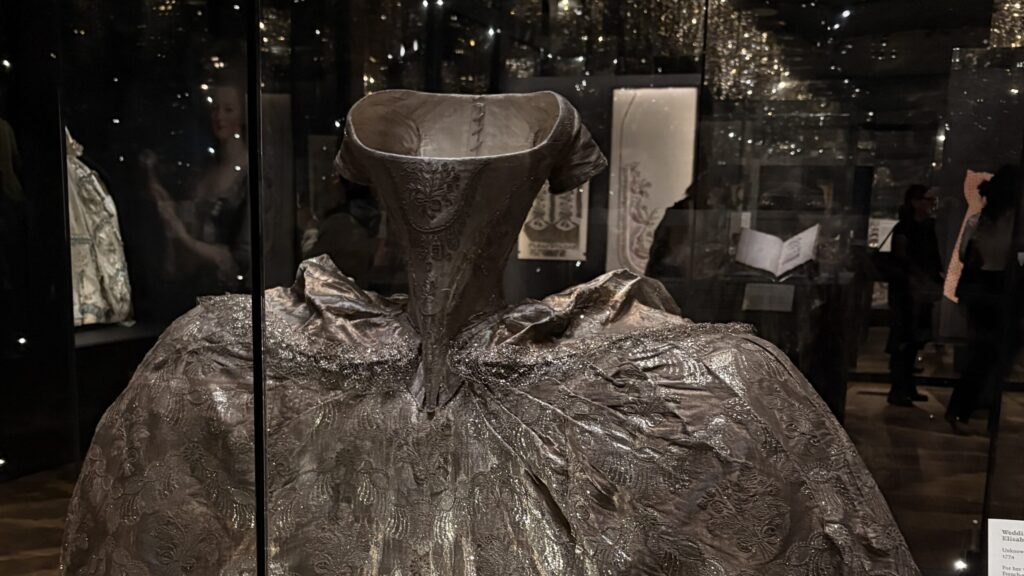
The exhibition presents both original garments and modern reinterpretations.
Dresses trimmed with lace and embellishment sit alongside impossibly small corsets, displayed beneath mirrored ceilings that scatter metallic light across the space.
Later rooms introduce contemporary responses, including a Tim Walker photograph of Kate Moss styled as Marie Antoinette at the Ritz, and costumes from Sofia Coppola’s film adaptation, where historical silhouettes are punctuated by modern colour and texture.
The costume from the key “Let Them Eat Cake” scene features in the collection, a silk ruched dress that falls delicately in enveloping layers, with a peak of hot pink taffeta that shows the modern touch.
Costume from Sofia Coppola’s ‘Marie Antoinette’ – features in the “Let them eat cake scene”
The final section of the exhibition shows the grislier end of the usurped Queen.
A room saturated in Crimson Red confronts visitors with the violence of the French Revolution, displaying the simple cotton garment worn by the queen at her execution, alongside the blade rumoured to have belonged to the guillotine.
Visitors described the exhibition as “ethereal”, “lustrous”, and as “a glimpse into a woman we will never fully know.”
According to curator Sarah Grant, Marie Antoinette’s enduring relevance lies in the contradictions she embodies.
“She was the most fashionable, scrutinised and controversial queen in history.”
Whilst historical cultural imagery is being integrated across different platform and being reworked into spaces of comfort, beauty and escape, institutions and audiences negotiate how much reality to let back in.
Whether through softened storytelling or selective curation, the resurgence suggests less a longing for the past itself than a recalibration of how history is used to make sense of the present.
Submitted Article
Headline
Short Headline
Standfirst
Published Article
HeadlineThe Revival and Reinvention of the Renaissance, Rococo and Regency period
Short HeadlineRenaissance, Rococo, and Regency Revival
StandfirstThis fantasy period, which it has been dubbed online, often encompasses themes from all three eras, and is a mythical period which exists with the beautiful clothes but no disease or death.
Search “born in the wrong era” on TikTok, the results show a highly standardised trend. It shows frescoed ceilings, gilded cornices, and exorbitant luxury in a pastoral retreat, untouched by modern pressures.
It’s called the Fantasy TikTok trend.
Regency silhouettes appear alongside Rococo detailing and Renaissance-inspired sleeves creating a composite past that is not tied to any specific historical moment.
Influencers are staging videos in lace and tulle, filming themselves moving slowly through candlelit interiors, historic homes or styled domestic spaces designed to resemble castles and salons.
Analyse or @ageminifairy on TikTok is one of these creators.
She posts fantasy costumes detailing handmade corsetry and showcasing vintage styling. This account has more than 1 million followers and her content appears almost daily.
However, cultural commentators and academics are quick to point it out as an escapism to the present rather than a fixation on the past.
This appetite for softened historical escapism has been amplified by mainstream entertainment.
Bridgerton
The fourth season of Bridgerton, which premiered first episodes on 29th of January, was met with widespread enthusiasm.
Credit: Netflix Poster of the new season of Bridgerton.
Caroline Siede, writing on Substack, described the series as
“a [g]oofy bit of romantic escapism from the harshness of the real-world”.
Online audiences echoed this response, with Reddit users characterising the season as “a warm exhale: romantic, thoughtful, and intimately human,” filled with “soft swoons and grounded emotion”.
The show’s aesthetic choices are central to its reception.
It has been described as a Regency-era Gossip Girl, Bridgerton removes modern technology while retaining contemporary emotional rhythms.
Pastel and jewel tones dominate the screen; social rituals unfold in powder-blue drawing rooms where tea, cakes and matchmaking conversations take precedence over political or economic realities.
FrockMe Vintage Fair Bridgerton inspired stall
For some viewers, the lack of historical accuracy is not a flaw but a key feature.
University student Kervina Dubovsky, who studies Art History at UAL, argues that selective representation makes the period more accessible.
“Bridgerton embodies the beauty and culture of the regency period in a soft and comforting way,” she said.
“It’s not historically accurate but rather that adds to the charm…I love the costumes and why would I want to watch something that is racist and homophobic [in] like real life.”
This reframing of history is not limited to television. Offline, it is shaping consumer behaviour and cultural spaces.
FrockMe Vintage Fair
Once a month, Chelsea Town Hall hosts FrockMe, a vintage fair specialising in clothing spanning from the 17th to the 20th century.
Chelsea Town Hall, where FrockMe’s vintage fair is held.
Long frequented by costume designers and film producers, the fair now attracts visitors seeking alternatives to mass-produced fashion.
More than 60 exhibitors take part, many of them former costume designers or specialists in archival dress.
Claire Hassell, a stall owner who specialises in Ottoman Empire pieces, links the fair’s growing popularity to a desire for distinction.
“People want [more] unique pieces,” she said.
“Sourcing these pieces take months, but you’ll never find something else like it.”
Historically, Ottoman textiles were highly prized by European elites, with materials such as silk, velvet and brocade imported in large quantities during the Renaissance period.
Hassell suggests that contemporary fashion’s reliance on synthetic fibres has renewed interest in natural materials and historical craftsmanship.
“As more and more fashion retailers bring out the same polyester jumpers and jeans, you want something that stands alone.”
V&A Marie Antoinette Exhibition
Museums, too, have responded to this resurgence of interest.
At the V&A, home to the world’s largest fashion collection, attention has recently centred on the sold-out Marie Antoinette exhibition, which closes on 22nd of March.
Replica of the controversial necklace that was rumoured to have caused the late Queen’s usurping.
While the museum’s holdings span centuries, the sustained demand for the exhibition has positioned the French queen once again as a focal point of cultural fascination.
The exhibition presents both original garments and modern reinterpretations.
Dresses trimmed with lace and embellishment sit alongside impossibly small corsets, displayed beneath mirrored ceilings that scatter metallic light across the space.
Later rooms introduce contemporary responses, including a Tim Walker photograph of Kate Moss styled as Marie Antoinette at the Ritz, and costumes from Sofia Coppola’s film adaptation, where historical silhouettes are punctuated by modern colour and texture.
The costume from the key “Let Them Eat Cake” scene features in the collection, a silk ruched dress that falls delicately in enveloping layers, with a peak of hot pink taffeta that shows the modern touch.
Costume from Sofia Coppola’s ‘Marie Antoinette’ – features in the “Let them eat cake scene”
The final section of the exhibition shows the grislier end of the usurped Queen.
A room saturated in Crimson Red confronts visitors with the violence of the French Revolution, displaying the simple cotton garment worn by the queen at her execution, alongside the blade rumoured to have belonged to the guillotine.
Visitors described the exhibition as “ethereal”, “lustrous”, and as “a glimpse into a woman we will never fully know.”
According to curator Sarah Grant, Marie Antoinette’s enduring relevance lies in the contradictions she embodies.
“She was the most fashionable, scrutinised and controversial queen in history.”
Whilst historical cultural imagery is being integrated across different platform and being reworked into spaces of comfort, beauty and escape, institutions and audiences negotiate how much reality to let back in.
Whether through softened storytelling or selective curation, the resurgence suggests less a longing for the past itself than a recalibration of how history is used to make sense of the present.
To mark the launch of HBO Max, iconic movie sets land in London for a two-day immersive experience, letting visitors wander through worlds from Friends, Harry Potter, The White Lotus and Superman.
In a rare, candid interview, Blake Fielder-Civil opens up about the relationship that gripped a generation - and why he refuses to carry the guilt alone.
While awards season usually draws celebrities to Los Angeles, several A-listers have instead been spotted working on film and TV sets across the capital.