Hammersmith Bridge: The Canary in the Coalmine for London’s Victorian Infrastructure?
After seven years, Hammersmith Bridge remains closed. Now that Albert Bridge joins its ranks, campaigners worry for the future of vital infrastructure.
In April 2019, a series of cracks appeared in the pedestals of Hammersmith Bridge. Ultrasound sensors revealed a grim reality; the 133-year-old suspension bridge was no longer fit for purpose, posing a critical safety risk to motorists, cyclists, and pedestrians. The bridge was closed, public meetings held, budgets costed, and in July 2021 it reopened to pedestrians and cyclists as a temporary measure.
But after seven years, a government task force, multiple restoration estimates, international coverage, three protest movements, and even a counter protest movement, Hammersmith Bridge is still closed to vehicles.
“I think it just signifies a certain sense of failure,” said Felix from the movement Looking for Growth, “it’s just depressing that such a major economic powerhouse like London – one of the wealthiest cities in the world – is just simply unable to fix its own infrastructure… it smacks of a certain sense of decline.”
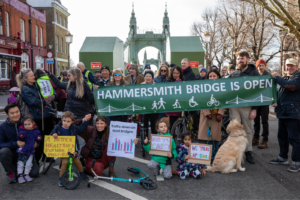
The London chapter of Looking for Growth is just one movement calling for an end to the closure; other groups such as Hammersmith Bridge SOS and Putney Action Group – comprised entirely of local residents – have also campaigned. Their shared immediate goal, according to Hammersmith Bridge SOS, is to “lobby for some form of public transport, and also emergency vehicles, to be able to cross the bridge at the earliest opportunity.”
The reopening has bipartisan political support. Speaking at a January protest, Labour MP Fleur Anderson spoke of the effect on locals, who were “so affected by the closure of the buses…it impacts us every single day.” The Conservatives have also addressed the issue, proposing that a temporary “military style” bridge should be erected whilst repairs for Hammersmith Bridge continue. An outlier, Hammersmith Bridge is Open, has conversely campaigned to “keep Hammersmith Bridge car free…despite what critics have said, traffic in the area is down, thanks to the bridge being traffic free”.
Photo: Paul Richard James
The reasons for the bridge’s continued closure are multifaceted but by no means unique. The bridge is Grade II listed – as are seventeen bridges in London – meaning that due to its special architectural and historical significance it is impossible to demolish. Any repairs it does undergo need to adhere to specific (and often costly) restrictions that remain sympathetic to the bridge’s historical character. TfL’s promise to contribute £24 million in funding cannot account for the overall £163 million estimate.
As a result, the Lords agreed in 2020 that, alongside TfL and Hammersmith and Fulham Council, the Department for Transport would help fund repairs. A government task force was formed, but six years on, no solution has been reached. According to Felix;
“It just seems to be that nothing has really got done. It seems that it’s just primarily driven by an inability to make decisions, and a love of process over a love of outcomes…there is no clear way forward.”
This issue comes at a time when the building of vital British infrastructure is increasingly making the headlines, or else going viral on social media. From the Houses of Parliament’s estimated 61-year refurbishment – which proposals have called “unsustainable” – to a Surbiton Station staircase that went viral on X for its ten-year timeline; there is increasing concern that Britain no longer knows how to build efficiently or within budget.
Amid the stalemate, another Grade II listed bridge closed on February 12th 2026 due to cracks in the pedestals. Albert Bridge, nicknamed the “Trembling Lady” due to its tendency to vibrate when large groups of people walk over it, may find itself still for the first time in 150 years. The cracks in the pedestals, temporary closure, and Grade II listed status have provoked comparisons with Hammersmith on social media.
In response to Hammersmith bridge closure, a DfT spokesperson said, “We recognise the disruption caused by the closure of the bridge and so far we have provided £17m of funding, including £4.7m in March 2025, to keep the bridge open for walking and cycling.” Whether this will be enough for activists and local residents is yet to be seen.
Submitted Article
Headline
Short Headline
Standfirst
Published Article
HeadlineHammersmith Bridge: The Canary in the Coalmine for London’s Victorian Infrastructure?
Short HeadlineHammersmith Bridge and the Future of London's Infrastructure
StandfirstAfter seven years, Hammersmith Bridge remains closed. Now that Albert Bridge joins its ranks, campaigners worry for the future of vital infrastructure.
In April 2019, a series of cracks appeared in the pedestals of Hammersmith Bridge. Ultrasound sensors revealed a grim reality; the 133-year-old suspension bridge was no longer fit for purpose, posing a critical safety risk to motorists, cyclists, and pedestrians. The bridge was closed, public meetings held, budgets costed, and in July 2021 it reopened to pedestrians and cyclists as a temporary measure.
But after seven years, a government task force, multiple restoration estimates, international coverage, three protest movements, and even a counter protest movement, Hammersmith Bridge is still closed to vehicles.
“I think it just signifies a certain sense of failure,” said Felix from the movement Looking for Growth, “it’s just depressing that such a major economic powerhouse like London – one of the wealthiest cities in the world – is just simply unable to fix its own infrastructure… it smacks of a certain sense of decline.”
The London chapter of Looking for Growth is just one movement calling for an end to the closure; other groups such as Hammersmith Bridge SOS and Putney Action Group – comprised entirely of local residents – have also campaigned. Their shared immediate goal, according to Hammersmith Bridge SOS, is to “lobby for some form of public transport, and also emergency vehicles, to be able to cross the bridge at the earliest opportunity.”
The reopening has bipartisan political support. Speaking at a January protest, Labour MP Fleur Anderson spoke of the effect on locals, who were “so affected by the closure of the buses…it impacts us every single day.” The Conservatives have also addressed the issue, proposing that a temporary “military style” bridge should be erected whilst repairs for Hammersmith Bridge continue. An outlier, Hammersmith Bridge is Open, has conversely campaigned to “keep Hammersmith Bridge car free…despite what critics have said, traffic in the area is down, thanks to the bridge being traffic free”.
Photo: Paul Richard James
The reasons for the bridge’s continued closure are multifaceted but by no means unique. The bridge is Grade II listed – as are seventeen bridges in London – meaning that due to its special architectural and historical significance it is impossible to demolish. Any repairs it does undergo need to adhere to specific (and often costly) restrictions that remain sympathetic to the bridge’s historical character. TfL’s promise to contribute £24 million in funding cannot account for the overall £163 million estimate.
As a result, the Lords agreed in 2020 that, alongside TfL and Hammersmith and Fulham Council, the Department for Transport would help fund repairs. A government task force was formed, but six years on, no solution has been reached. According to Felix;
“It just seems to be that nothing has really got done. It seems that it’s just primarily driven by an inability to make decisions, and a love of process over a love of outcomes…there is no clear way forward.”
This issue comes at a time when the building of vital British infrastructure is increasingly making the headlines, or else going viral on social media. From the Houses of Parliament’s estimated 61-year refurbishment – which proposals have called “unsustainable” – to a Surbiton Station staircase that went viral on X for its ten-year timeline; there is increasing concern that Britain no longer knows how to build efficiently or within budget.
Amid the stalemate, another Grade II listed bridge closed on February 12th 2026 due to cracks in the pedestals. Albert Bridge, nicknamed the “Trembling Lady” due to its tendency to vibrate when large groups of people walk over it, may find itself still for the first time in 150 years. The cracks in the pedestals, temporary closure, and Grade II listed status have provoked comparisons with Hammersmith on social media.
In response to Hammersmith bridge closure, a DfT spokesperson said, “We recognise the disruption caused by the closure of the bridge and so far we have provided £17m of funding, including £4.7m in March 2025, to keep the bridge open for walking and cycling.” Whether this will be enough for activists and local residents is yet to be seen.
A 2024 Freedom of Information request showed Bromley Council had £4.5 million invested in arms companies that year with £1.5 million reportedly linked to Israel.
Undercover officers raided three linked shops in Barking town centre, revealing how illicit tobacco is being hidden in walls, ceilings and nearby locations to evade detection.
More than 330,000 people across the UK sought support from the Stop It Now helpline in 2025 over concerns about their own or someone else’s online sexual behaviour towards children, according to new charity data. The anonymous service says contacts by phone, email and webchat rose significantly over the year.