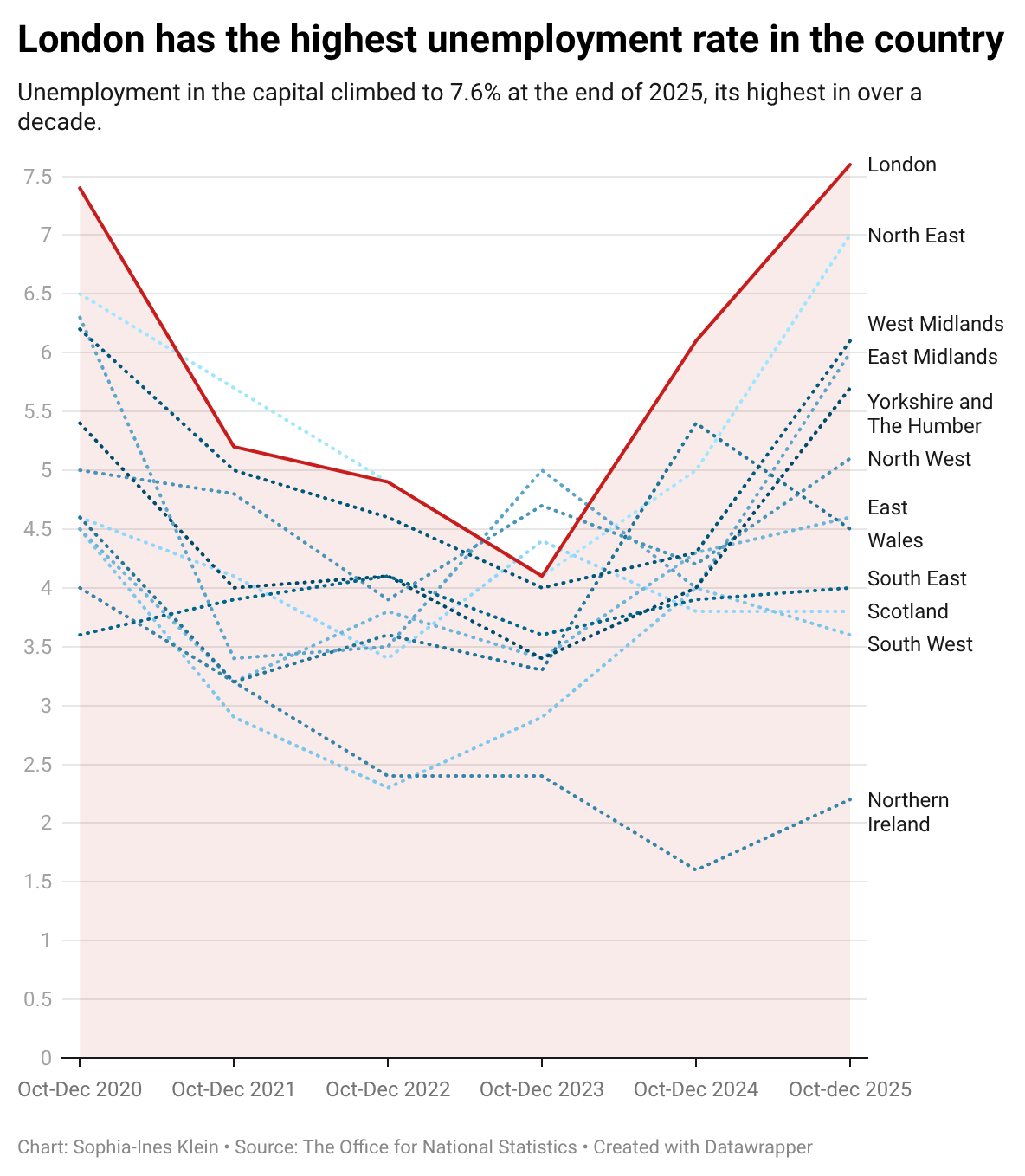
London has the highest unemployment rate in the UK according to new figures by the Office for National Statistics (ONS).
The unemployment rate of 7.6 per cent surpasses the 2020 pandemic record and represents the worst figures in the capital for more than a decade.
Figures released today by the ONS show unemployment in the UK as a whole has unexpectedly climbed to its highest level in five years.
At the end of 2025, unemployment amongst people under 25 reached a decade high of 16.1% as nearly one in six young people remain out of work.
In the last decade, London has consistently held the highest concentration of university graduates across the country.
Yet, the pressure of high costs of living and a concentrated job market remains a challenge as the number of graduate positions advertised last year fell by 33 per cent, its lowest since 2018.
A recent Oxford graduate from London, Olivia Miles, told City News that she expects to live at home with her parents for at least three years after graduating university. She explained that this was both due to a lack of jobs available and high cost of living in the capital.
Danni Hewson, head of financial analysis at AJ Bell says, “businesses have been crystal clear that government policies which increased labour costs resulted in them pressing pause on their hiring plans.”
Hewson says that AI presents a particular hurdle for young people who already struggle to land their first job, as “AI could result in a scarcity of entry-level posts.”
Work and Pensions Secretary Pat McFadden has said the government is aware “there is more to do to get people into jobs.”
Following the chancellor’s November budget, shadow work and pensions secretary, Helen Whately, says “entry-level roles are the first to disappear from Labour’s tax hikes.”
“By making hiring more expensive and more risky, Labour are ensuring school leavers and graduates never even get a foot in the door,” she says.
Despite the downturn, the slight increase in job vacancies in the three months leading to January suggests the labour market may recover.
Submitted Article
Headline
Short Headline
Standfirst
Published Article
HeadlineLondon hit the hardest by five-year unemployment high
Short HeadlineLondon hit the hardest by five-year unemployment high
StandfirstNew figures reveal that London has been hit the hardest by record unemployment rates in the countries.
London has the highest unemployment rate in the UK according to new figures by the Office for National Statistics (ONS).
The unemployment rate of 7.6 per cent surpasses the 2020 pandemic record and represents the worst figures in the capital for more than a decade.
Figures released today by the ONS show unemployment in the UK as a whole has unexpectedly climbed to its highest level in five years.
At the end of 2025, unemployment amongst people under 25 reached a decade high of 16.1% as nearly one in six young people remain out of work.
In the last decade, London has consistently held the highest concentration of university graduates across the country.
Yet, the pressure of high costs of living and a concentrated job market remains a challenge as the number of graduate positions advertised last year fell by 33 per cent, its lowest since 2018.
A recent Oxford graduate from London, Olivia Miles, told City News that she expects to live at home with her parents for at least three years after graduating university. She explained that this was both due to a lack of jobs available and high cost of living in the capital.
Danni Hewson, head of financial analysis at AJ Bell says, “businesses have been crystal clear that government policies which increased labour costs resulted in them pressing pause on their hiring plans.”
Hewson says that AI presents a particular hurdle for young people who already struggle to land their first job, as “AI could result in a scarcity of entry-level posts.”
Work and Pensions Secretary Pat McFadden has said the government is aware “there is more to do to get people into jobs.”
Following the chancellor’s November budget, shadow work and pensions secretary, Helen Whately, says “entry-level roles are the first to disappear from Labour’s tax hikes.”
“By making hiring more expensive and more risky, Labour are ensuring school leavers and graduates never even get a foot in the door,” she says.
Despite the downturn, the slight increase in job vacancies in the three months leading to January suggests the labour market may recover.
As the weather turns, City News has spoken to a long-term rough sleeper to see how those on the street feel about Andy Burnham’s plan to end homelessness and the upcoming winter.