Following Millwall’s match against Sheffield Wednesday, a Millwall fan was allegedly arrested at Hillsborough on suspicion of biting the ear of an opposing supporter. It’s the kind of incident that instantly feeds Millwall’s long-running reputation for crowd trouble. But Home Office figures suggest the reality is more complicated than a footballing cliché.
A notorious past
Football hooliganism has long been part of English football’s darker history, and Millwall’s association with it stretches back decades. Flashpoints often cited include a hand grenade being thrown onto the pitch in 1965, a rampage at an away match against Slough in 1982 that prompted the club’s chairman to threaten closure, and disorder against Birmingham in 2002 in which up to 50 police officers were injured. Reports from the time describe bricks and other missiles being thrown, including paving stones, as rival groups clashed.
The alleged ear-biting incident therefore could seem par for the course for the club. Comments from the public on the original Daily Mail article expose this underlying prejudice against the Lions- “Millwall fans are like wild animals. They should be muzzled for the next game” and “their fan base is utterly deplorable with a violent, abusive fan base… the delinquents will never change”.
Mike Keegan, chief sports reporter at the Daily Mail, says “their reputation is still one of a very intimidating away day…if you look at their attendances- they are by no means the best supported club at the Championship”. He also cited the number of arrests in the 2024/25 season show they top the Championship table in that regard.
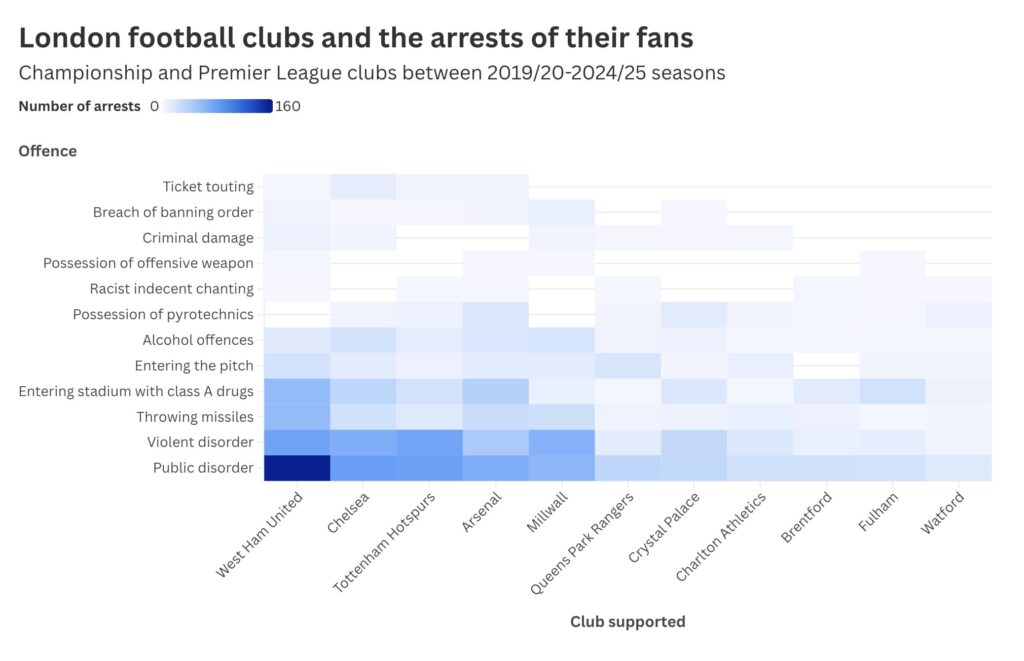
However, Home Office data of the 11 London teams in the Championship or Premier Leagues show that across the 2019/20 and 2024/25 seasons, Millwall comes 4th for the total number of violent disorder arrests and 5th for public disorder arrests respectively. Total arrests for offences such as these and others such as throwing missiles, mean Millwall ranks 5th across the 11 teams in London playing in the big leagues.
Home Office data showing the total arrests per London football club split by offence type across 2019/20 and 2024/25
Dr Richard Hester, a former police officer within football policing as well as a criminologist with research on public order policing, says “football disorder clearly still presents a social issue that requires management by the police and football clubs, but often the approach to policing is based on legacy issues rather than contemporary intelligence.” He adds
“Millwall supporters can still present policing challenges, the data over the last decade shows that there are lower rates of arrests and disorder in comparison to other clubs.”
Jake Preston, a Millwall fan, voices his defence- “most Millwall fans love (its) unique underdog identity. There are obviously some fans who are idiots and make us all look bad but that is not dissimilar from any other club”.
Consequences beyond stigma
Like any reputation that hardens into prejudice, the fallout spreads well beyond the headlines. Clive, a lifelong Millwall fan, says most supporters are friendly, but the club’s image puts off visiting fans who might otherwise travel to The Den.
Dr Hester says there are practical consequences too, arguing it can “result in over-policing of fixtures” — officers being deployed to matches that don’t warrant it, while other areas risk being left short.
And with Millwall pushing at the right end of the table this season, Mike Keegan says promotion to the Premier League would be a test case. “Their fans will tell you this is real football,” he says, describing the club as “predominantly working class” — and suggesting there could be a “clash of cultures” if Millwall enter a more corporate, globalised top flight.
Millwall FC did not respond for comment.
Submitted Article
Headline
Short Headline
Standfirst
Published Article
Headline“No One Likes Us, We Don’t Care!” but Does Millwall Football Club Still Deserve Its Notorious Tag?
Short HeadlineDenial and Disorder: Is Millwall's Reputation Outdated?
StandfirstMillwall's fan base's historic association with violence comes to the fore but we ask today if that is a fair picture.
Following Millwall’s match against Sheffield Wednesday, a Millwall fan was allegedly arrested at Hillsborough on suspicion of biting the ear of an opposing supporter. It’s the kind of incident that instantly feeds Millwall’s long-running reputation for crowd trouble. But Home Office figures suggest the reality is more complicated than a footballing cliché.
A notorious past
Football hooliganism has long been part of English football’s darker history, and Millwall’s association with it stretches back decades. Flashpoints often cited include a hand grenade being thrown onto the pitch in 1965, a rampage at an away match against Slough in 1982 that prompted the club’s chairman to threaten closure, and disorder against Birmingham in 2002 in which up to 50 police officers were injured. Reports from the time describe bricks and other missiles being thrown, including paving stones, as rival groups clashed.
The alleged ear-biting incident therefore could seem par for the course for the club. Comments from the public on the original Daily Mail article expose this underlying prejudice against the Lions- “Millwall fans are like wild animals. They should be muzzled for the next game” and “their fan base is utterly deplorable with a violent, abusive fan base… the delinquents will never change”.
Mike Keegan, chief sports reporter at the Daily Mail, says “their reputation is still one of a very intimidating away day…if you look at their attendances- they are by no means the best supported club at the Championship”. He also cited the number of arrests in the 2024/25 season show they top the Championship table in that regard.
However, Home Office data of the 11 London teams in the Championship or Premier Leagues show that across the 2019/20 and 2024/25 seasons, Millwall comes 4th for the total number of violent disorder arrests and 5th for public disorder arrests respectively. Total arrests for offences such as these and others such as throwing missiles, mean Millwall ranks 5th across the 11 teams in London playing in the big leagues.
Home Office data showing the total arrests per London football club split by offence type across 2019/20 and 2024/25
Dr Richard Hester, a former police officer within football policing as well as a criminologist with research on public order policing, says “football disorder clearly still presents a social issue that requires management by the police and football clubs, but often the approach to policing is based on legacy issues rather than contemporary intelligence.” He adds
“Millwall supporters can still present policing challenges, the data over the last decade shows that there are lower rates of arrests and disorder in comparison to other clubs.”
Jake Preston, a Millwall fan, voices his defence- “most Millwall fans love (its) unique underdog identity. There are obviously some fans who are idiots and make us all look bad but that is not dissimilar from any other club”.
Consequences beyond stigma
Like any reputation that hardens into prejudice, the fallout spreads well beyond the headlines. Clive, a lifelong Millwall fan, says most supporters are friendly, but the club’s image puts off visiting fans who might otherwise travel to The Den.
Dr Hester says there are practical consequences too, arguing it can “result in over-policing of fixtures” — officers being deployed to matches that don’t warrant it, while other areas risk being left short.
And with Millwall pushing at the right end of the table this season, Mike Keegan says promotion to the Premier League would be a test case. “Their fans will tell you this is real football,” he says, describing the club as “predominantly working class” — and suggesting there could be a “clash of cultures” if Millwall enter a more corporate, globalised top flight.
A 2024 Freedom of Information request showed Bromley Council had £4.5 million invested in arms companies that year with £1.5 million reportedly linked to Israel.
Undercover officers raided three linked shops in Barking town centre, revealing how illicit tobacco is being hidden in walls, ceilings and nearby locations to evade detection.
More than 330,000 people across the UK sought support from the Stop It Now helpline in 2025 over concerns about their own or someone else’s online sexual behaviour towards children, according to new charity data. The anonymous service says contacts by phone, email and webchat rose significantly over the year.