The British Olympic Association (BOA) has chosen not to send a female alpine skier to the Milano Cortina Winter Olympics, despite Great Britain holding a women’s quota place and having an athlete who meets the sport’s minimum Olympic qualification standard.
Victoria Palla, 25, competes in slalom and giant slalom and has recorded FIS points of 21.55 in slalom and 30.99 in giant slalom, with lower points indicating stronger performance. Under the Olympic system, athletes must be below the qualifying threshold in each discipline they intend to enter.
But meeting the IOC and FIS minimum does not guarantee selection for Team GB. The BOA can apply stricter nomination standards when deciding whether to fill quota places. Those tougher thresholds have long been part of the post “Eddie the Eagle” era, after Michael Edwards’ underdog appearance at Calgary 1988 helped trigger tighter eligibility rules designed to prevent under-qualified entries at future Games.
Those standards can be defined as:
· Two top-30 finishes at a FIS World Cup and/or World Championships, or
· One top-30 World Cup/World Championships finish plus one top-10 Europa Cup result.
All the male skiers who attended the games, Dave Ryding, Laurie Taylor and Billie Major qualified on these standards.
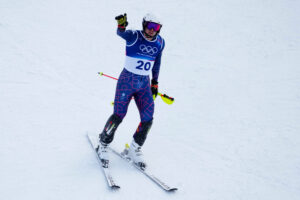
Britain’s Dave Ryding arrives at the finish area of an alpine ski, men’s slalom race, at the 2026 Winter Olympics, in Bormio, Italy, Monday, Feb. 16, 2026. (AP Photo/Julia Demaree Nikhinson)
Victoria Palla met part of Team GB’s nomination standard when she finished 23rd in slalom at the 2025 Alpine World Championships in Saalbach, Austria. She did not record a second top-30 result at World Cup or World Championships level, but she did place 23rd in the Europa Cup slalom in Chamonix in January.
GB Snowsport, which advises the British Olympic Association on nominations, has confirmed that despite Great Britain holding a women’s quota place, “no female athlete was ultimately selected” because no one met the BOA’s standards in full. The policy says athletes who fall short would only be considered in “genuinely exceptional and extenuating circumstances”.
The BOA has also set out a firm position on quota places, saying it will not treat reallocated or invitation places as qualification except in exceptional circumstances.
That stance is now being questioned after GB Snowsport put forward men’s skier Freddy Carrick-Smith as an exceptional case and prepared a detailed submission seeking a reallocated quota spot if one became available. Carrick-Smith won a Europa Cup giant slalom in Valloire in December 2025, a landmark result for British skiing. However, he has not posted the two benchmark results set out in the standard criteria either, leaving critics to argue the approach is being applied unevenly.
Michael Edwards, more famously known as Eddie the Eagle, has criticised the decision not to use quota places, arguing the Olympics should still value participation even when medal contention is unlikely.
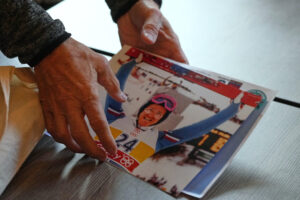
British former ski jumper Michael Edwards, known as Eddie the Eagle, arranges his photos from the 1988 Winter Olympics in Calgary (AP Photo/Frank Augstein)
In Team GB’s own words, the BOA exists to “lead the promotion of Olympism” and its “philosophy, aims and traditions”. (teamgb.com) One of the best-known lines linked to that philosophy is Pierre de Coubertin’s: “The important thing in the Olympic Games is not winning but taking part… what counts is not the victory but the struggle.”
Eddie the Eagle argues the BOA is drifting away from that ideal. “They do not follow the Coubertin quote… I don’t think they follow that ideal at all,” he said, questioning whether participation still carries any value in Team GB selection.
Others in the sport are more sympathetic to the BOA’s approach. Five-time Olympian Graham Bell says the standards should reflect Britain’s ability rather than lean on “excuses”, and notes Team GB’s thresholds are not as hard as some other nations’. But he also suggests Palla had enough of a case to push back. “It was pretty tight and definitely worth an appeal.”
Smaller nations often take a more inclusive approach. Ireland’s Anabelle Zurbay finished 48th in the women’s slalom on Wednesday 18 February, completing her Olympic debut. (Team Ireland) Supporters of a broader selection policy argue results like that show quota places can still be used meaningfully, even when athletes are not expected to contend for medals.
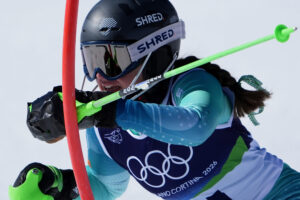
Ireland’s Annabel Zurbay competes during an alpine ski, women’s slalom race, at the 2026 Winter Olympics, in Cortina d’Ampezzo, Italy, Wednesday, Feb. 18, 2026. (AP Photo/Jacquelyn Martin)
Bell says he finds the disparity frustrating. “I don’t think it’s fair that top-class skiers miss out because some people have the right passport,” he said, adding that the issue is for the IOC and the International Ski Federation to address, rather than the athletes who take the places available to them.
Team GB’s approach, by contrast, is built around performance thresholds rather than representation, even when quota places exist.
Two-time alpine Olympian Charlie Guest described the absence of British female racers as “really sad”. She did not focus her criticism on the selection criteria, instead pointing to deeper problems in the sport, including limited funding and a lack of clear development pathways for women coming through.
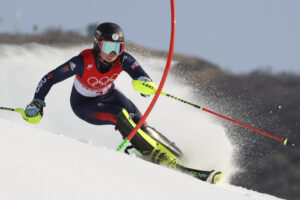
Charlie Guest, of Britain, competes in the first run of the women’s slalom at the 2022 Winter Olympics, Wednesday, Feb. 9, 2022, in the Yanqing district of Beijing. (AP Photo/Alessandro Trovati)
Both Team GB and the BOA declined to comment when approached by City News. The British Olympic Association remain able to change its qualification criteria at its own discretion at any point.
Short HeadlineEddie the Eagle fumes as Team GB snubs women’s Olympic ski pick
StandfirstCritics call it a betrayal of Olympism, while insiders point to funding gaps and broken pathways that left Team GB with no women on the slopes.
The British Olympic Association (BOA) has chosen not to send a female alpine skier to the Milano Cortina Winter Olympics, despite Great Britain holding a women’s quota place and having an athlete who meets the sport’s minimum Olympic qualification standard.
Victoria Palla, 25, competes in slalom and giant slalom and has recorded FIS points of 21.55 in slalom and 30.99 in giant slalom, with lower points indicating stronger performance. Under the Olympic system, athletes must be below the qualifying threshold in each discipline they intend to enter.
But meeting the IOC and FIS minimum does not guarantee selection for Team GB. The BOA can apply stricter nomination standards when deciding whether to fill quota places. Those tougher thresholds have long been part of the post “Eddie the Eagle” era, after Michael Edwards’ underdog appearance at Calgary 1988 helped trigger tighter eligibility rules designed to prevent under-qualified entries at future Games.
Those standards can be defined as:
· Two top-30 finishes at a FIS World Cup and/or World Championships, or
· One top-30 World Cup/World Championships finish plus one top-10 Europa Cup result.
All the male skiers who attended the games, Dave Ryding, Laurie Taylor and Billie Major qualified on these standards.
Britain’s Dave Ryding arrives at the finish area of an alpine ski, men’s slalom race, at the 2026 Winter Olympics, in Bormio, Italy, Monday, Feb. 16, 2026. (AP Photo/Julia Demaree Nikhinson)
Victoria Palla met part of Team GB’s nomination standard when she finished 23rd in slalom at the 2025 Alpine World Championships in Saalbach, Austria. She did not record a second top-30 result at World Cup or World Championships level, but she did place 23rd in the Europa Cup slalom in Chamonix in January.
GB Snowsport, which advises the British Olympic Association on nominations, has confirmed that despite Great Britain holding a women’s quota place, “no female athlete was ultimately selected” because no one met the BOA’s standards in full. The policy says athletes who fall short would only be considered in “genuinely exceptional and extenuating circumstances”.
The BOA has also set out a firm position on quota places, saying it will not treat reallocated or invitation places as qualification except in exceptional circumstances.
That stance is now being questioned after GB Snowsport put forward men’s skier Freddy Carrick-Smith as an exceptional case and prepared a detailed submission seeking a reallocated quota spot if one became available. Carrick-Smith won a Europa Cup giant slalom in Valloire in December 2025, a landmark result for British skiing. However, he has not posted the two benchmark results set out in the standard criteria either, leaving critics to argue the approach is being applied unevenly.
Michael Edwards, more famously known as Eddie the Eagle, has criticised the decision not to use quota places, arguing the Olympics should still value participation even when medal contention is unlikely.
British former ski jumper Michael Edwards, known as Eddie the Eagle, arranges his photos from the 1988 Winter Olympics in Calgary (AP Photo/Frank Augstein)
In Team GB’s own words, the BOA exists to “lead the promotion of Olympism” and its “philosophy, aims and traditions”. (teamgb.com) One of the best-known lines linked to that philosophy is Pierre de Coubertin’s: “The important thing in the Olympic Games is not winning but taking part… what counts is not the victory but the struggle.”
Eddie the Eagle argues the BOA is drifting away from that ideal. “They do not follow the Coubertin quote… I don’t think they follow that ideal at all,” he said, questioning whether participation still carries any value in Team GB selection.
Others in the sport are more sympathetic to the BOA’s approach. Five-time Olympian Graham Bell says the standards should reflect Britain’s ability rather than lean on “excuses”, and notes Team GB’s thresholds are not as hard as some other nations’. But he also suggests Palla had enough of a case to push back. “It was pretty tight and definitely worth an appeal.”
Smaller nations often take a more inclusive approach. Ireland’s Anabelle Zurbay finished 48th in the women’s slalom on Wednesday 18 February, completing her Olympic debut. (Team Ireland) Supporters of a broader selection policy argue results like that show quota places can still be used meaningfully, even when athletes are not expected to contend for medals.
Ireland’s Annabel Zurbay competes during an alpine ski, women’s slalom race, at the 2026 Winter Olympics, in Cortina d’Ampezzo, Italy, Wednesday, Feb. 18, 2026. (AP Photo/Jacquelyn Martin)
Bell says he finds the disparity frustrating. “I don’t think it’s fair that top-class skiers miss out because some people have the right passport,” he said, adding that the issue is for the IOC and the International Ski Federation to address, rather than the athletes who take the places available to them.
Team GB’s approach, by contrast, is built around performance thresholds rather than representation, even when quota places exist.
Two-time alpine Olympian Charlie Guest described the absence of British female racers as “really sad”. She did not focus her criticism on the selection criteria, instead pointing to deeper problems in the sport, including limited funding and a lack of clear development pathways for women coming through.
Charlie Guest, of Britain, competes in the first run of the women’s slalom at the 2022 Winter Olympics, Wednesday, Feb. 9, 2022, in the Yanqing district of Beijing. (AP Photo/Alessandro Trovati)
Both Team GB and the BOA declined to comment when approached by City News. The British Olympic Association remain able to change its qualification criteria at its own discretion at any point.