A senior judge has criticised “extraordinary” delays in transporting prisoners to court, after being forced to delay the trial of an asylum seeker accused of placing a fake bomb outside MI5 headquarters.
Chief Magistrate Paul Goldspring made his remarks at City of London Magistrates’ Court, where the trial is currently ongoing.
The case, which was marked as a “priority” due to the serious nature of the allegation, was due to start at 10am, but court officials were told that the defendant would be at least an hour late and may not even have left the prison where he was being held.
“It’s quite extraordinary, isn’t it? I should know by now that they can’t get them here on time, but it never ceases to amaze me.”
The judge opted to start a different trial while waiting for the defendant, which eventually happened at 11:30am.
The incident comes shortly after the release of a report from Charlie Taylor, the Chief Inspector of Prisons, intro failings at custody facilities across London’s magistrates’ courts.
Mr Taylor wrote found that the “lack of consistent cooperation” between the courts and transport agencies were “causing avoidable delays, poor outcomes for detainees and unnecessary strain on staff.”
In his report, he said that transport arrangements required “urgent attention”, as “many detainees arrived late to court custody.
“We were told that delays in prisons and police stations, the use of smaller vehicles, multiple collections, and circuitous routes all contributed to delays with detainees arriving at court”.
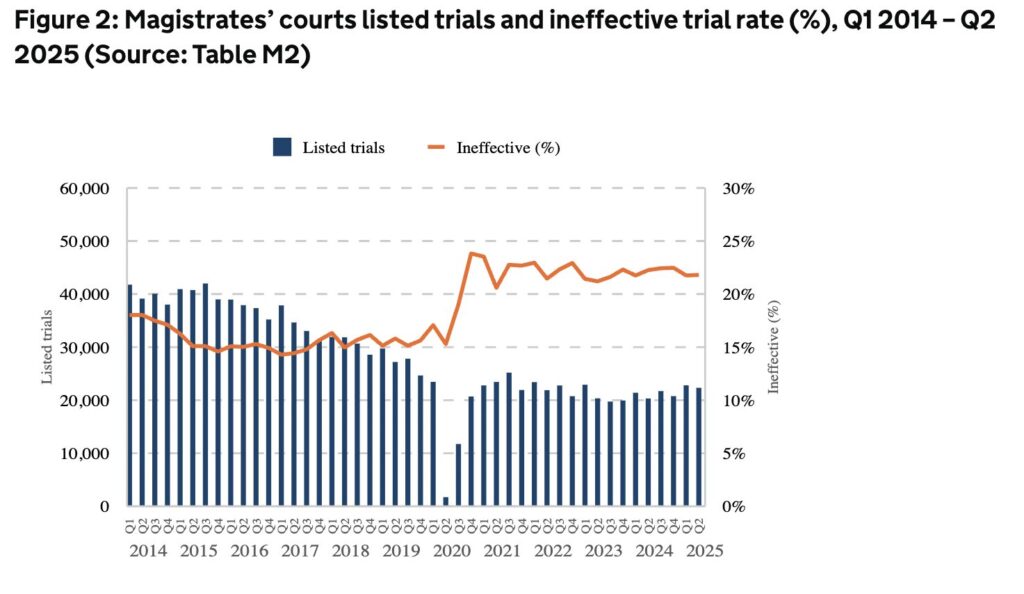
For the last few years, the number of trials in magistrates’ courts in England and Wales listed as ineffective, meaning they did not go ahead at the originally scheduled time, has remained consistently higher than pre-pandemic levels.
Source: Ministry of Justice
In a recent, independent review of the justice system, retired Court of Appeal judge, Sir Brian Leveson, acknowledged the problems with prisoners being brought late to court.
He made a number of suggestions, including allowing prison escort vans to use bus lanes and increasing the number of court hearings which take place with the defendant on a video link from either a prison or police station.
A Ministry of Justice spokesperson said:
“It is vital we provide safe environments for those in court custody, and we work closely with suppliers to strengthen safeguards for people in our care. This includes physical separations in prison transport vans to ensure there is no inappropriate mixing and specially trained escorts for children.
“We ensure those who are disabled or neurodiverse have support and adjustments.”
Submitted Article
Headline
Short Headline
Standfirst
Published Article
HeadlineSenior judge criticises ‘extraordinary’ delays in transporting prisoners to London Courts
Short HeadlinePrisoner transport delays criticised as 'extraordinary'
StandfirstThe trial of an asylum seeker accused of planting a fake bomb outside MI5 was delayed by over an hour
A senior judge has criticised “extraordinary” delays in transporting prisoners to court, after being forced to delay the trial of an asylum seeker accused of placing a fake bomb outside MI5 headquarters.
Chief Magistrate Paul Goldspring made his remarks at City of London Magistrates’ Court, where the trial is currently ongoing.
The case, which was marked as a “priority” due to the serious nature of the allegation, was due to start at 10am, but court officials were told that the defendant would be at least an hour late and may not even have left the prison where he was being held.
“It’s quite extraordinary, isn’t it? I should know by now that they can’t get them here on time, but it never ceases to amaze me.”
The judge opted to start a different trial while waiting for the defendant, which eventually happened at 11:30am.
The incident comes shortly after the release of a report from Charlie Taylor, the Chief Inspector of Prisons, intro failings at custody facilities across London’s magistrates’ courts.
Mr Taylor wrote found that the “lack of consistent cooperation” between the courts and transport agencies were “causing avoidable delays, poor outcomes for detainees and unnecessary strain on staff.”
In his report, he said that transport arrangements required “urgent attention”, as “many detainees arrived late to court custody.
“We were told that delays in prisons and police stations, the use of smaller vehicles, multiple collections, and circuitous routes all contributed to delays with detainees arriving at court”.
For the last few years, the number of trials in magistrates’ courts in England and Wales listed as ineffective, meaning they did not go ahead at the originally scheduled time, has remained consistently higher than pre-pandemic levels.
Source: Ministry of Justice
In a recent, independent review of the justice system, retired Court of Appeal judge, Sir Brian Leveson, acknowledged the problems with prisoners being brought late to court.
He made a number of suggestions, including allowing prison escort vans to use bus lanes and increasing the number of court hearings which take place with the defendant on a video link from either a prison or police station.
A Ministry of Justice spokesperson said:
“It is vital we provide safe environments for those in court custody, and we work closely with suppliers to strengthen safeguards for people in our care. This includes physical separations in prison transport vans to ensure there is no inappropriate mixing and specially trained escorts for children.
“We ensure those who are disabled or neurodiverse have support and adjustments.”
As the weather turns, City News has spoken to a long-term rough sleeper to see how those on the street feel about Andy Burnham’s plan to end homelessness and the upcoming winter.