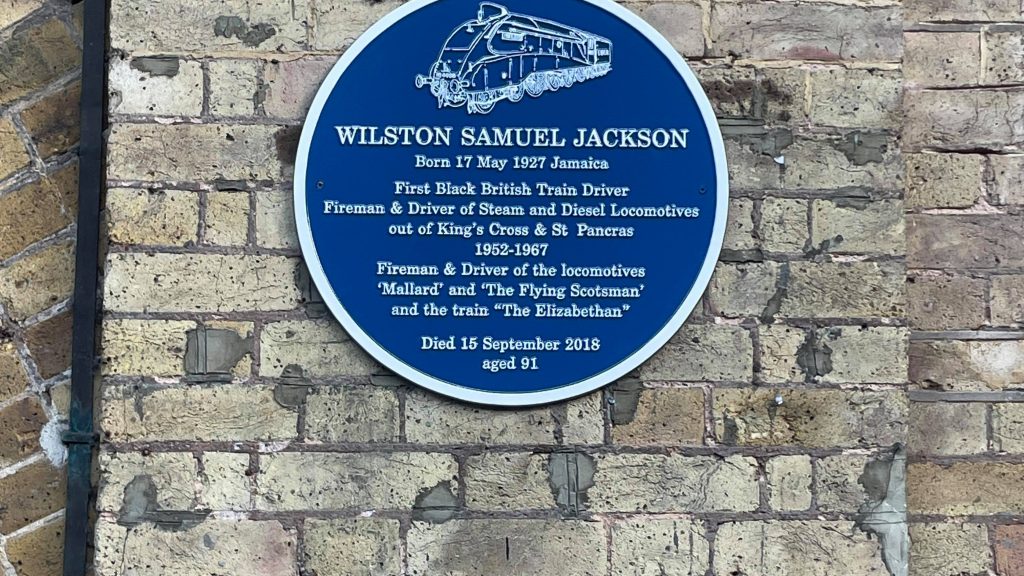
The plaque commemorating Wilston Jackson, the first Black British train driver, outside King's Cross' Platform 5.
SHARE:
A union spokesperson says train freight operators still have ‘work to do’ to ensure their drivers are representative of the UK population.
It comes after Network Rail revealed a commemorative plaque in London on Tuesday to Wilston Samuel Jackson, the first Black British train driver.
Keith Desmond, spokesman for Train Drivers’ Union ASLEF, said that whilst the union were ‘proud’ of the plaque, BAME and female train drivers are still under-represented on Britain’s rails.
The comments follow that of Jackson’s daughter, Polly, who said at Tuesday’s unveiling that the plaque represented ‘a fitting tribute to his life and career’.
Jamaican-born ‘Bill’ Jackson became a train driver in 1962, after 10 years of working on train maintenance. He died in 2018, aged 91.
The plaque, erected on Tuesday, is at King’s Cross Station, one of the UK’s core terminals. The memorial comes amidst annual Black History Month celebrations.
A plaque papering over the cracks?
Despite significant improvements in the numbers of Black and Minority Ethnic train drivers over the last 50 years, they account for just 8.5% of the workforce.
Despite this, train driver Mark spoke encouragingly about his own experience as a BAME driver in the industry.
An LNER train driver speaks on diversity in the workforce.
Yet despite this, Mark’s experience belies the numbers which highlight that the diversity gap still exists.
Some analysts have however said that recognition of glass-ceiling achievements like that of Mr. Jackson could encourage more BAME people to consider a role as a train driver.
LNER, National Rail and a number of other major freight train operating services in the UK refused to make official comment.
Submitted Article
Headline
Short Headline
Standfirst
Published Article
HeadlineASLEF: Drivers not diverse enough
Short HeadlineUnion to train operators: Tackle lack of diversity
Standfirst49 years after the first Black British train driver, ASLEF say the workforce is still not ethnically representative of Britain.
A union spokesperson says train freight operators still have ‘work to do’ to ensure their drivers are representative of the UK population.
It comes after Network Rail revealed a commemorative plaque in London on Tuesday to Wilston Samuel Jackson, the first Black British train driver.
Keith Desmond, spokesman for Train Drivers’ Union ASLEF, said that whilst the union were ‘proud’ of the plaque, BAME and female train drivers are still under-represented on Britain’s rails.
The comments follow that of Jackson’s daughter, Polly, who said at Tuesday’s unveiling that the plaque represented ‘a fitting tribute to his life and career’.
Jamaican-born ‘Bill’ Jackson became a train driver in 1962, after 10 years of working on train maintenance. He died in 2018, aged 91.
The plaque, erected on Tuesday, is at King’s Cross Station, one of the UK’s core terminals. The memorial comes amidst annual Black History Month celebrations.
A plaque papering over the cracks?
Despite significant improvements in the numbers of Black and Minority Ethnic train drivers over the last 50 years, they account for just 8.5% of the workforce.
Despite this, train driver Mark spoke encouragingly about his own experience as a BAME driver in the industry.
An LNER train driver speaks on diversity in the workforce.
Yet despite this, Mark’s experience belies the numbers which highlight that the diversity gap still exists.
Some analysts have however said that recognition of glass-ceiling achievements like that of Mr. Jackson could encourage more BAME people to consider a role as a train driver.
LNER, National Rail and a number of other major freight train operating services in the UK refused to make official comment.
A 39-year-old cyclist was killed in South East London after a collision with a lorry. A "ghost bike" has been placed near the site of the collision to warn future riders.
A 2024 Freedom of Information request showed Bromley Council had £4.5 million invested in arms companies that year with £1.5 million reportedly linked to Israel.
Undercover officers raided three linked shops in Barking town centre, revealing how illicit tobacco is being hidden in walls, ceilings and nearby locations to evade detection.
More than 330,000 people across the UK sought support from the Stop It Now helpline in 2025 over concerns about their own or someone else’s online sexual behaviour towards children, according to new charity data. The anonymous service says contacts by phone, email and webchat rose significantly over the year.