Sam Fender won the Mercury Prize last Thursday for his third studio album People Watching at the ceremony in Newcastle, less than 10 miles from his childhood home in North Shields.
Fender beat odds-on favourites CMAT and Fontaines D.C. to take home the prestigious award. His Springsteen-inspired heartland rock is described by the judges as “melody-rich and expansive”, touching on the “realities of everyday life and the importance of community.”
The Prize was created by the British Phonographic Industry (BPI) in 1992. The less-mainstream alternative to the BRIT Awards can have a considerable impact on an artist’s sales figures and reputation. It has often drawn criticism for being too London-centric.
Historically, the capital has been very overrepresented in the awards. Half of all winners hailing from London since its inception in 1992.
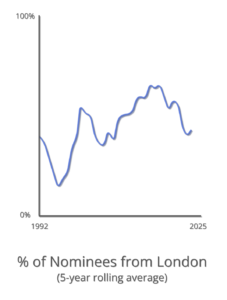
Even when Londoners don’t take home the Prize, they’ve still dominated nominations. London albums account for 43% of all nominees.
This might be changing, with the ceremony leaving its 34-year home at the Hammersmith Apollo in West London and moving to Newcastle’s Utilita Arena.
BPI Chief Executive Jo Twist said that the Prize hoped to extend their reach and celebrate creativity across Britain and Ireland, but is this really happening?
It’s the second year in a row that a Northern artist has won the award. Leeds-based indie band English Teacher’s were victorious last year with their album, This Could Be Texas.
These results have broken a nine-year streak that saw artists from London winning. Artists from outside of the capital have triumphed at the ceremony back-to-back, bucking the trend of Londoners taking home the trophy.
All London-based winners of the Prize 2015-2023
After the most London-dominated lineup ever in 2023, the capital’s influence has sharply declined. This year featured a record-low 2 nominees from the city, joint with Dublin. This is the first time since 1996 that London hasn’t held more than anywhere else.
Alongside the BRIT Awards moving to Manchester next year, British Music Awards may indeed be getting less London-centric.
Submitted Article
Headline
Short Headline
Standfirst
Published Article
HeadlineIs the UK Music Scene Moving Out of London?
Short Headline
StandfirstWinners of the Mercury Prize are often from the capital city - but that is beginning to change.
Sam Fender won the Mercury Prize last Thursday for his third studio album People Watching at the ceremony in Newcastle, less than 10 miles from his childhood home in North Shields.
Fender beat odds-on favourites CMAT and Fontaines D.C. to take home the prestigious award. His Springsteen-inspired heartland rock is described by the judges as “melody-rich and expansive”, touching on the “realities of everyday life and the importance of community.”
The Prize was created by the British Phonographic Industry (BPI) in 1992. The less-mainstream alternative to the BRIT Awards can have a considerable impact on an artist’s sales figures and reputation. It has often drawn criticism for being too London-centric.
Historically, the capital has been very overrepresented in the awards. Half of all winners hailing from London since its inception in 1992.
Even when Londoners don’t take home the Prize, they’ve still dominated nominations. London albums account for 43% of all nominees.
This might be changing, with the ceremony leaving its 34-year home at the Hammersmith Apollo in West London and moving to Newcastle’s Utilita Arena.
BPI Chief Executive Jo Twist said that the Prize hoped to extend their reach and celebrate creativity across Britain and Ireland, but is this really happening?
It’s the second year in a row that a Northern artist has won the award. Leeds-based indie band English Teacher’s were victorious last year with their album, This Could Be Texas.
These results have broken a nine-year streak that saw artists from London winning. Artists from outside of the capital have triumphed at the ceremony back-to-back, bucking the trend of Londoners taking home the trophy.
All London-based winners of the Prize 2015-2023
After the most London-dominated lineup ever in 2023, the capital’s influence has sharply declined. This year featured a record-low 2 nominees from the city, joint with Dublin. This is the first time since 1996 that London hasn’t held more than anywhere else.
Alongside the BRIT Awards moving to Manchester next year, British Music Awards may indeed be getting less London-centric.
To mark the launch of HBO Max, iconic movie sets land in London for a two-day immersive experience, letting visitors wander through worlds from Friends, Harry Potter, The White Lotus and Superman.
In a rare, candid interview, Blake Fielder-Civil opens up about the relationship that gripped a generation - and why he refuses to carry the guilt alone.
While awards season usually draws celebrities to Los Angeles, several A-listers have instead been spotted working on film and TV sets across the capital.