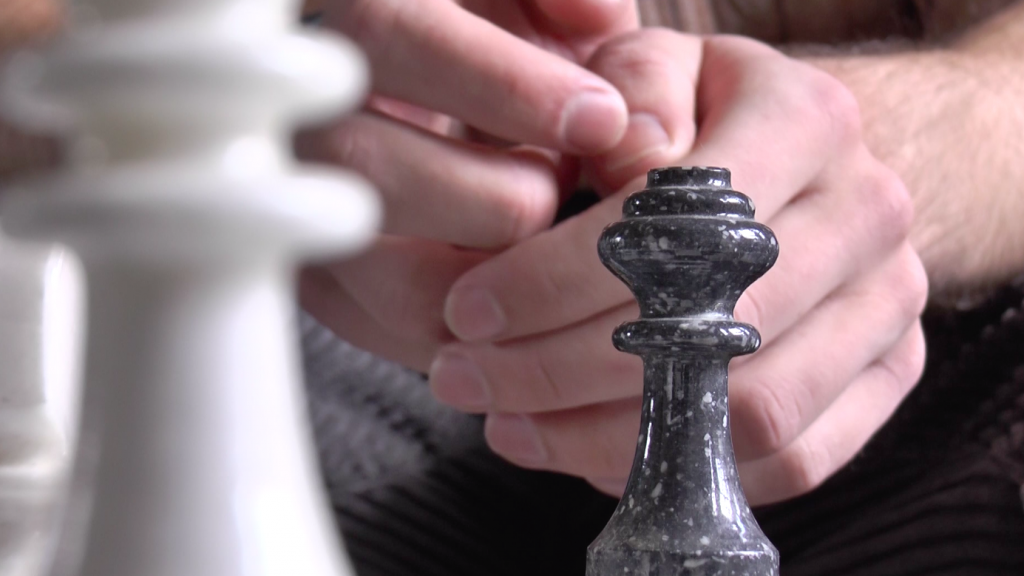
“To start off with you think they are so at other ends of the spectrum. Intellectual: chess. Physical: boxing. But it’s not really like that.”
Matt Read is talking to me at Islington boxing club, a seemingly run-of-the-mill boxing gym kitted out with numerous punch bags, free weights, treadmills and several full-sized boxing rings. Muhammed Ali glares down from a nearby wall, and press cuttings plaster the surfaces, detailing successes and failures of local prodigies. Think the Rocky films, then tidy it up and add a North London accent.
But this gym isn’t just home to boxing purists. On Saturday mornings, it also functions as the training base for one of the world’s most unusual sports: chessboxing.
Chessboxing essentially does what it says on the tin. Fighters are welcomed into a boxing ring in front of packed venues, and often sporting fancy dress to suit their chessboxing alter-ego. Before any boxing happens, however, they are met with a chessboard. First, they play a round of chess, then a round of boxing. Then they chess again, then box again. And then several more times (with the exact length depending on the varying contest rules).
The chess game is a cumulative process; fighters will return to the board having hit each other in the head for three minutes and have to remember where they’ve left it. (It’s often the worst move they’ll make, and have appropriated a cricketing term for a bad move post-boxing: a “jaffer”).
Victory is won in a variety of ways, but primarily via checkmate, knockout, or running out of time of your chess clock. Physically and mentally, it’s exhausting.
Chessboxing is won either by checkmate, knockout or timing out. Credit: London Chessboxing
That brings us back to Matt Read. Or to give him his chessboxing name: Matt “Crazy Arms” Read. Matt’s had the most fights in chessboxing history, with 31 (20 wins, 11 losses). I ask him to take me through the fight day experience.
Matt “Crazy Arms” Read has the most chessboxing fights in history.
“The first few times you do the ring walk you feel a little bit stupid, but after a while you just love it. The adrenaline and energy that they [the crowd] give a fighter is so important.
“So in a championship chessboxing fight, we will fight six rounds of chess, five rounds of boxing as a maximum.
“My strategy in chessboxing fights is always to survive the boxing and win on the chess. To do that I want to play my chess as quickly as possible, because the quicker I play my chess, the less boxing I have to do.
“You can gas yourself incredibly quickly in boxing… even in two-minute rounds, they’re very, very difficult to get through.”
While Matt may be a veteran of the ring, David “the Northern Powerhouse” Jarmany fought (and won) for the first time in October 2020.
David “The Northern Powerhouse” Jarmany won his first fight against Cameron “The Hurtlocker” Little in October.
“I don’t normally get nervous about things… but that was something totally different. You’re almost scared for your life a little bit, because somebody’s in that ring, trying to punch your lights out.
“I wanted to win on the boxing… but I sort of realised halfway through the second round [the first boxing round] that there was no way I was going to!
“You’ll notice as we went to the third chess round there was a complete blunder by me. Then the next move, [my opponent] Cameron also made a massive blunder. After that, the game was pretty much over.”
It’s a sport that owes its existence to a French comic book Froid Équateur and brought to life by Dutch performance artist, Iepe Rubingh. Iepe sadly passed away in 2020, but the year previously he spoke to ESPN about how the sport was created.
He talks of how he met his friend in Amsterdam and how, by chance, they’d both started boxing. With encouragement from a group of friends, and recalling Enki Bilal’s invention, Iepe decided: “we’re going to do a fight, but we’re going to do it differently and measure ourselves on every potential level. We’re going to do a chessboxing fight.”
Since then, chessboxing has gone global.
Iepe Rubingh in 2012. Credit: Ornella Orlandini
The Iepe-led and Berlin-based World Chessboxing Organisation now has members on four continents.
Matt and David are two of nearly 50 members of London’s group, although training each week normally welcomes closer to 10. Gavin Patterson has been involved since 2015 and organises the sessions, and explains where the recruits come from.
“Mostly people come from a chess background but it does vary. I came into it not having played chess or boxed. It’s rare people come from a boxing background.”
Gavin Patterson running a Saturday morning chessboxing session.
The final question that I have for the chessboxers is why? Why does this combination work so well in their view? What is the appeal of mixing the world’s foremost intellectual sport with the most famous physical one?
Gavin feels that there are a lot more similarities between chess and boxing than meets the eye at first:
“I think what people don’t understand is that boxing is like chess [in the sense that] it’s very strategic. In chess, if you go a few pieces down it’s very hard to gain that advantage back. It’s attritional, just like in boxing.”
Matt has a similar outlook.
“They’re both one-on-one games, they’re both me against the opponent, there’s no real luck involved in either. If you lose at chess, if you lose at boxing, you just have to suck it up.”
David on the other hand looks at it as opposites attracting.
“So they’re polar opposites and that’s why it works well together. You’ve got the battle of the mind in chess and the battle of the muscles in body, and how one interacts with the other. And they do very much affect each other.”
Whatever the reason, it’s clear that for many it does work. The London chessboxers are already planning a training camp in Helsinki, and fresh events at the end of the year.
In terms of an all-round challenge, it’s fair to say that chessboxing delivers a knockout, or perhaps a checkmate, to your average local sports club.
Submitted Article
Headline
Short Headline
Standfirst
Published Article
HeadlineChessboxing, the extreme hybrid sport happening right on Londoner’s doorstep
Short HeadlineChessboxing, an extreme hybrid sport
StandfirstA 21st century combination of two of the world's oldest past-times is happening right on Londoner's doorsteps.
“To start off with you think they are so at other ends of the spectrum. Intellectual: chess. Physical: boxing. But it’s not really like that.”
Matt Read is talking to me at Islington boxing club, a seemingly run-of-the-mill boxing gym kitted out with numerous punch bags, free weights, treadmills and several full-sized boxing rings. Muhammed Ali glares down from a nearby wall, and press cuttings plaster the surfaces, detailing successes and failures of local prodigies. Think the Rocky films, then tidy it up and add a North London accent.
But this gym isn’t just home to boxing purists. On Saturday mornings, it also functions as the training base for one of the world’s most unusual sports: chessboxing.
Chessboxing essentially does what it says on the tin. Fighters are welcomed into a boxing ring in front of packed venues, and often sporting fancy dress to suit their chessboxing alter-ego. Before any boxing happens, however, they are met with a chessboard. First, they play a round of chess, then a round of boxing. Then they chess again, then box again. And then several more times (with the exact length depending on the varying contest rules).
The chess game is a cumulative process; fighters will return to the board having hit each other in the head for three minutes and have to remember where they’ve left it. (It’s often the worst move they’ll make, and have appropriated a cricketing term for a bad move post-boxing: a “jaffer”).
Victory is won in a variety of ways, but primarily via checkmate, knockout, or running out of time of your chess clock. Physically and mentally, it’s exhausting.
Chessboxing is won either by checkmate, knockout or timing out. Credit: London Chessboxing
That brings us back to Matt Read. Or to give him his chessboxing name: Matt “Crazy Arms” Read. Matt’s had the most fights in chessboxing history, with 31 (20 wins, 11 losses). I ask him to take me through the fight day experience.
Matt “Crazy Arms” Read has the most chessboxing fights in history.
“The first few times you do the ring walk you feel a little bit stupid, but after a while you just love it. The adrenaline and energy that they [the crowd] give a fighter is so important.
“So in a championship chessboxing fight, we will fight six rounds of chess, five rounds of boxing as a maximum.
“My strategy in chessboxing fights is always to survive the boxing and win on the chess. To do that I want to play my chess as quickly as possible, because the quicker I play my chess, the less boxing I have to do.
“You can gas yourself incredibly quickly in boxing… even in two-minute rounds, they’re very, very difficult to get through.”
While Matt may be a veteran of the ring, David “the Northern Powerhouse” Jarmany fought (and won) for the first time in October 2020.
David “The Northern Powerhouse” Jarmany won his first fight against Cameron “The Hurtlocker” Little in October.
“I don’t normally get nervous about things… but that was something totally different. You’re almost scared for your life a little bit, because somebody’s in that ring, trying to punch your lights out.
“I wanted to win on the boxing… but I sort of realised halfway through the second round [the first boxing round] that there was no way I was going to!
“You’ll notice as we went to the third chess round there was a complete blunder by me. Then the next move, [my opponent] Cameron also made a massive blunder. After that, the game was pretty much over.”
It’s a sport that owes its existence to a French comic book Froid Équateur and brought to life by Dutch performance artist, Iepe Rubingh. Iepe sadly passed away in 2020, but the year previously he spoke to ESPN about how the sport was created.
He talks of how he met his friend in Amsterdam and how, by chance, they’d both started boxing. With encouragement from a group of friends, and recalling Enki Bilal’s invention, Iepe decided: “we’re going to do a fight, but we’re going to do it differently and measure ourselves on every potential level. We’re going to do a chessboxing fight.”
Since then, chessboxing has gone global.
Iepe Rubingh in 2012. Credit: Ornella Orlandini
The Iepe-led and Berlin-based World Chessboxing Organisation now has members on four continents.
Matt and David are two of nearly 50 members of London’s group, although training each week normally welcomes closer to 10. Gavin Patterson has been involved since 2015 and organises the sessions, and explains where the recruits come from.
“Mostly people come from a chess background but it does vary. I came into it not having played chess or boxed. It’s rare people come from a boxing background.”
Gavin Patterson running a Saturday morning chessboxing session.
The final question that I have for the chessboxers is why? Why does this combination work so well in their view? What is the appeal of mixing the world’s foremost intellectual sport with the most famous physical one?
Gavin feels that there are a lot more similarities between chess and boxing than meets the eye at first:
“I think what people don’t understand is that boxing is like chess [in the sense that] it’s very strategic. In chess, if you go a few pieces down it’s very hard to gain that advantage back. It’s attritional, just like in boxing.”
Matt has a similar outlook.
“They’re both one-on-one games, they’re both me against the opponent, there’s no real luck involved in either. If you lose at chess, if you lose at boxing, you just have to suck it up.”
David on the other hand looks at it as opposites attracting.
“So they’re polar opposites and that’s why it works well together. You’ve got the battle of the mind in chess and the battle of the muscles in body, and how one interacts with the other. And they do very much affect each other.”
Whatever the reason, it’s clear that for many it does work. The London chessboxers are already planning a training camp in Helsinki, and fresh events at the end of the year.
In terms of an all-round challenge, it’s fair to say that chessboxing delivers a knockout, or perhaps a checkmate, to your average local sports club.
As e-bike riders weave through London’s busiest junctions, red lights are increasingly treated as optional. One software engineer says the problem may be baked into how hire firms charge users