Nigel Farage has been a constant presence in British politics for years. From UKIP to the Brexit Party and now Reform UK, he has shaped debates around the European Union, immigration, and national identity. But could he be the UK’s next Prime Minister?
The UK has historically operated as a two-party system, with Labour and the Conservatives alternating in power.
Smaller parties have always existed, but they have rarely been strong enough to form a government on their own.
In fact, the last time a party outside Labour or the Conservatives governed alone was more than a century ago, when the Liberal Party held office between 1906 and 1915.
So how could this status quo be upset by Nigel Farage? Well, he’s certainly popular, but now a new polling system has predicted victory for Reform.
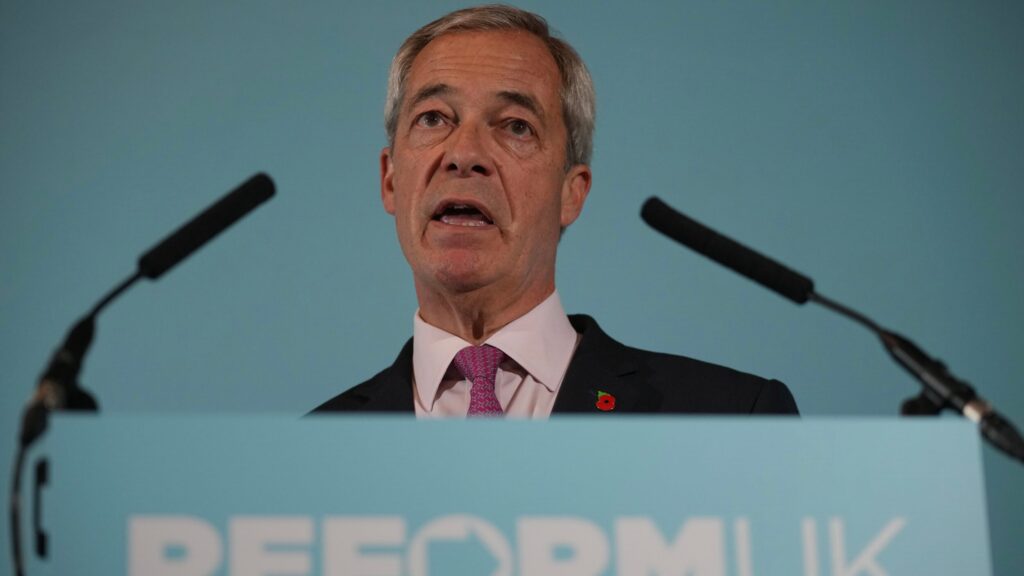
Britain’s Reform UK party leader Nigel Farage reacts during the Reform party’s annual conference at the National Exhibition Centre in Birmingham, England, Saturday, Sept. 6, 2025.(AP Photo/Thomas Krych)
This system is called an MRP. MRP stands for Multilevel Regression and Post-stratification. It’s a polling method that takes a large survey and combines it with background data – like people’s age, where they live, and how they’ve voted before – to estimate how much support each party has in individual constituencies across the UK.
MRP is a relatively new method of election prediction, but it does have a strong track record, having accurately forecasted the outcomes of the last three UK general elections.
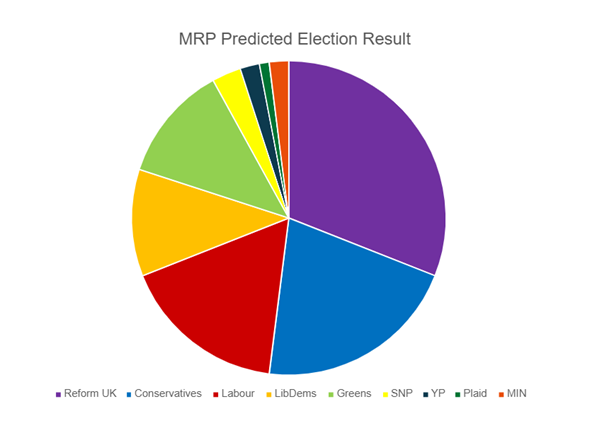
Based on polling of more than 5,500 people, this MRP, carried out by the company Electoral Calculus, has some pretty unprecedented results. It puts Reform UK on 31%, ahead of the Conservative Party on 21%, and the Labour Party on 17%.
Pie chart showing the MRP’s prediction. Credit: City News
Translating that into seats in parliament, Reform is predicted to secure 335 seats, leaving the Conservatives on 92 seats and the Liberal Democrats on 60. Labour would be in 6th place behind the Greens and the Scottish National Party.
This suggests that Reform UK is currently the most popular party nationally and could go on to win the next general election with a small overall majority, leaving the Conservatives as the official opposition.
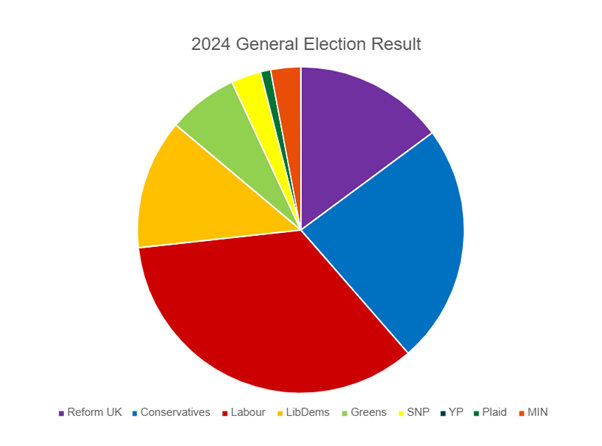
This looks very different to the last general election. In the 2024 general election, the Labour Party led with 35% of the vote, meaning they had 412 seats, whilst Reform UK secured 15% of the vote, and only five seats.
This means that, according to the MRP, Reform would more than double its 2024 vote share if an election were held today.
Pie chart showing the 2024 general election results. Credit: City News
In fact, though in 2024 the party won just five seats, under these new MRP projections it would secure around 335 seats – an increase equivalent to a 6600% rise in Reform’s parliamentary representation.
“Labour are suffering double trouble from the rise of Reform on the right, and the growth of the Greens on the left. Our figures suggest a near-catastrophic wipe-out for Labour which would be the party’s worst result since February 1910”.
These MRP predictions suggests that voters are becoming increasingly willing to back political alternatives.
It points to growing frustration with both Labour and the Conservatives, and an increasing tendency to vote based on specific issues rather than long-standing party loyalty.
Following the recent defection of two senior Conservative MPs, Robert Jenrick and Andrew Rosindell, to Reform UK, it seems people may be more willing than at any point in recent history to abandon the main parties.
Nigel Farage, leader of the Reform UK waves from inside a jeep at the end of an electoral rally at Clacton Pier in Clacton-on-Sea, England, Wednesday, July 3, 2024. (AP Photo/Vadim Ghirda)
MRPs rely on modelling and assumptions, meaning different models can reach different conclusions even when using the same data. Like all polls, it also only reflects opinion at the time the data is collected and voters’ views can change as an election campaign unfolds.
The UK’s next general election will take place by 15 August 2029, although the prime minister Keir Starmer can choose to call it earlier. So there’s still a lot of time for this to change.
Submitted Article
Headline
Short Headline
Standfirst
Published Article
HeadlineCould Nigel Farage be our next prime minister?
Short HeadlineCould Nigel Farage be our next prime minister?
StandfirstA new poll suggests the leader of Reform UK could enter Downing Street if a general election were held today.
Nigel Farage has been a constant presence in British politics for years. From UKIP to the Brexit Party and now Reform UK, he has shaped debates around the European Union, immigration, and national identity. But could he be the UK’s next Prime Minister?
The UK has historically operated as a two-party system, with Labour and the Conservatives alternating in power.
Smaller parties have always existed, but they have rarely been strong enough to form a government on their own.
In fact, the last time a party outside Labour or the Conservatives governed alone was more than a century ago, when the Liberal Party held office between 1906 and 1915.
So how could this status quo be upset by Nigel Farage? Well, he’s certainly popular, but now a new polling system has predicted victory for Reform.
Britain’s Reform UK party leader Nigel Farage reacts during the Reform party’s annual conference at the National Exhibition Centre in Birmingham, England, Saturday, Sept. 6, 2025.(AP Photo/Thomas Krych)
This system is called an MRP. MRP stands for Multilevel Regression and Post-stratification. It’s a polling method that takes a large survey and combines it with background data – like people’s age, where they live, and how they’ve voted before – to estimate how much support each party has in individual constituencies across the UK.
MRP is a relatively new method of election prediction, but it does have a strong track record, having accurately forecasted the outcomes of the last three UK general elections.
Based on polling of more than 5,500 people, this MRP, carried out by the company Electoral Calculus, has some pretty unprecedented results. It puts Reform UK on 31%, ahead of the Conservative Party on 21%, and the Labour Party on 17%.
Pie chart showing the MRP’s prediction. Credit: City News
Translating that into seats in parliament, Reform is predicted to secure 335 seats, leaving the Conservatives on 92 seats and the Liberal Democrats on 60. Labour would be in 6th place behind the Greens and the Scottish National Party.
This suggests that Reform UK is currently the most popular party nationally and could go on to win the next general election with a small overall majority, leaving the Conservatives as the official opposition.
This looks very different to the last general election. In the 2024 general election, the Labour Party led with 35% of the vote, meaning they had 412 seats, whilst Reform UK secured 15% of the vote, and only five seats.
This means that, according to the MRP, Reform would more than double its 2024 vote share if an election were held today.
Pie chart showing the 2024 general election results. Credit: City News
In fact, though in 2024 the party won just five seats, under these new MRP projections it would secure around 335 seats – an increase equivalent to a 6600% rise in Reform’s parliamentary representation.
“Labour are suffering double trouble from the rise of Reform on the right, and the growth of the Greens on the left. Our figures suggest a near-catastrophic wipe-out for Labour which would be the party’s worst result since February 1910”.
These MRP predictions suggests that voters are becoming increasingly willing to back political alternatives.
It points to growing frustration with both Labour and the Conservatives, and an increasing tendency to vote based on specific issues rather than long-standing party loyalty.
Following the recent defection of two senior Conservative MPs, Robert Jenrick and Andrew Rosindell, to Reform UK, it seems people may be more willing than at any point in recent history to abandon the main parties.
Nigel Farage, leader of the Reform UK waves from inside a jeep at the end of an electoral rally at Clacton Pier in Clacton-on-Sea, England, Wednesday, July 3, 2024. (AP Photo/Vadim Ghirda)
MRPs rely on modelling and assumptions, meaning different models can reach different conclusions even when using the same data. Like all polls, it also only reflects opinion at the time the data is collected and voters’ views can change as an election campaign unfolds.
The UK’s next general election will take place by 15 August 2029, although the prime minister Keir Starmer can choose to call it earlier. So there’s still a lot of time for this to change.
A 2024 Freedom of Information request showed Bromley Council had £4.5 million invested in arms companies that year with £1.5 million reportedly linked to Israel.
Undercover officers raided three linked shops in Barking town centre, revealing how illicit tobacco is being hidden in walls, ceilings and nearby locations to evade detection.
More than 330,000 people across the UK sought support from the Stop It Now helpline in 2025 over concerns about their own or someone else’s online sexual behaviour towards children, according to new charity data. The anonymous service says contacts by phone, email and webchat rose significantly over the year.