From Brexit to ‘Born Again’? Inside UKIP’s Second Coming
Nigel Farage's old party has had a radical makeover, aiming to put 'muscular Christianity' into the 'heart of government'. But what's behind this shift?
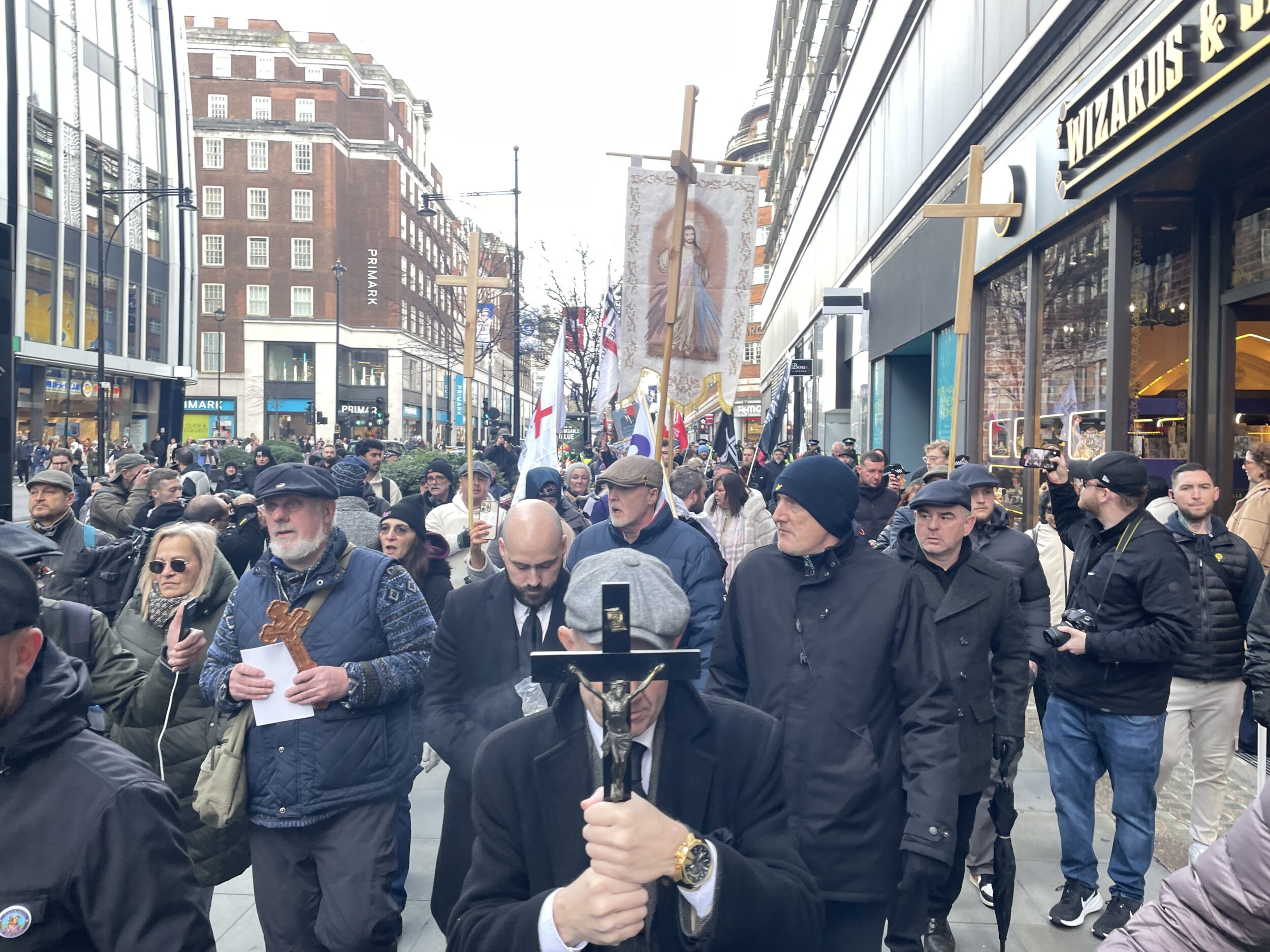
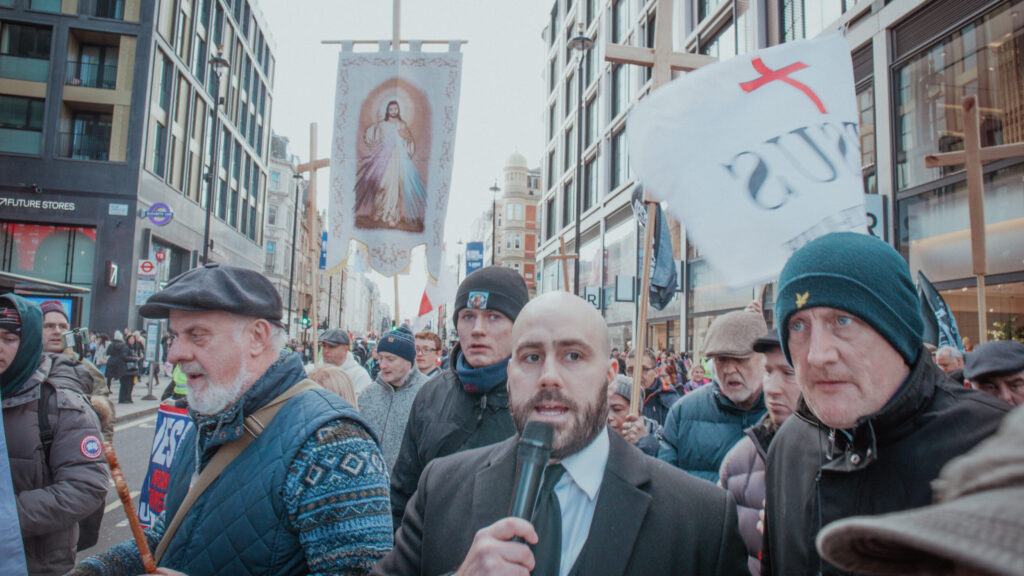
Just in front of Marble Arch on a sunny Saturday morning, a crowd is forming. Bearing wooden crosses and banners adorned with Jesus and Mary, you’d be forgiven for thinking this was a church day-out. But believe it or not, this is the new face of UKIP – the United Kingdom Independence Party.
Remember them? The party that introduced us to Nigel Farage has had a radical makeover.
Led by ex-personal trainer Nick Tenconi, UKIP has now launched an ‘explicitly Christian’ campaign to put what it calls ‘Muscular Christianity’ at the ‘heart of government’.
“We’re taking our country back,” Tenconi says, addressing spectators in the square, “we’re doing so for the glory of God. UKIP is a Christian land.”
This ‘Walk with Jesus’ has been marketed as one of the “largest explicitly Christian gatherings in recent history”. The turnout may not match that ambition – only around 200 people took to the streets. But with incense burning and prayer booklets being passed around, the atmosphere certainly feels different to your usual political rally.
It’s a far cry from Brexit.
Dr William Allchorn is a fellow of the American University in Richmond, who specialises in British far-right political movements. He told City News that since Farage’s departure as leader, UKIP has undergone an extreme transformation.
“Since 2016 the party has changed largely beyond recognition from a Eurosceptic civic nationalist party – looking at anxieties around immigration and exiting the European Union – towards now looking at this more civilisational or religious identity politics.”
But how did UKIP get here? And what can we make of its new found faith?
What is UKIP?
UKIP was originally founded by Scottish academic Alan Sked as the ‘Anti-Federalist League’ in 1992, a cross-party group in opposition to the establishment of the European Union.
After Sked’s departure as leader in 1997, UKIP reached a peak popularity of over 3 million votes in the 2015 election under Nigel Farage’s leadership.
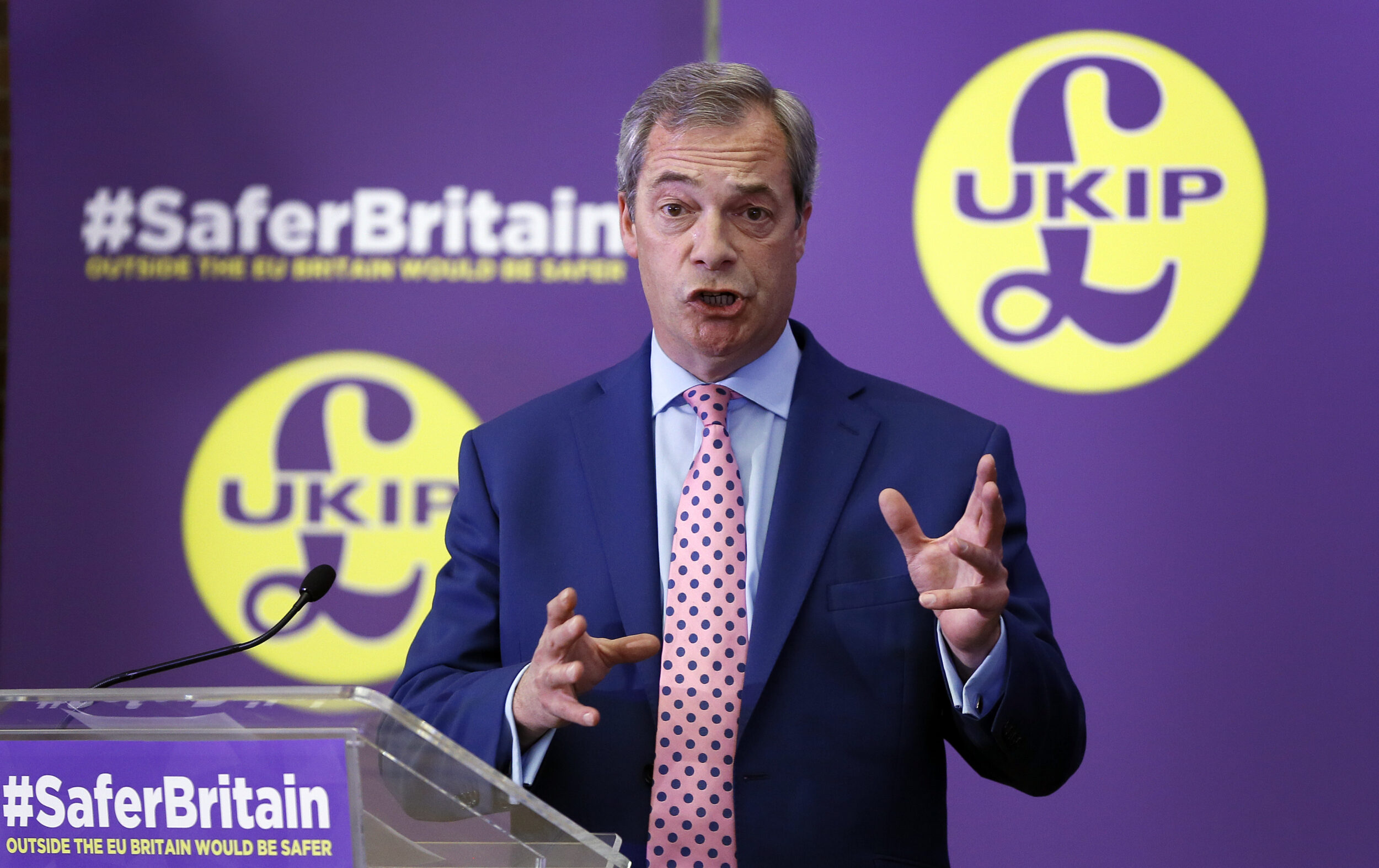
(AP Photo/Kirsty Wigglesworth) Nigel Farage, leader of Britain’s UK Independence Party delivers a speech about the EU referendum, in London, Friday, April 29, 2016.
One year later, it achieved its main objective in the 2016 referendum, when Britain voted to leave the EU.
But since 2024, its support, and attention, has plummeted.
Farage left UKIP in 2018 to form the Brexit Party, now known as Reform UK, after then-leader Gerard Batten appointed the convicted far-right activist, known as Tommy Robinson, to an advisory role.
Dr Allchorn explains that from this point UKIP became less involved in formal politics.
“Batten took up this mantle of engaging with the kind of anti-Islam street protest scene”, he says. In 2018, Gerard Batten was filmed marching with the Democratic Football Lads Alliance, a far-right hooligan group, against what it called ‘radical Islam’.
“Now the current leadership [under Tenconi] have kind of dove-tailed behind that street-based politics”.
This isn’t the first time Tenconi’s UKIP has taken to the streets of London. Last October, the Met Police banned the party from marching through Whitechapel as part of its ‘mass-deportation tour’, over fears of violent clashes with the area’s local Muslim population.
A UKIP protest that was due to take place in Whitechapel next Saturday, 31 January must now take place outside the borough of Tower Hamlets following the imposition of Public Order Act conditions.
Addressing his supporters, Tenconi hits out at the police for instating “anti-Christian no-go zones.”
Such provocative language has become a staple of UKIP’s branding. And it extends to its new look, too.
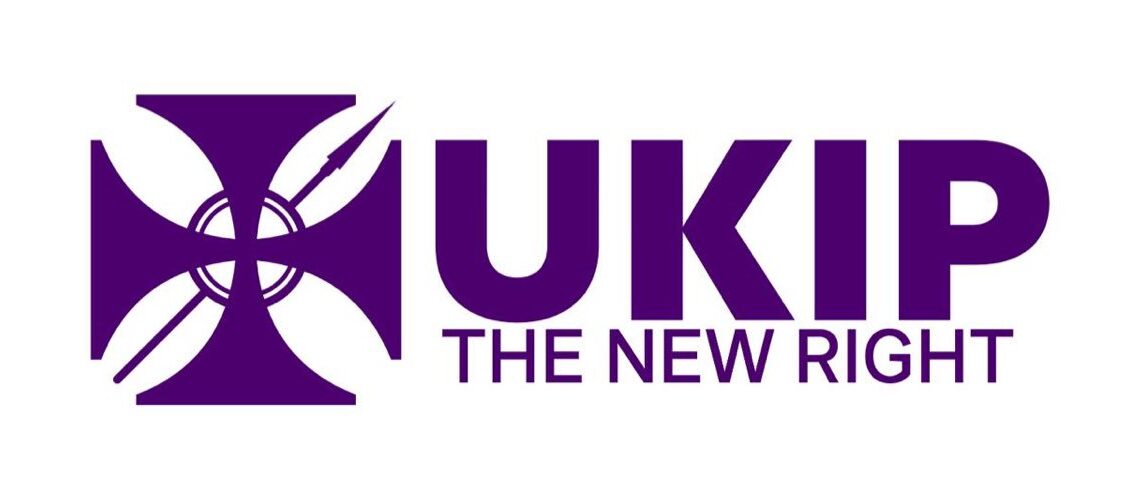
(Image: UKIP) UKIP’s controversial new logo, rejected by the Electoral Commission
Last week the party officially launched its new logo, ditching the signature purple pound-sign for what it called a traditional English ‘cross patee’, a symbol of ancient Christianity, but what many compared to a Nazi iron cross. The Electoral Commission rejected the design as “offensive”, prompting Tenconi to accuse them of ‘religious bigotry’.
Distinguishing the ‘Walk with Jesus’ from the October’s political march, Tenconi said this march was dedicated to the ‘holy name of Jesus’ – the first in a series of monthly marches based around the Christian calendar.
Over the course of the march, songs were sung, prayers were recited, and regular cries of ‘Christ is King’ echoed down Oxford Street. But the precise kind of Christianity the new UKIP preaches is hard to pin down.
“Muscular Christianity”
Those attending the march were a broad church. Catholics, baptists, protestants – and those just wanting to voice their support for “the faith.”
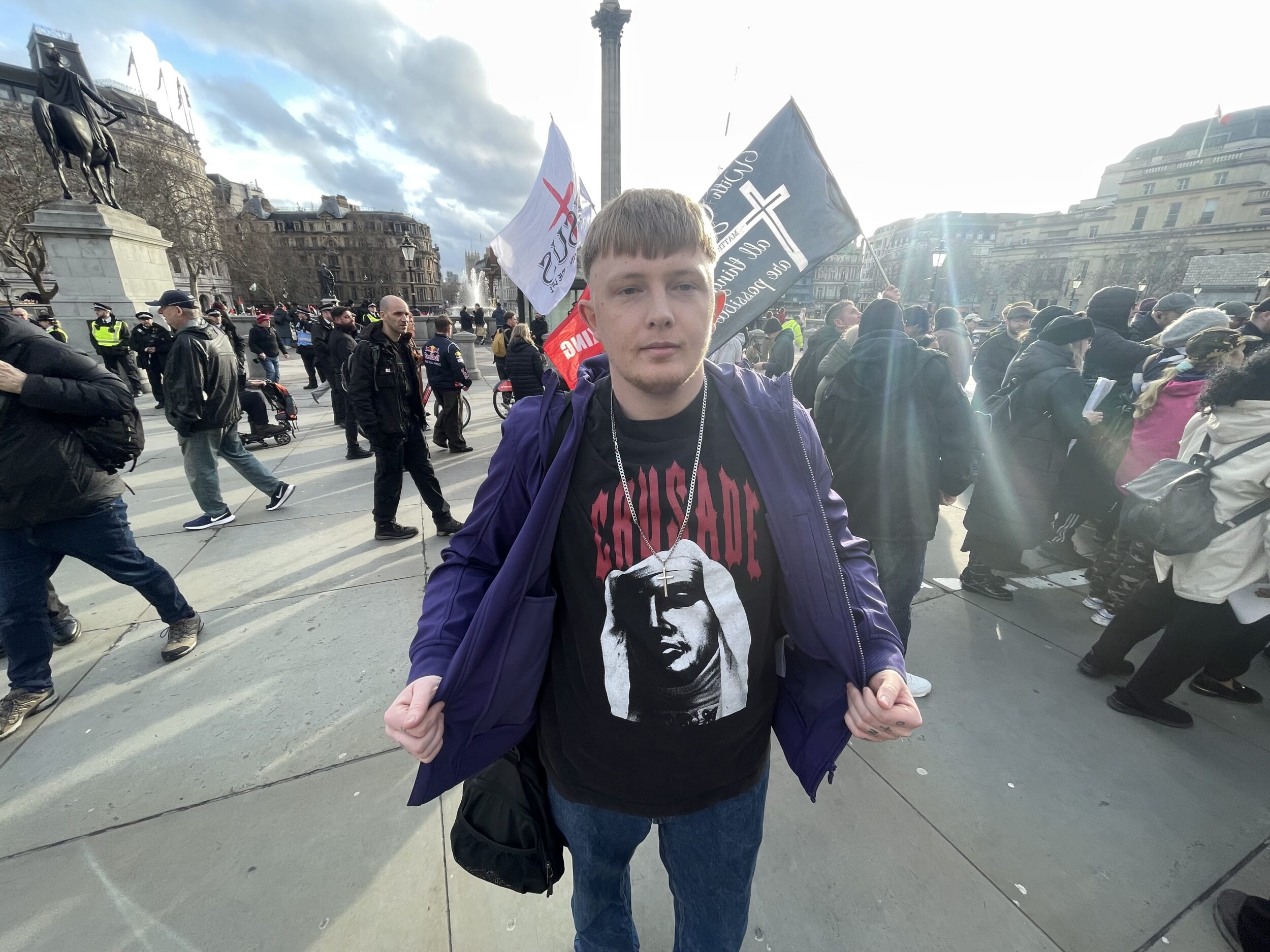
Jack Hurst, wearing a ‘crusade’ t-shirt, is running to be Richmond’s UKIP candidate.
Jack Hurst, from Richmond, is running to be a UKIP candiate. Sporting a t-shirt referencing the Crusades, a series of medieval invasions into Muslim-occupied territories, Jack said Christians need to be prepared to fight to survive.
“Christianity is the nation’s religion, and it’s our faith. We’re not going to be pushed around.”
He took issue with the Church of England, which previously signed an open letter criticising members of the far-right ‘co-opting the cross’.
“[The CoE] might even say that the Crusades weren’t a righteous war.”
In a statement to City News, the Bible Society – a British Christian charity – criticised UKIP’s theology.
“Linking love of God with love of country can be a very healthy thing, leading to greater social commitment and deeper involvement in civic life, and we’d applaud that. Where it becomes unhealthy is when it’s based on rejection and hostility rather than inclusion.”
Is there a Christian revival in the UK?
Research published last year by the Bible Society spoke of a ‘Quiet Revival’ of Christianity among young Britons, with an apparent increase in church attendance of over 50%.
However, new analysis from the Pew Research Center casts doubt over these claims. It says that the use of opt-in surveys, where participants choose to get involved, creates a misleading impression of the number of young people practicing Christianity in the UK.
Which begs the question – is there really a demand for this?
For Dr William Allchorn, UKIP’s newfound faith, tapping into a trend along with the recent Unite the Kingdom rally, seems more strategic than spiritual.
‘What’s happened more recently, especially for those on the more extreme of the far-right, is that Christianity has become what we call a Shibboleth,’ explains Dr Allchorn, ‘it’s a kind of adoption of Christianity to be seen as part of the crowd and the in-group.’
‘People like Tommy Robinson have also professed a sort of conversion to Christianity.’
Robinson’s “Unite the Kingdom” rally, held in London last September, attracted an estimated 150,000 protesters, including the Missionary Bishop Ceirion Dewar, who delivered a sermon to the crowd, along with Elon Musk over a video-call. In contrast, a follow-up Christian carol event, hosted by Robinson in December, pulled in just 1,000.
‘It’s quite a source of strategically placing himself on the Christian right globally and using it as a source of funding and attention with US audiences.’
When it comes to UKIP, this transatlantic influence is apparent at an executive level.
The party spokesperson, priest Calvin Robinson, also has American ties, having briefly moved to join the Anglican Catholic Church in 2024. But his church licence was revoked in January last year after he mimicked a controversial gesture made by Elon Musk.
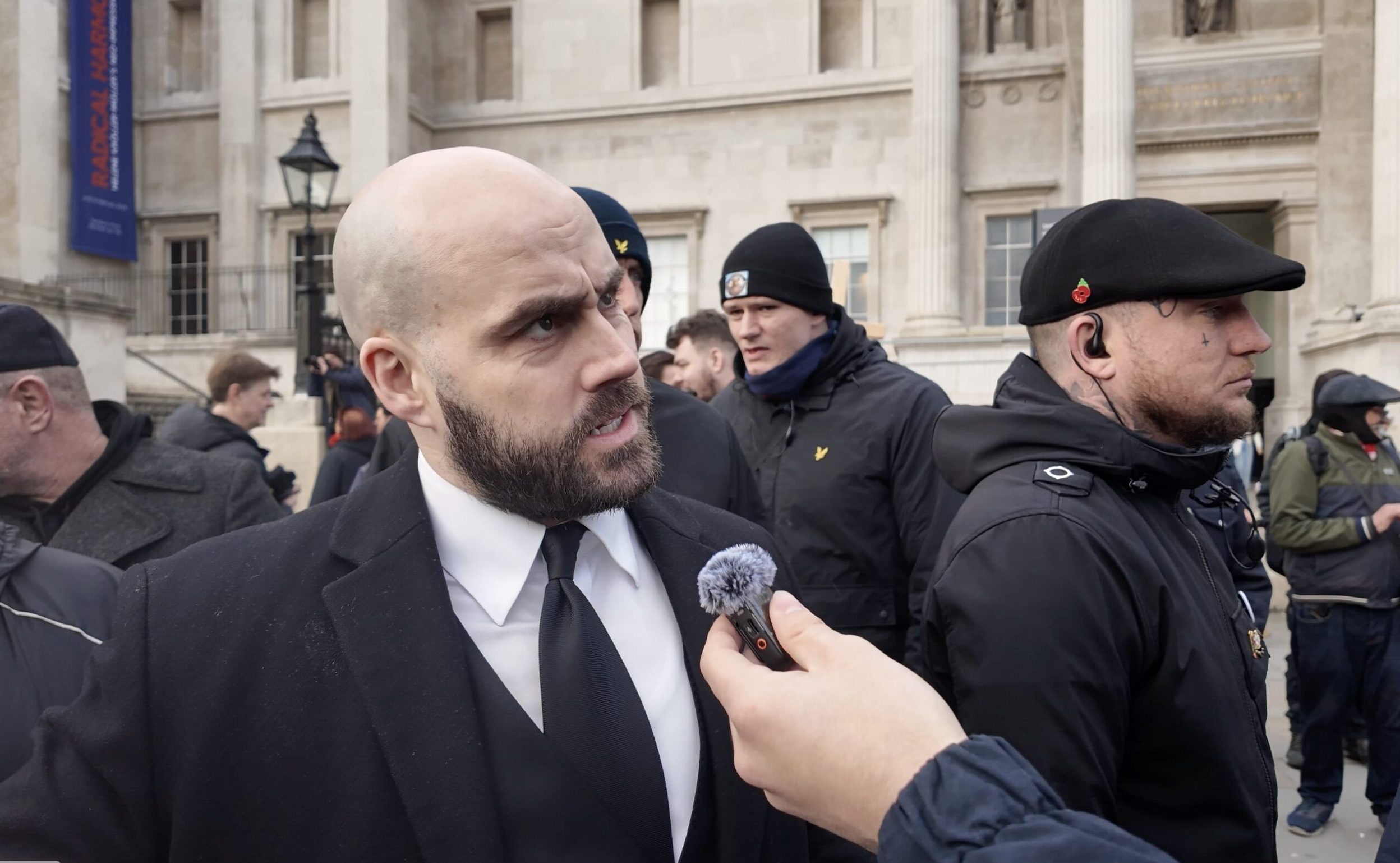
After the march, City News caught up with Nick Tenconi, who denied that the party’s Christian rebrand was in bad faith.
UKIP leader Nick Tenconi rejects accusations of “importing” American Christian Nationalism
“We’re not concerned in any way with the Left’s smear tactics,” he responded, “the Left specialise – be they Socialist or devout Communist and Marxist – they specialise in undermining, in devaluing.”
“I completely reject the allegation that we’re importing an American Christian Nationalism. This is very much a universal nationalism – i.e. that of the Church: one body in Christ.”
But that’s not quite the whole picture.
Since 2021, Tenconi has also served as Chief Operating Officer for Turning Point UK – a British chapter of the American student group founded by conservative commentator Charlie Kirk, who was assassinated at an event in Utah last September.
When confronted with this, Tenconi’s tone changed from one of defensiveness to enthusiastic gratitude.
“It is an honour to serve as Turning Point UK’s [COO], and if they have plans for me to take an honorary president role, that would be an honour.”
“First and foremost, all glory and praise to God. But without Turning Point, there wouldn’t be a Nick Tenconi in British politics.”
Sins of the father
UKIP’s political transformation is certainly unexpected. As the march processed to Trafalgar Square, many Londoners were confused as to what was actually occurring.
“I didn’t know [UKIP] were still around!” one man told City News.
A woman who had been marching in a near-by Pro-Palestine protest said she had been given a leaflet for a “religious organisation”.
“There was no mention of UKIP at all!’
But perhaps most surprised was UKIP’s founder, Alan Sked, who told City News he didn’t recognise the party he’d created all those years ago.
“I resigned from the party when I left in 1997 and thereafter I’ve just been appalled by its racist journey […] and then under whoever is leading them now.”
“I, as a Christian, am appalled by the would-be ‘muscular Christianity’ because it goes against everything that Christ taught, which is all about love and forgiveness.”
In a statement to City News responding to these claims, UKIP’s press team said “the vast majority of people in Britain either identify as Christian or support Christian cultural norms.”
“We at UKIP stand with the silent majority and are now proud to provide Christians, and supporters of Christianity with a political home.”
HeadlineFrom Brexit to ‘Born Again’? Inside UKIP’s Second Coming
Short HeadlineIs the 'Walk with Jesus' UKIP's Second Coming?
StandfirstNigel Farage's old party has had a radical makeover, aiming to put 'muscular Christianity' into the 'heart of government'. But what's behind this shift?
Just in front of Marble Arch on a sunny Saturday morning, a crowd is forming. Bearing wooden crosses and banners adorned with Jesus and Mary, you’d be forgiven for thinking this was a church day-out. But believe it or not, this is the new face of UKIP – the United Kingdom Independence Party.
Remember them? The party that introduced us to Nigel Farage has had a radical makeover.
Led by ex-personal trainer Nick Tenconi, UKIP has now launched an ‘explicitly Christian’ campaign to put what it calls ‘Muscular Christianity’ at the ‘heart of government’.
“We’re taking our country back,” Tenconi says, addressing spectators in the square, “we’re doing so for the glory of God. UKIP is a Christian land.”
This ‘Walk with Jesus’ has been marketed as one of the “largest explicitly Christian gatherings in recent history”. The turnout may not match that ambition – only around 200 people took to the streets. But with incense burning and prayer booklets being passed around, the atmosphere certainly feels different to your usual political rally.
It’s a far cry from Brexit.
Dr William Allchorn is a fellow of the American University in Richmond, who specialises in British far-right political movements. He told City News that since Farage’s departure as leader, UKIP has undergone an extreme transformation.
“Since 2016 the party has changed largely beyond recognition from a Eurosceptic civic nationalist party – looking at anxieties around immigration and exiting the European Union – towards now looking at this more civilisational or religious identity politics.”
But how did UKIP get here? And what can we make of its new found faith?
What is UKIP?
UKIP was originally founded by Scottish academic Alan Sked as the ‘Anti-Federalist League’ in 1992, a cross-party group in opposition to the establishment of the European Union.
After Sked’s departure as leader in 1997, UKIP reached a peak popularity of over 3 million votes in the 2015 election under Nigel Farage’s leadership.
(AP Photo/Kirsty Wigglesworth) Nigel Farage, leader of Britain’s UK Independence Party delivers a speech about the EU referendum, in London, Friday, April 29, 2016.
One year later, it achieved its main objective in the 2016 referendum, when Britain voted to leave the EU.
But since 2024, its support, and attention, has plummeted.
Farage left UKIP in 2018 to form the Brexit Party, now known as Reform UK, after then-leader Gerard Batten appointed the convicted far-right activist, known as Tommy Robinson, to an advisory role.
Dr Allchorn explains that from this point UKIP became less involved in formal politics.
“Batten took up this mantle of engaging with the kind of anti-Islam street protest scene”, he says. In 2018, Gerard Batten was filmed marching with the Democratic Football Lads Alliance, a far-right hooligan group, against what it called ‘radical Islam’.
“Now the current leadership [under Tenconi] have kind of dove-tailed behind that street-based politics”.
This isn’t the first time Tenconi’s UKIP has taken to the streets of London. Last October, the Met Police banned the party from marching through Whitechapel as part of its ‘mass-deportation tour’, over fears of violent clashes with the area’s local Muslim population.
A UKIP protest that was due to take place in Whitechapel next Saturday, 31 January must now take place outside the borough of Tower Hamlets following the imposition of Public Order Act conditions.
Addressing his supporters, Tenconi hits out at the police for instating “anti-Christian no-go zones.”
Such provocative language has become a staple of UKIP’s branding. And it extends to its new look, too.
(Image: UKIP) UKIP’s controversial new logo, rejected by the Electoral Commission
Last week the party officially launched its new logo, ditching the signature purple pound-sign for what it called a traditional English ‘cross patee’, a symbol of ancient Christianity, but what many compared to a Nazi iron cross. The Electoral Commission rejected the design as “offensive”, prompting Tenconi to accuse them of ‘religious bigotry’.
Distinguishing the ‘Walk with Jesus’ from the October’s political march, Tenconi said this march was dedicated to the ‘holy name of Jesus’ – the first in a series of monthly marches based around the Christian calendar.
Over the course of the march, songs were sung, prayers were recited, and regular cries of ‘Christ is King’ echoed down Oxford Street. But the precise kind of Christianity the new UKIP preaches is hard to pin down.
“Muscular Christianity”
Those attending the march were a broad church. Catholics, baptists, protestants – and those just wanting to voice their support for “the faith.”
Jack Hurst, wearing a ‘crusade’ t-shirt, is running to be Richmond’s UKIP candidate.
Jack Hurst, from Richmond, is running to be a UKIP candiate. Sporting a t-shirt referencing the Crusades, a series of medieval invasions into Muslim-occupied territories, Jack said Christians need to be prepared to fight to survive.
“Christianity is the nation’s religion, and it’s our faith. We’re not going to be pushed around.”
He took issue with the Church of England, which previously signed an open letter criticising members of the far-right ‘co-opting the cross’.
“[The CoE] might even say that the Crusades weren’t a righteous war.”
In a statement to City News, the Bible Society – a British Christian charity – criticised UKIP’s theology.
“Linking love of God with love of country can be a very healthy thing, leading to greater social commitment and deeper involvement in civic life, and we’d applaud that. Where it becomes unhealthy is when it’s based on rejection and hostility rather than inclusion.”
Is there a Christian revival in the UK?
Research published last year by the Bible Society spoke of a ‘Quiet Revival’ of Christianity among young Britons, with an apparent increase in church attendance of over 50%.
However, new analysis from the Pew Research Center casts doubt over these claims. It says that the use of opt-in surveys, where participants choose to get involved, creates a misleading impression of the number of young people practicing Christianity in the UK.
Which begs the question – is there really a demand for this?
For Dr William Allchorn, UKIP’s newfound faith, tapping into a trend along with the recent Unite the Kingdom rally, seems more strategic than spiritual.
‘What’s happened more recently, especially for those on the more extreme of the far-right, is that Christianity has become what we call a Shibboleth,’ explains Dr Allchorn, ‘it’s a kind of adoption of Christianity to be seen as part of the crowd and the in-group.’
‘People like Tommy Robinson have also professed a sort of conversion to Christianity.’
Robinson’s “Unite the Kingdom” rally, held in London last September, attracted an estimated 150,000 protesters, including the Missionary Bishop Ceirion Dewar, who delivered a sermon to the crowd, along with Elon Musk over a video-call. In contrast, a follow-up Christian carol event, hosted by Robinson in December, pulled in just 1,000.
‘It’s quite a source of strategically placing himself on the Christian right globally and using it as a source of funding and attention with US audiences.’
When it comes to UKIP, this transatlantic influence is apparent at an executive level.
The party spokesperson, priest Calvin Robinson, also has American ties, having briefly moved to join the Anglican Catholic Church in 2024. But his church licence was revoked in January last year after he mimicked a controversial gesture made by Elon Musk.
After the march, City News caught up with Nick Tenconi, who denied that the party’s Christian rebrand was in bad faith.
UKIP leader Nick Tenconi rejects accusations of “importing” American Christian Nationalism
“We’re not concerned in any way with the Left’s smear tactics,” he responded, “the Left specialise – be they Socialist or devout Communist and Marxist – they specialise in undermining, in devaluing.”
“I completely reject the allegation that we’re importing an American Christian Nationalism. This is very much a universal nationalism – i.e. that of the Church: one body in Christ.”
But that’s not quite the whole picture.
Since 2021, Tenconi has also served as Chief Operating Officer for Turning Point UK – a British chapter of the American student group founded by conservative commentator Charlie Kirk, who was assassinated at an event in Utah last September.
When confronted with this, Tenconi’s tone changed from one of defensiveness to enthusiastic gratitude.
“It is an honour to serve as Turning Point UK’s [COO], and if they have plans for me to take an honorary president role, that would be an honour.”
“First and foremost, all glory and praise to God. But without Turning Point, there wouldn’t be a Nick Tenconi in British politics.”
Sins of the father
UKIP’s political transformation is certainly unexpected. As the march processed to Trafalgar Square, many Londoners were confused as to what was actually occurring.
“I didn’t know [UKIP] were still around!” one man told City News.
A woman who had been marching in a near-by Pro-Palestine protest said she had been given a leaflet for a “religious organisation”.
“There was no mention of UKIP at all!’
But perhaps most surprised was UKIP’s founder, Alan Sked, who told City News he didn’t recognise the party he’d created all those years ago.
“I resigned from the party when I left in 1997 and thereafter I’ve just been appalled by its racist journey […] and then under whoever is leading them now.”
“I, as a Christian, am appalled by the would-be ‘muscular Christianity’ because it goes against everything that Christ taught, which is all about love and forgiveness.”
In a statement to City News responding to these claims, UKIP’s press team said “the vast majority of people in Britain either identify as Christian or support Christian cultural norms.”
“We at UKIP stand with the silent majority and are now proud to provide Christians, and supporters of Christianity with a political home.”
A 2024 Freedom of Information request showed Bromley Council had £4.5 million invested in arms companies that year with £1.5 million reportedly linked to Israel.
Undercover officers raided three linked shops in Barking town centre, revealing how illicit tobacco is being hidden in walls, ceilings and nearby locations to evade detection.
More than 330,000 people across the UK sought support from the Stop It Now helpline in 2025 over concerns about their own or someone else’s online sexual behaviour towards children, according to new charity data. The anonymous service says contacts by phone, email and webchat rose significantly over the year.