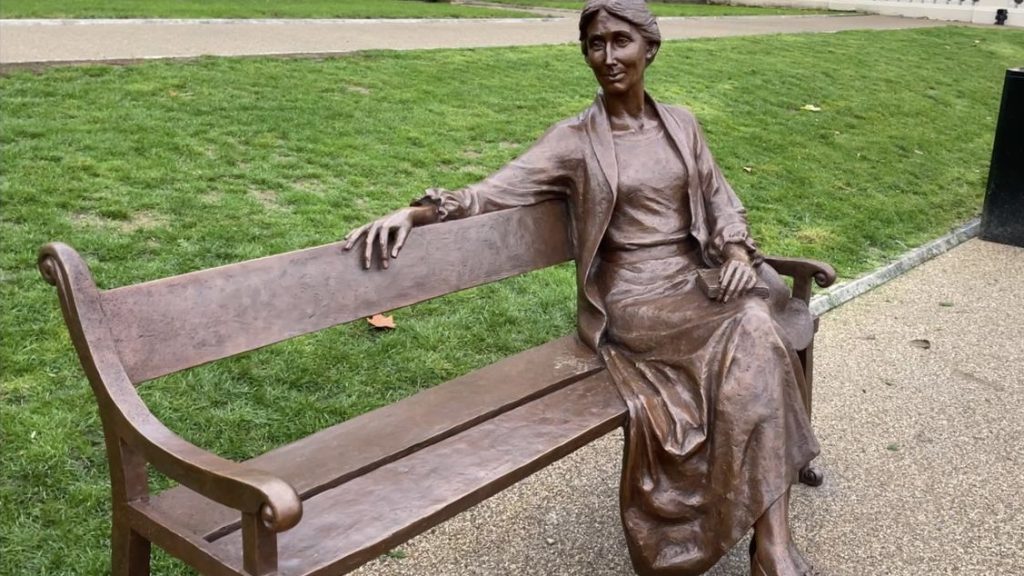
Sculptor Laury Dizengremel wanted to capture the author in a moment of repose, inviting passersby to join her for a moment by the river.
SHARE:
A new statue to commemorate the English author Virginia Woolf has been unveiled in Richmond.
The life-sized bronze figure sits on a bench overlooking Richmond-upon-Thames. The celebrated author lived and wrote in Richmond with her husband from 1914 to 1924.
Amongst the crowd gathered to watch the unveiling were the ancestors of Virginia Woolf, the statue’s sculptor Laury Dizengremel, and Cheryl Robson who campaigned for 5 years to fund the statue.
The importance of this statue is not only to commemorate one of Britain’s most celebrated female authors. Robson hopes to promote equality and diversity in the arts.
Research has shown a lack of representation for women in London sculptures. An ongoing research project by Art UK reveals London has more statues of animals than women and 79% of statues are male.
Robson said “Women are completely under-represented in public sculptures in Britain. You had to be a queen or a naked muse to merit being depicted. We see our Virginia artwork as an attempt to begin redressing this imbalance.”
Founder of the ‘online museum’ inVISIBLEwomen, Terry Bell-Halliwel, says society puts statues up “to commemorate some clever, beneficial, kind thing that someone has done”.
The sculptor hopes people will engage with the statue by taking photos or sitting down for a moment next to the figure.
Submitted Article
Headline
Short Headline
Standfirst
Published Article
HeadlineCommemorative statue of Virginia Woolf unveiled in Richmond
Short HeadlineStatue of Virginia Woolf unveiled in Richmond
StandfirstA statue of Virginia Woolf joins the slowly growing number of female figures cast in bronze on the streets of London
A new statue to commemorate the English author Virginia Woolf has been unveiled in Richmond.
The life-sized bronze figure sits on a bench overlooking Richmond-upon-Thames. The celebrated author lived and wrote in Richmond with her husband from 1914 to 1924.
Amongst the crowd gathered to watch the unveiling were the ancestors of Virginia Woolf, the statue’s sculptor Laury Dizengremel, and Cheryl Robson who campaigned for 5 years to fund the statue.
The importance of this statue is not only to commemorate one of Britain’s most celebrated female authors. Robson hopes to promote equality and diversity in the arts.
Research has shown a lack of representation for women in London sculptures. An ongoing research project by Art UK reveals London has more statues of animals than women and 79% of statues are male.
Robson said “Women are completely under-represented in public sculptures in Britain. You had to be a queen or a naked muse to merit being depicted. We see our Virginia artwork as an attempt to begin redressing this imbalance.”
Founder of the ‘online museum’ inVISIBLEwomen, Terry Bell-Halliwel, says society puts statues up “to commemorate some clever, beneficial, kind thing that someone has done”.
The sculptor hopes people will engage with the statue by taking photos or sitting down for a moment next to the figure.
A 2024 Freedom of Information request showed Bromley Council had £4.5 million invested in arms companies that year with £1.5 million reportedly linked to Israel.
Undercover officers raided three linked shops in Barking town centre, revealing how illicit tobacco is being hidden in walls, ceilings and nearby locations to evade detection.
More than 330,000 people across the UK sought support from the Stop It Now helpline in 2025 over concerns about their own or someone else’s online sexual behaviour towards children, according to new charity data. The anonymous service says contacts by phone, email and webchat rose significantly over the year.