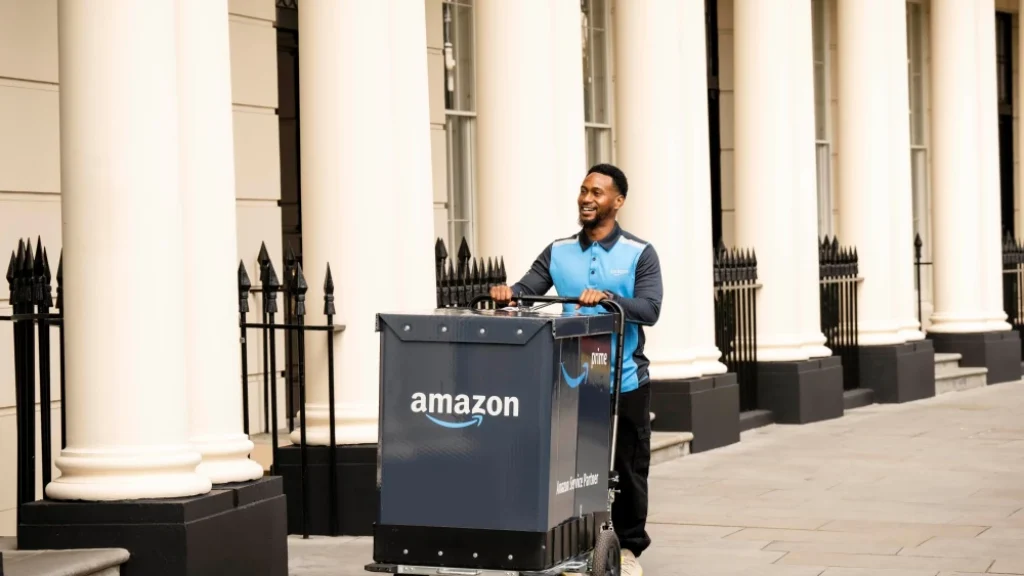
Amazon has begun trialling more environmentally-friendly parcel deliveries in Westminster, Hackney, and Islington in an effort to cut congestion, reduce emissions and improve road safety.
The partnership with the councils in these areas, which was launched in January, involves Amazon couriers walking on foot and using trolleys that can be restocked while on the move.
This scheme follows a successful pilot by Westminster City Council in Pimlico, where bikes were used instead of vans for the last mile of deliveries.
According to the council, 50,000 parcels have already been delivered by Amazon using this different delivery system in the first 10 weeks of the trial.
But this compares to around 1.2 million parcel deliveries each day in London.
Hopes it will lead to less large vans in London
Emissions in Westminster are currently being among the highest in the UK.
The council launched the trial in 2023 as part of its aim to be carbon neutral by 2030, and help to meet London’s ambition of being a net zero city by 2040.
Paul Dimoldenberg, a former Westminster councillor who was heavily involved in the original trial, told City London News:
“The aim of these new deliveries is to reduce the need for large vehicles in central London, which is hoped will decrease the number of vehicle movements, road danger, harmful emissions and alleviate kerbside congestion.”
Paul Dimoldenberg, former Westminster councillor
Pimlico trial ‘reduced traffic, emissions and was more efficient’
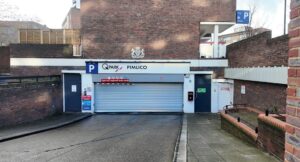
In April 2023, Westminster Council launched a six-month trial, turning a small underground car park in Pimlico into a micro-logistics hub for deliveries.
This unassuming car park was turned into a parcel delivery hub
Large vans dropped off parcels at this sorting site, and then cargo bikes fulfilled last-mile deliveries across Westminster instead of vans.
The pilot scheme resulted in:
40% reduction in emissions compared to traditional van deliveries
25% faster deliveries by avoiding congestion
Up to 1,000 parcels delivered a day from just six parking spaces
Dimoldenberg said the model had demonstrated both environmental and business benefits.
“A large van brings all the parcels to the car park, deposits them, and then there’s a small fleet of bikes. That reduces the amount of traffic, improves air quality, and makes deliveries more efficient.”
The scheme was overseen by the Cross River Partnership, a non-profit organisation that aims to deliver both economic and environmental improvements to the capital.
Its director, Susannah Wilks, told City London News the project had a significant impact, and there “wasn’t a single complaint from any of the residents”, despite the hub being located beneath a residential block.
She said its quiet operation demonstrated how logistics hubs could be integrated into urban spaces.
Residential flats, Pimlico
Calls for changes to London’s infrastructure
Cargo bikes are being used to provide more eco-friendly parcel delivery service across London (Delivery Mates)
Sustainable courier service Delivery Mates provided the pedal power for the Pimlico pilot.
Its chief operating officer, Kevin Savage, told City London News that if the scheme was expanded city-wide, cargo bike delivery firms like his could take on a significant share of the one million parcels distributed in a day – if the right infrastructure were in place.
On our busiest day, we did over a thousand parcels from just six parking spaces… With the right infrastructure, we could take on a huge portion of London’s last-mile deliveries.
Kevin Savage, Chief Operating Officer, Delivery Mates
Savage said that continued government investment in cycling infrastructure will be crucial to successfully scale up the model, with London’s cycle lanes already under pressure during peak hours.
He suggested that upcoming tax changes for vans, which are set to take effect in April, could help fund these improvements and also encourage more businesses to consider sustainable delivery options.
What’s the future for green deliveries?
Dimoldenberg told City London News that if these initiatives continue to succeed they could pave the way for a major shift toward more sustainable delivery options.
“If we can crack it with Amazon, then that opens the door to this sort of scheme being rolled out in every city, not just Westminster, but anywhere in the country where there’s huge competition for road space and curb space, and people are concerned about air quality and road safety”
Submitted Article
Headline
Short Headline
Standfirst
Published Article
HeadlineEnvironmentally-friendly Amazon delivery scheme trialled in parts of London
Short HeadlineEco-friendly Amazon delivery scheme trialled in parts of London
StandfirstThe trials in Westminster, Islington and Hackney follows a pilot in Pimlico that reduced emissions and cut congestion.
Amazon has begun trialling more environmentally-friendly parcel deliveries in Westminster, Hackney, and Islington in an effort to cut congestion, reduce emissions and improve road safety.
The partnership with the councils in these areas, which was launched in January, involves Amazon couriers walking on foot and using trolleys that can be restocked while on the move.
This scheme follows a successful pilot by Westminster City Council in Pimlico, where bikes were used instead of vans for the last mile of deliveries.
According to the council, 50,000 parcels have already been delivered by Amazon using this different delivery system in the first 10 weeks of the trial.
But this compares to around 1.2 million parcel deliveries each day in London.
Hopes it will lead to less large vans in London
Emissions in Westminster are currently being among the highest in the UK.
The council launched the trial in 2023 as part of its aim to be carbon neutral by 2030, and help to meet London’s ambition of being a net zero city by 2040.
Paul Dimoldenberg, a former Westminster councillor who was heavily involved in the original trial, told City London News:
“The aim of these new deliveries is to reduce the need for large vehicles in central London, which is hoped will decrease the number of vehicle movements, road danger, harmful emissions and alleviate kerbside congestion.”
Paul Dimoldenberg, former Westminster councillor
Pimlico trial ‘reduced traffic, emissions and was more efficient’
In April 2023, Westminster Council launched a six-month trial, turning a small underground car park in Pimlico into a micro-logistics hub for deliveries.
This unassuming car park was turned into a parcel delivery hub
Large vans dropped off parcels at this sorting site, and then cargo bikes fulfilled last-mile deliveries across Westminster instead of vans.
The pilot scheme resulted in:
40% reduction in emissions compared to traditional van deliveries
25% faster deliveries by avoiding congestion
Up to 1,000 parcels delivered a day from just six parking spaces
Dimoldenberg said the model had demonstrated both environmental and business benefits.
“A large van brings all the parcels to the car park, deposits them, and then there’s a small fleet of bikes. That reduces the amount of traffic, improves air quality, and makes deliveries more efficient.”
The scheme was overseen by the Cross River Partnership, a non-profit organisation that aims to deliver both economic and environmental improvements to the capital.
Its director, Susannah Wilks, told City London News the project had a significant impact, and there “wasn’t a single complaint from any of the residents”, despite the hub being located beneath a residential block.
She said its quiet operation demonstrated how logistics hubs could be integrated into urban spaces.
Residential flats, Pimlico
Calls for changes to London’s infrastructure
Cargo bikes are being used to provide more eco-friendly parcel delivery service across London (Delivery Mates)
Sustainable courier service Delivery Mates provided the pedal power for the Pimlico pilot.
Its chief operating officer, Kevin Savage, told City London News that if the scheme was expanded city-wide, cargo bike delivery firms like his could take on a significant share of the one million parcels distributed in a day – if the right infrastructure were in place.
On our busiest day, we did over a thousand parcels from just six parking spaces… With the right infrastructure, we could take on a huge portion of London’s last-mile deliveries.
Kevin Savage, Chief Operating Officer, Delivery Mates
Savage said that continued government investment in cycling infrastructure will be crucial to successfully scale up the model, with London’s cycle lanes already under pressure during peak hours.
He suggested that upcoming tax changes for vans, which are set to take effect in April, could help fund these improvements and also encourage more businesses to consider sustainable delivery options.
What’s the future for green deliveries?
Dimoldenberg told City London News that if these initiatives continue to succeed they could pave the way for a major shift toward more sustainable delivery options.
“If we can crack it with Amazon, then that opens the door to this sort of scheme being rolled out in every city, not just Westminster, but anywhere in the country where there’s huge competition for road space and curb space, and people are concerned about air quality and road safety”
A 2024 Freedom of Information request showed Bromley Council had £4.5 million invested in arms companies that year with £1.5 million reportedly linked to Israel.
Undercover officers raided three linked shops in Barking town centre, revealing how illicit tobacco is being hidden in walls, ceilings and nearby locations to evade detection.
More than 330,000 people across the UK sought support from the Stop It Now helpline in 2025 over concerns about their own or someone else’s online sexual behaviour towards children, according to new charity data. The anonymous service says contacts by phone, email and webchat rose significantly over the year.