Elephant & Castle Traders Face Uncertain Future After Years Of Regeneration Promises
Traders evicted from Castle Square in Elephant & Castle have been told they can return under a 12-month repayment plan, but many say back-billed debts and years of uncertainty have made the offer impossible to accept.
When Southwark Council approved the £3 billion regeneration of Elephant & Castle in 2018, the project was sold as a model for how redevelopment could work for residents and businesses.
The ageing shopping centre had long been a lifeline for migrant-run cafés and shops serving Elephant & Castle’s Latin American, African and Caribbean communities.
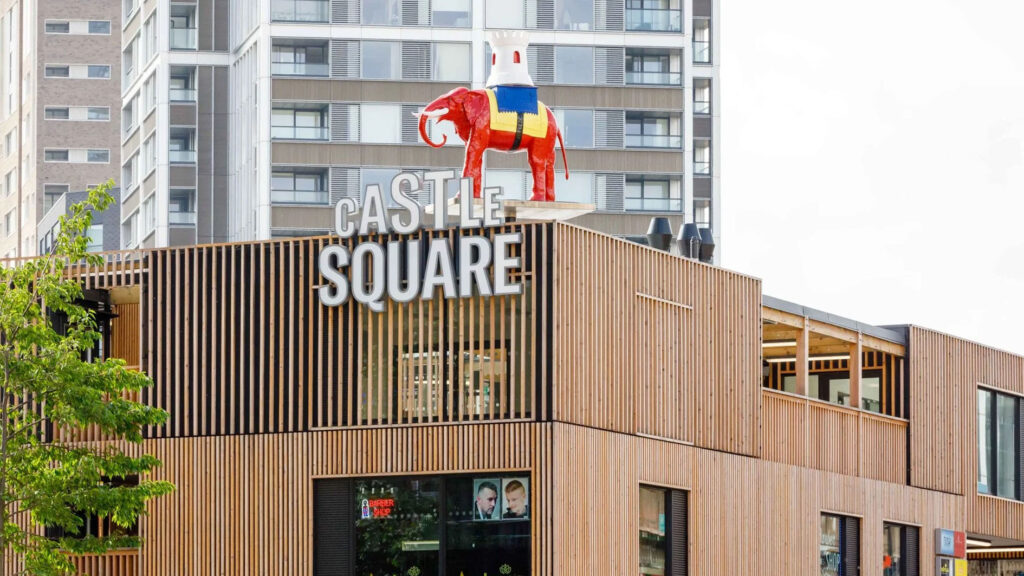
Traders were told they would be relocated to Castle Square, a temporary cluster of brightly painted units across the road, while the new town centre took shape.
At the time, the council said Castle Square would “ensure the diversity and vitality of Elephant & Castle’s businesses are protected.”
For a while, it worked. Restaurants like Kaieteur Kitchen, El Guambra, and Original Caribbean Spice rebuilt customer bases and became landmarks of the temporary site. But by 2021, issues arose.
Business owners began raising concerns about irregular electricity billing and rising service charges. Some reported not receiving invoices for years; others said meter readings were disputed.
When back-bills finally arrived in 2025, they totalled tens of thousands of pounds.
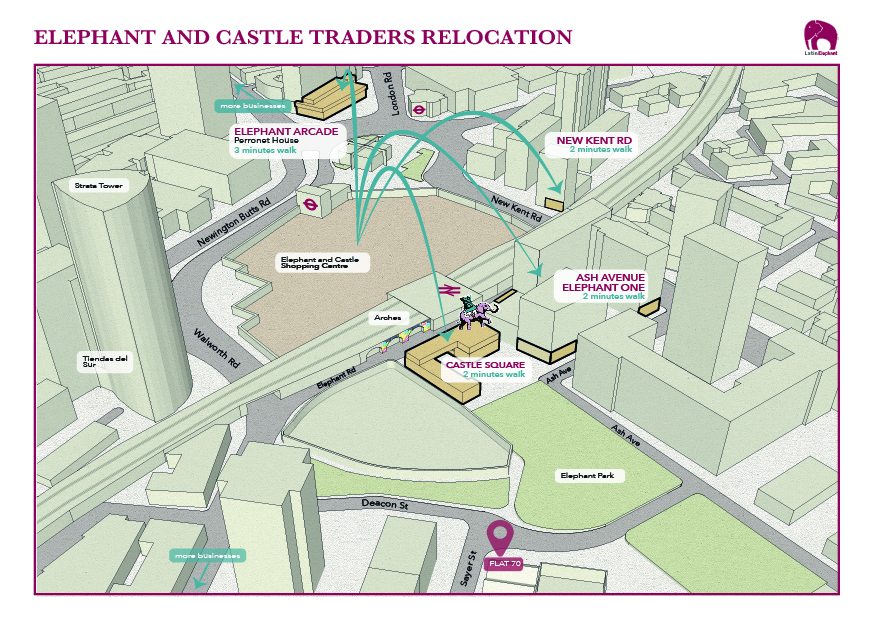
Elephant & Castle Traders Relocation. Source: Latin Elephant
On Wednesday, the 1st of October, Faye Gomes, a Guyanese business owner, arrived at her shop to find an eviction notice taped to the door.
She is one of the four long-standing traders locked out of their units that morning.
“Four years of electricity in one go, how are we supposed to pay that?” asked Gomes, who runs Kaieteur Kitchen. “We were never told it would come like this.”
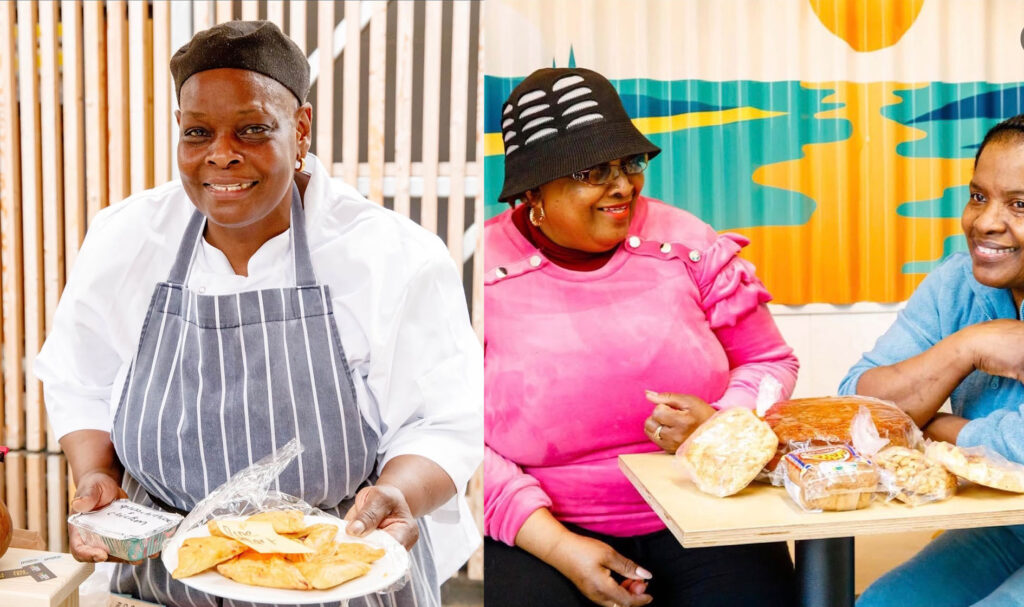
Faye Gomes. Source: Kaieteur Kitchen. Loroma and Marcia. Source: Original Caribbean Spice.
Families who had run cafés and takeaways for more than a decade suddenly found themselves shut out.
Those removals came after Diana Sach from Coma Y Beba Cafe was also evicted in September and excluded from negotiations.
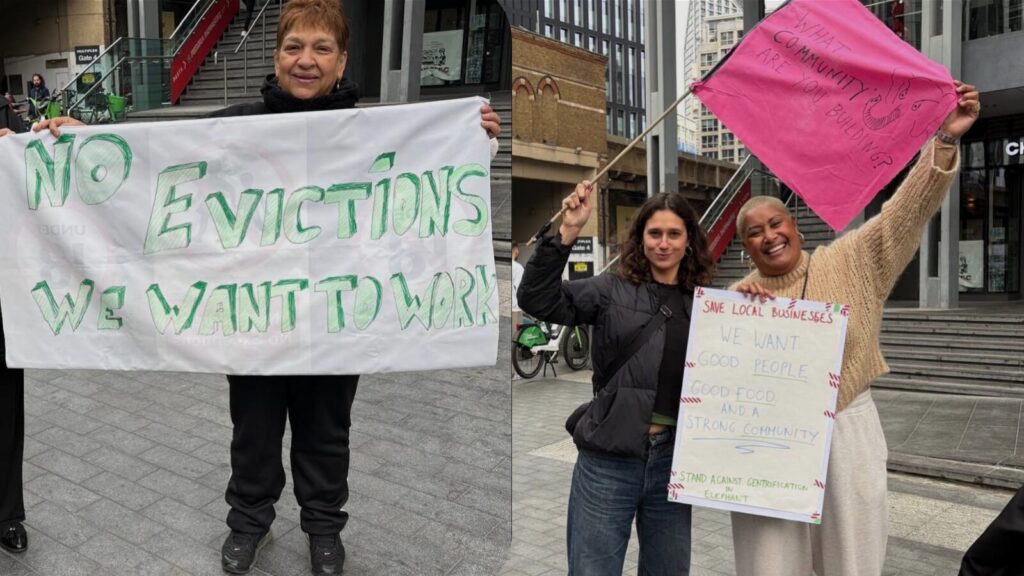
The evictions sparked protests outside Castle Square and involvement from campaign group Latin Elephant, which represents migrant vendors in the area.
Community organisers accused the council and developer Get Living of breaking the spirit of the regeneration deal. Lawyers began preparing a legal challenge, while residents petitioned the council to intervene.
Protesters in Castle Square
Two weeks later, Southwark Council announced an agreement with Get Living, “allowing Castle Square businesses to return to their units.”
Traders could reopen if they entered a 12-month repayment plan; those who declined would have historic debts written off.
The council said it wanted to “balance fairness with support for small business owners,” and acknowledged that “rising energy costs” had worsened the situation.
For many small businesses, the offer felt like too little, too late.
Some businesses reported arrears of over £20,000. Several owners said the new terms were “simply unaffordable,” given that trade had not yet recovered from the pandemic.
“We can’t sign something that will put us back in debt again,” said Steven Landeta, whose mother, Marlene Calderon, runs El Guambra. “We want to stay, but not at any cost.”
Marlene Calderon. Source: El Guambra
Get Living said eviction was “never our desired course of action” and described the new plan as a good-faith attempt to resolve the dispute.
Meanwhile, Latin Elephant confirmed in an Instagram post that legal and community pressure had led to the updated offer and that shopkeepers now had until 10 November to decide.
Castle Square’s troubles are part of a wider pattern.
The borough ranks among the most income-deprived in London for older residents, according to the 2025 Ministry of Housing, Communities and Local Government (MHCLG) Index of Deprivation.
Regeneration has brought modern housing and a new station entrance, but campaigners say the benefits have little impact on the communities that make the area’s culture distinctive.
The Elephant & Castle scheme will deliver 485 new homes, 172 marketed as “affordable” and just three for social rent, alongside 55 retail and restaurant spaces.
Campaigners argue that without firm safeguards, independent and migrant-led traders will again be priced out.
As of early November, business owners must choose either to return under a 12-month arrears plan, continuing to trade while repaying debt, or to walk away, with the council confirming debts will not be pursued.
Latin Elephant and local solicitors say they are still in talks with the council to secure clearer billing and fair lease terms.
Some vendors have reopened, others remain undecided.
This is a developing story, we will bring you more details as they come. Please refresh the page to update.
HeadlineElephant & Castle Traders Face Uncertain Future After Years Of Regeneration Promises
Short HeadlineCastle Square Traders Offered Deal
StandfirstTraders evicted from Castle Square in Elephant & Castle have been told they can return under a 12-month repayment plan, but many say back-billed debts and years of uncertainty have made the offer impossible to accept.
When Southwark Council approved the £3 billion regeneration of Elephant & Castle in 2018, the project was sold as a model for how redevelopment could work for residents and businesses.
The ageing shopping centre had long been a lifeline for migrant-run cafés and shops serving Elephant & Castle’s Latin American, African and Caribbean communities.
Traders were told they would be relocated to Castle Square, a temporary cluster of brightly painted units across the road, while the new town centre took shape.
At the time, the council said Castle Square would “ensure the diversity and vitality of Elephant & Castle’s businesses are protected.”
For a while, it worked. Restaurants like Kaieteur Kitchen, El Guambra, and Original Caribbean Spice rebuilt customer bases and became landmarks of the temporary site. But by 2021, issues arose.
Business owners began raising concerns about irregular electricity billing and rising service charges. Some reported not receiving invoices for years; others said meter readings were disputed.
When back-bills finally arrived in 2025, they totalled tens of thousands of pounds.
Elephant & Castle Traders Relocation. Source: Latin Elephant
On Wednesday, the 1st of October, Faye Gomes, a Guyanese business owner, arrived at her shop to find an eviction notice taped to the door.
She is one of the four long-standing traders locked out of their units that morning.
“Four years of electricity in one go, how are we supposed to pay that?” asked Gomes, who runs Kaieteur Kitchen. “We were never told it would come like this.”
Faye Gomes. Source: Kaieteur Kitchen. Loroma and Marcia. Source: Original Caribbean Spice.
Families who had run cafés and takeaways for more than a decade suddenly found themselves shut out.
Those removals came after Diana Sach from Coma Y Beba Cafe was also evicted in September and excluded from negotiations.
The evictions sparked protests outside Castle Square and involvement from campaign group Latin Elephant, which represents migrant vendors in the area.
Community organisers accused the council and developer Get Living of breaking the spirit of the regeneration deal. Lawyers began preparing a legal challenge, while residents petitioned the council to intervene.
Protesters in Castle Square
Two weeks later, Southwark Council announced an agreement with Get Living, “allowing Castle Square businesses to return to their units.”
Traders could reopen if they entered a 12-month repayment plan; those who declined would have historic debts written off.
The council said it wanted to “balance fairness with support for small business owners,” and acknowledged that “rising energy costs” had worsened the situation.
For many small businesses, the offer felt like too little, too late.
Some businesses reported arrears of over £20,000. Several owners said the new terms were “simply unaffordable,” given that trade had not yet recovered from the pandemic.
“We can’t sign something that will put us back in debt again,” said Steven Landeta, whose mother, Marlene Calderon, runs El Guambra. “We want to stay, but not at any cost.”
Marlene Calderon. Source: El Guambra
Get Living said eviction was “never our desired course of action” and described the new plan as a good-faith attempt to resolve the dispute.
Meanwhile, Latin Elephant confirmed in an Instagram post that legal and community pressure had led to the updated offer and that shopkeepers now had until 10 November to decide.
Castle Square’s troubles are part of a wider pattern.
The borough ranks among the most income-deprived in London for older residents, according to the 2025 Ministry of Housing, Communities and Local Government (MHCLG) Index of Deprivation.
Regeneration has brought modern housing and a new station entrance, but campaigners say the benefits have little impact on the communities that make the area’s culture distinctive.
The Elephant & Castle scheme will deliver 485 new homes, 172 marketed as “affordable” and just three for social rent, alongside 55 retail and restaurant spaces.
Campaigners argue that without firm safeguards, independent and migrant-led traders will again be priced out.
As of early November, business owners must choose either to return under a 12-month arrears plan, continuing to trade while repaying debt, or to walk away, with the council confirming debts will not be pursued.
Latin Elephant and local solicitors say they are still in talks with the council to secure clearer billing and fair lease terms.
Some vendors have reopened, others remain undecided.
A 2024 Freedom of Information request showed Bromley Council had £4.5 million invested in arms companies that year with £1.5 million reportedly linked to Israel.
Undercover officers raided three linked shops in Barking town centre, revealing how illicit tobacco is being hidden in walls, ceilings and nearby locations to evade detection.
More than 330,000 people across the UK sought support from the Stop It Now helpline in 2025 over concerns about their own or someone else’s online sexual behaviour towards children, according to new charity data. The anonymous service says contacts by phone, email and webchat rose significantly over the year.