The government’s pledge to end HIV transmissions in the UK is entering a decisive phase. This year on World AIDS day clinicians warn progress is real, but fragile as stigma remains entrenched in many communities.
Thousands have fallen out of treatment reports AidsMap, and global funding cuts risk increasing infections. Innovative London Programmes aim to close the gap.
London is among a number of global Fast-Track Cities committed to eradicate HIV transmissions by 2030.
The London Mayor Sadiq Khan plans to roll out new proposals in order to hit the 2030 new target. Photo Credit: Associated Press
According to the Greater London Authority, the capital has seen significant, world-leading reductions in diagnoses, but warns “progress is uneven,” particularly among Black communities, migrants, and young queer people.
Mayor of London Sadiq Khan marked World AIDS Day by reaffirming the city’s commitment to the Fast-Track goals.
“We are working with communities to stop the stigma that prevents people from getting tested or treated”
Dr Emma Russell is a clinical psychologist, working in HIV care at North Middlesex Hospital in Edmonton. She says London’s demographics mean stigma presents differently, and more persistently in black and ethnic communities.
“Most of our patients are Black African or Caribbean… many come from cultures where homosexuality is illegal, sex outside marriage is judged harshly, or AIDS is associated with family loss. That historical trauma lingers – people fear being ostracised all over again”
Emma Russell, a clinical psychologist working in HIV care at North Middlesex Hospital
Last week the government announced a new scheme to find and re-engage thousands in England who have stopped accessing HIV care. According to the Department of Health and Social Care, officials have called them the missing thousands. Health officials say these people pose the biggest risk of transmission as viral loads remain high.
Russell remarks that the scheme is essential, particularly in London:
“We see people who know their diagnosis but struggle to attend clinic because of shame, fear, or practical barriers like travel-money. They can become resistant to drugs, they can pass the virus on, and they can become seriously unwell. This work is critical”.
Clinicians and campaigners say stigma remains a big barrier to ending HIV. The legacy of the UK’s infamous 1987 AIDS: “Don’t die of Ignorance” tombstone campaign still looms.
Russell says while its shock factor put HIV on the public agenda, health experts say it terrified a generation without explaining how HIV is transmitted or prevented.
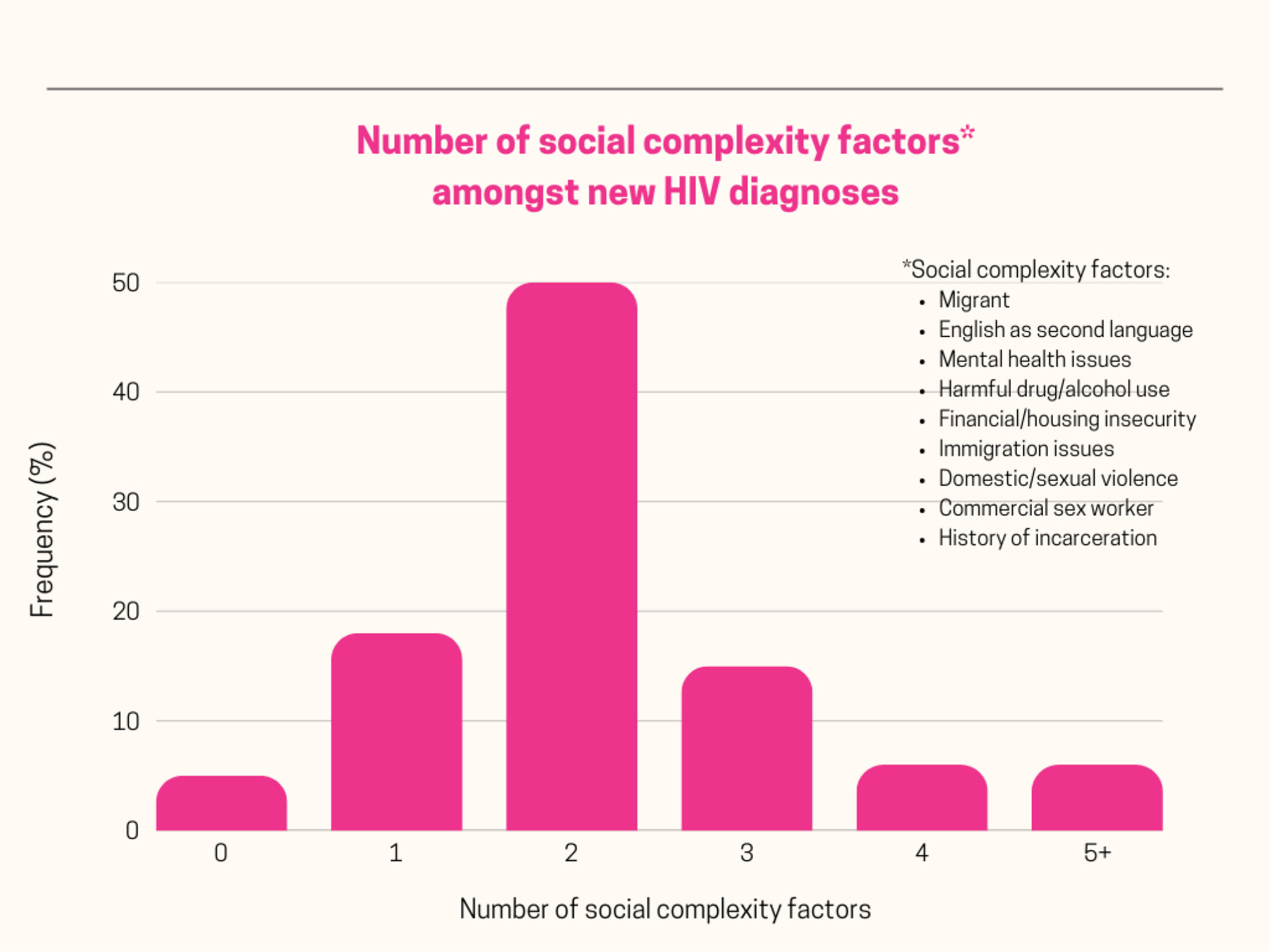
Statistics concerning the number of social complexity factors that have been present in new HIV diagnoses. Photo Credit: NHS England
“Infectious diseases don’t have borders, people travel. If prevention collapses abroad, we will see the impact here. It’s unethical and it’s short-sighted.”
UNAIDS has warned of “historic setbacks” to global HIV progress after significant reductions in international funding, particularly in sub-Saharan Africa.
Cuts to US aid, including restrictions under the former Trump administration that blocked HIV prevention support for sex workers and LGBTQ+ groups, are expected to drive up infections abroad.
The Greater London Authority warns momentum is essential to achieve the 2030 goal. The International AIDS Society says it will require evidence-led investment, not complacency.
Submitted Article
Headline
Short Headline
Standfirst
Published Article
HeadlineLondon’s HIV Services Face a New Test as UK Pushes Toward 2030 Zero-Transmission Targets
Short HeadlineHIV Services Tackle Zero Transmission Targets
StandfirstStigma remains the “real killer” as clinicians say we still aren’t tackling it head on
The government’s pledge to end HIV transmissions in the UK is entering a decisive phase. This year on World AIDS day clinicians warn progress is real, but fragile as stigma remains entrenched in many communities.
Thousands have fallen out of treatment reports AidsMap, and global funding cuts risk increasing infections. Innovative London Programmes aim to close the gap.
London is among a number of global Fast-Track Cities committed to eradicate HIV transmissions by 2030.
The London Mayor Sadiq Khan plans to roll out new proposals in order to hit the 2030 new target. Photo Credit: Associated Press
According to the Greater London Authority, the capital has seen significant, world-leading reductions in diagnoses, but warns “progress is uneven,” particularly among Black communities, migrants, and young queer people.
Mayor of London Sadiq Khan marked World AIDS Day by reaffirming the city’s commitment to the Fast-Track goals.
“We are working with communities to stop the stigma that prevents people from getting tested or treated”
Dr Emma Russell is a clinical psychologist, working in HIV care at North Middlesex Hospital in Edmonton. She says London’s demographics mean stigma presents differently, and more persistently in black and ethnic communities.
“Most of our patients are Black African or Caribbean… many come from cultures where homosexuality is illegal, sex outside marriage is judged harshly, or AIDS is associated with family loss. That historical trauma lingers – people fear being ostracised all over again”
Emma Russell, a clinical psychologist working in HIV care at North Middlesex Hospital
Last week the government announced a new scheme to find and re-engage thousands in England who have stopped accessing HIV care. According to the Department of Health and Social Care, officials have called them the missing thousands. Health officials say these people pose the biggest risk of transmission as viral loads remain high.
Russell remarks that the scheme is essential, particularly in London:
“We see people who know their diagnosis but struggle to attend clinic because of shame, fear, or practical barriers like travel-money. They can become resistant to drugs, they can pass the virus on, and they can become seriously unwell. This work is critical”.
Clinicians and campaigners say stigma remains a big barrier to ending HIV. The legacy of the UK’s infamous 1987 AIDS: “Don’t die of Ignorance” tombstone campaign still looms.
Russell says while its shock factor put HIV on the public agenda, health experts say it terrified a generation without explaining how HIV is transmitted or prevented.
Statistics concerning the number of social complexity factors that have been present in new HIV diagnoses. Photo Credit: NHS England
“Infectious diseases don’t have borders, people travel. If prevention collapses abroad, we will see the impact here. It’s unethical and it’s short-sighted.”
UNAIDS has warned of “historic setbacks” to global HIV progress after significant reductions in international funding, particularly in sub-Saharan Africa.
Cuts to US aid, including restrictions under the former Trump administration that blocked HIV prevention support for sex workers and LGBTQ+ groups, are expected to drive up infections abroad.
The Greater London Authority warns momentum is essential to achieve the 2030 goal. The International AIDS Society says it will require evidence-led investment, not complacency.
A 2024 Freedom of Information request showed Bromley Council had £4.5 million invested in arms companies that year with £1.5 million reportedly linked to Israel.
Undercover officers raided three linked shops in Barking town centre, revealing how illicit tobacco is being hidden in walls, ceilings and nearby locations to evade detection.
More than 330,000 people across the UK sought support from the Stop It Now helpline in 2025 over concerns about their own or someone else’s online sexual behaviour towards children, according to new charity data. The anonymous service says contacts by phone, email and webchat rose significantly over the year.